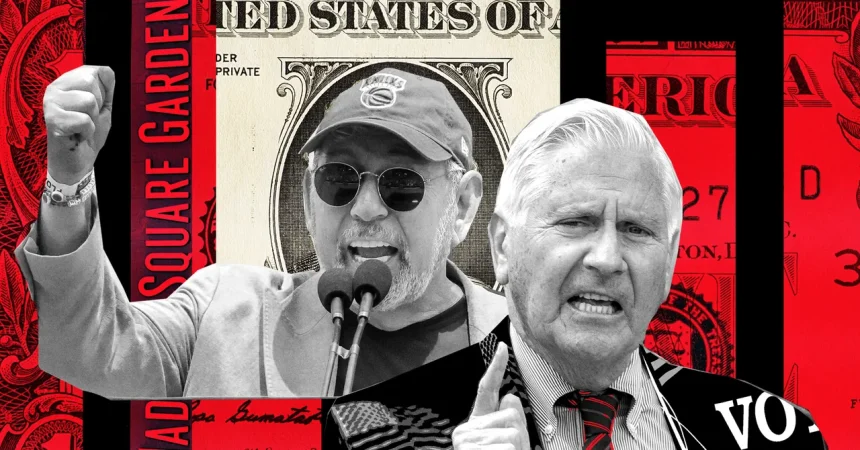
Bruce Blakeman’s pitch for governor was never subtle. It was, by design, a suburbanite’s nightmare dressed as a security plan. Last November, when he was the Republican nominee trying to close the gap against Governor Kathy Hochul, he promised a digital wall between New York City and the suburbs—not a wall of concrete and steel, but something more modern, more intrusive, and arguably more permanent. A sprawling network of spy gear, license plate readers, and biometric surveillance would stretch between the city and the places where people raise families, mow lawns, and think of themselves as safely removed from the chaos of Manhattan and the outer boroughs. For many voters on Long Island, the message landed with the force of common sense. Crime, disorder, and urban anxiety are supposed to stop at the county line. Blakeman, the executive of Nassau County, understood the optics perfectly. He would be the sheriff at the gate, wielding cameras and scanners to guard the cul-de-sacs, the school parking lots, the shopping malls. It was a promise to keep one version of New York away from another, and it was deliberately visual, deliberately emotional. If you drive from Queens into Nassau, you cross an invisible line; Blakeman wanted to make that line visible and armed. But campaigns like that cost money, and Blakeman needed friends. He found one in James Dolan, the billionaire owner of Madison Square Garden, a man whose own arena is a living laboratory of the surveillance future. Dolan and his family poured millions into Blakeman’s operation through direct donations, county party accounts, and a super PAC. The money did more than change the arithmetic; it fused two of the most controversial forces in New York public life—surveillance politics and billionaire vanity—into a single campaign. The wall Blakeman promised would, if built, look a lot like the inside of Dolan’s Garden: cameras on every corner, faces scanned, critics watched, and no one quite sure who is being protected and who is being controlled.
To understand why Dolan would pour so much money into Blakeman, you have to understand the world Dolan has built. His Madison Square Garden has become the sports world’s most famous surveillance state, a fortress where facial-recognition cameras capture the face of nearly every patron who walks through the doors. The technology is so precise, and so personal, that it has been used to identify and eject lawyers involved in litigation against the company, as well as other people considered inconvenient or unwelcome. Corporate security forces do not merely look for weapons or rowdy fans; they look for critics of the boss. If you have ever crossed James Dolan, there is a chance the arena knows you before you reach the metal detectors. In that environment, the idea of a wall of spy gear between the city and the suburbs does not seem radical; it seems like an extension of the business model. On the surface, the alliance is counterintuitive. Dolan supported Hochul in the last election cycle, and New York is a state where Republicans are a permanent minority. Yet Dolan has always been a mercurial presence in politics, guided less by ideology than by instinct, grievance, and self-interest. He is also a close ally of Donald Trump, having given nearly a million dollars to Trump’s reelection campaign and the Republican National Committee in 2020. His politics, if they can be called that, are about control—control over his properties, his image, and the political environment that regulates them. Blakeman offers him a package deal: tax-friendly governance, a pro-business climate, and a vision of order that matches the fortress-like atmosphere of the Garden. It may not be a traditional Republican coalition, but it is a natural one, made of people who believe that safety is more important than privacy and that the people with the money to build walls should also get to decide who stands on which side.
The fact that Blakeman is running in a blue state, against a well-funded Democratic incumbent, might make Dolan’s investment seem foolish. Polls at the time showed Blakeman trailing by nine points or more, and there were unmistakable signs of a national blue wave building. A rational political investor, one might think, would sit this one out. But Dolan’s spending reveals a different logic. He is not necessarily trying to win the governorship on the first try. He is buying a position, a seat at the table, a relationship with whoever emerges from the wreckage. Losing campaigns produce obligations, gratitude, and familiarity. They also produce a donor who can say he stood by Republicans when nobody else would. One veteran strategist told WIRED that Dolan can step into the breach and become the biggest player in New York’s Republican politics, donor-wise. The strategist added that Dolan’s people are smart enough to know that. That is the real investment. In a party starved for money, a single mega-donor with a sports empire, a family fortune, and a taste for surveillance can reshape the landscape. The super PAC, the county party contributions, and the direct donations are all part of a strategy that will outlive the election. Even if Blakeman loses, Dolan has introduced himself to every operative, every county chairman, every future candidate, and every lobbyist in the state. He has made himself impossible to ignore. In politics, that may be the only thing that matters. The race is less a wager on Blakeman’s victory than a down payment on a permanent role in the state’s political order, an order that Dolan clearly intends to help rebuild in his own image.
The money trail, compiled from city, state, and federal databases, shows a deliberate, multilayered strategy. The Dolan family first gave $108,000 directly to Blakeman’s campaign, a legal but unusually large amount for a single family. Then came a much larger gift: $970,000 to the Nassau County Republican Committee, which in turn became Blakeman’s single-largest contributor. That kind of county-level money is invisible but essential. It underwrites phone banks, mailers, party workers, and all the little infrastructure that turns a candidate into a movement. But the most striking intervention was corporate. Madison Square Garden entities contributed $2 million to Strong and Safe New York Inc., a super PAC created to support Blakeman’s run. The PAC, which lists the Garden’s top government relations executive as an officer, raised a total of $5.3 million. That is a mountain of cash for a Republican in a state where the GOP has long been outgunned. The cash was all the more important because the incumbent’s campaign had a nine-to-one advantage over Blakeman at the last filing deadline in July. Hochul could outspend him everywhere, at any time, and the race could have been over before it truly began. Instead, Dolan’s money made Blakeman competitive, or at least credible. It sent a signal to donors, voters, and the press that this was a campaign worth taking seriously. The name of the super PAC—Strong and Safe New York—was itself a message, evoking the fortress politics that both Blakeman and Dolan seem to believe in. The money did not guarantee victory, but it guaranteed that the argument would be heard in every county, every swing district, and every living room where someone was still deciding whether the future of New York should be built on surveillance.
Blakeman’s platform is not a mystery. He backs data centers, the enormous facilities that store and process the digital world, and the tax breaks and construction jobs that come with them. He has aligned himself with the world of AI deepfakes, the synthetic videos and images that have made reality itself a contested concept. He supports Flock surveillance, the license-plate-reading camera networks now spreading across American suburbs, promising to solve crimes and track suspicious vehicles. He has voiced support for ICE and a hard line on immigration, for private militias that operate outside normal police structures, and for Donald Trump, the former president whose political style ties all these strands together. None of this is accidental. It is a coherent worldview in which the state protects its citizens by watching them, by sorting them, and by using every available tool to draw a line between the safe and the dangerous. For a suburban voter worried about car thefts, package thieves, and gangs, the message is reassuring: there is a technology for that. For Dolan, who has spent years building exactly that kind of technology into the visitor experience at Madison Square Garden, Blakeman’s agenda is not abstract. It is the same logic that allows the arena to welcome tens of thousands of fans while quietly taking note of every face among them. The wall Blakeman wants to build between the city and the suburbs would be nothing more than the Garden’s front door, writ large across a county line. The cameras, the databases, the unblinking algorithms—these are the tools of a world where surveillance has become a product, and the product has found a politician willing to sell it as safety.
In the end, this is a story about what happens when public safety becomes a private industry, and when a billionaire decides to become a kingmaker. The same surveillance systems that make a sports arena feel safe can be used to silence critics. The same license plate readers that recover stolen cars can track every movement of a citizen. The same facial recognition that bans a lawyer from a basketball game can identify a political protester. Blakeman’s promises may sound like common sense to a voter who just wants a safe neighborhood, but the money behind them comes from a man who has already built his own surveillance state, answerable not to voters, but to the boss. If Dolan becomes the biggest donor in New York Republican politics, his influence will be felt long after the ballots are counted. It will be felt in the laws the state passes, in the contracts awarded for surveillance equipment, in the tone of the party, and in the way New Yorkers come to accept their own watchers. The wall between the city and the suburbs may never be built. But a dollar wall, built from political contributions, access, and obligation, already exists. It surrounds Madison Square Garden. It surrounds the campaign. And if Blakeman and Dolan get their way, it will surround the rest of us. The question is not whether the wall is real, or whether it works, or even who deserves to pass through it. The question is who gets to decide. Right now, in New York, that answer looks increasingly like a man who has spent his life making sure the doors of his own kingdom only open for the people he wants inside.