Paragraph 1: The Quiet Shift Inside the Data Center
Inside the vast, windowless warehouses that form the backbone of Meta’s digital empire, a subtle but seismic shift is taking place. These facilities, traditionally filled with the low hum of cooling fans and the steady footsteps of human technicians, are now witnessing the slow, deliberate movements of robotic arms. The company, known for its social media platforms and massive investments in artificial intelligence, has begun quietly testing a fleet of robots designed to perform the most mundane but critical physical tasks that keep the internet alive. From plugging in heavy network cables to resetting servers that have crashed, these machines are stepping into roles that humans have held for decades. According to several current and former Meta employees who spoke on the condition of anonymity, the initiative is no longer a speculative research project but an active, ongoing experiment happening right now on the data center floor. The unspoken goal is ambitious yet unnerving: to eventually run these colossal server farms with a dramatically smaller human footprint, slashing labor costs as the company pours billions into building out the physical infrastructure required for the next generation of generative AI.
Paragraph 2: The Mechanical Hands and Their Tedious Duties
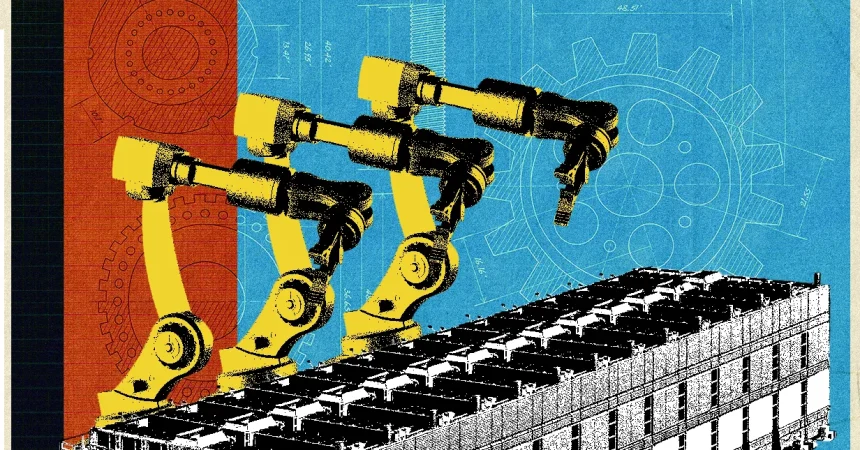
The specific robots being deployed are not the humanoid, sci-fi walkers one might imagine, but rather specialized pieces of industrial machinery sourced from several different vendors, including Watney Robotics, Kinova, and ABB. In one particularly telling experiment, Meta is evaluating the Kinova Gen3, a lightweight, articulated robotic arm, to handle the process of “power cycling”—essentially cutting off and restoring electricity to a server. This task, while simple in concept, is fraught with risk for humans because it requires precise interaction with sensitive equipment. In another test, a different robot is being taught to swap out tangled or broken networking cables, a job that often requires technicians to contort themselves in tight spaces and meticulously label thousands of connections. For the humans currently on shift, watching these machines work is a strange experience. The robots are slower than a skilled human, but they never get tired, never need a break, and never complain about the cold, sterile environment. The financial logic is inescapable; as Meta’s spending on AI infrastructure skyrockets, squeezing every ounce of efficiency out of operational costs, including the payroll for shift workers, becomes a matter of survival. The robots represent a future where the only constant is the hum of automation.
Paragraph 3: The Human Anxiety and the Inevitable March
For the workers who have dedicated their careers to maintaining these digital fortresses, the arrival of the robots is a source of deep, visceral unease. “We thought those of us performing the physical tasks were safe for a while, but not anymore,” one data center employee confided, echoing the sentiment of many. “It’s coming for us all, unfortunately.” This admission highlights a painful irony: for years, many laborers felt insulated from the threat of automation because their jobs required physical presence, dexterity, and on-the-fly troubleshooting. They watched as AI began writing code and drafting emails, but believed their hands-on role was untouchable. Now, with the advancement of tactile sensors and computer vision, the physical realm is being colonized by machines as well. The psychological impact is profound. The quiet, repetitive work of swapping a failed hard drive or plugging in a cable—tasks that once provided stable middle-class employment—are being broken down into algorithmic sequences that a robotic arm can execute with perfect, monotonous accuracy. The fear is no longer abstract; it is the sound of a servo motor whirring just a few aisles over.
Paragraph 4: Meta’s Official Defense and the “Human-Centric” Narrative
In response to inquiries about these experiments, Meta has adopted a public stance that seeks to frame the robotics push not as a job destroyer, but as a necessary evolution during an unprecedented era of growth. Francis Brennan, a spokesperson for the company, issued a statement emphasizing that America is in the middle of its biggest infrastructure boom since World War II, and that there is a major shortage of skilled workers to fill the countless roles required to build and operate new data centers. “We need more workers, not fewer,” Brennan insisted, portraying the robots as a supplementary workforce rather than a replacement. This narrative is further reinforced by Eric Xu, Meta’s senior manager for robotics, who articulated a long-term vision where machines handle the dirty, dangerous, and dull work. By deploying robots for incident response, environmental monitoring, and preventative maintenance, Meta argues that it is actually freeing human employees to focus on more complex, cognitive challenges that require intuition and problem-solving. Xu emphasized that this is a collaborative journey, stating, “We believe more collaboration and research will be needed, but we have to start otherwise we don’t have a chance to do this.” It is a carefully crafted message designed to reassure both the workforce and the public that humans remain central to the mission.
Paragraph 5: Why Now? The Evolution of Robotics and AI
The timing of this push is no coincidence. For years, robots were largely unsuitable for the delicate work required inside a data center. Early trials in the industry were riddled with costly failures; some robotic arms, lacking the finesse needed for precise movements, notoriously crushed servers while attempting simple tasks like sliding a component into a rack. High costs made the return on investment difficult to justify. However, the landscape has changed dramatically. Hardware has gotten significantly cheaper, and—crucially—the AI models that power these machines have become exponentially more capable. Modern robots are equipped with advanced vision systems and neural networks that allow them to adapt to minor variations in their environment, making them far less likely to fumble a delicate operation. This convergence of affordability and intelligence has ignited a surge of interest from startups and established industrial giants alike, who are racing to build commercial robots specifically designed for the data center market. The ability to offer consistent, reliable output at a lower cost than human labor—especially in less populous regions where qualified technicians are scarce—has made the robotic value proposition almost impossible for giant tech firms like Meta to ignore.
Paragraph 6: The Futuristic Endgame—Underwater and in Space
Beyond the immediate cost savings, proponents of robotic data center maintenance are championing a pro-worker message that points to a far more radical future. The argument is that if robots can handle the most repetitive and dangerous tasks, they will eventually allow for the establishment of data centers in environments that are simply inhospitable to human life. Imagine server farms resting on the ocean floor, cooled naturally by the surrounding water, requiring no human presence for years at a time. Envision outposts in the vacuum of space, or in radiation-contaminated zones, where a human could never survive. Long-term, getting flesh-and-blood workers out of the picture entirely could make these previously impossible locations feasible. This vision represents a profound philosophical shift: the digital world, built by and for humans, would increasingly be maintained by mechanical entities empowered by the very AI they host. As Meta and its competitors race toward this automated horizon, the line between the physical and the digital continues to blur, leaving us to ponder a future where the internet runs itself, watched over by silent, tireless mechanical arms that never sleep.