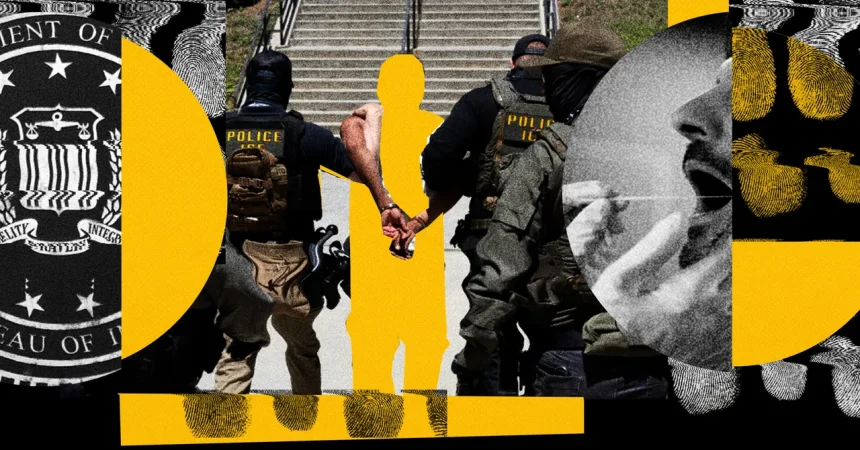
On March 13, 2025, Hugo Moreno-Mendez walked into the McLennan County Probation Department in Waco, Texas, expecting nothing more than a routine check-in. Instead, his life took an abrupt and jarring turn when he was intercepted by Immigration and Customs Enforcement (ICE) officers. What should have been a mundane administrative task became a high-stakes standoff. As he was driven to an ICE field office, he was met with a repetitive, insistent demand from a rotation of officers: open your mouth. They wanted his fingerprints and a swab of his inner cheek for a DNA sample. Moreno-Mendez stood his ground and refused each time, an act of defiance that would soon see him charged with federal crimes—including a misdemeanor for refusing to provide DNA, a charge so obscure that even ICE had previously admitted they weren’t aware of it ever being prosecuted.
The legal fallout for Moreno-Mendez was swift. He was charged with failing to register as a noncitizen and for his refusal to surrender his genetic material while in federal custody. Despite taking his case to trial, a magistrate judge found him guilty on both counts in August 2025. While his sentence was ultimately “time served,” the implications of his case ripple far beyond his personal ordeal. His experience highlights a quiet but aggressive transformation in how the U.S. government handles those in immigration detention, shifting from simple processing to the mass-scale collection of biological data. This is no longer just about tracking identity; it is about building a massive, permanent digital map of human beings to be stored in the FBI’s criminal archives.
This expansion is part of a broader, sweeping federal campaign that treats almost everyone in ICE custody as a subject for the Combined DNA Index System (CODIS), a database originally designed for criminal investigations. Research from Georgetown Law’s Center on Privacy and Technology paints a staggering picture: the Department of Homeland Security (DHS) has effectively become the largest contributor of new genetic profiles to the nation’s criminal DNA system. In 2025 alone, ICE potentially added roughly 920,000 profiles to this system. The gravity of this cannot be overstated—many of these individuals have never been convicted of a crime, and, in many cases, their undocumented status is a civil matter rather than a criminal one. Yet, once that swab is processed, their entire genome is locked away in a federal lab indefinitely, ripe for comparison against unsolved crimes from today or decades into the future.
The reach of this program is as broad as it is controversial, extending its grasp even to families held in detention centers. The ethical concerns were brought to the forefront when reports emerged that even children were being swabbed at a facility in Dilley, Texas. This move drew sharp criticism from members of Congress, who argued that families—and especially children—have no place in a database intended for the identification of violent offenders. There is a profound sense of dehumanization inherent in the process; when you take a person’s genetic blueprint under the threat of prosecution, you are stripping away their privacy and reducing them to a data point in a machine that never forgets and never stops scanning.
DHS has maintained a firm stance, defending these measures as necessary tools for border security and proper identification. They argue that these samples are collected from individuals arrested on federal charges or those subject to standard detention protocols. However, this justification often brushes past the reality of how these samples are used. While the government distinguishes between its routine identification programs and criminal DNA collection, the result is the same: the massive aggregation of biological data from people who have not been charged with crimes. DHS officials have notably remained silent on the sheer volume of profiles being added, choosing instead to focus on the policy framework rather than the scale of the collection, which has ballooned to an eye-watering rate of roughly 2,700 people per day.
Ultimately, the transformation of this program marks a profound shift in the American surveillance landscape. Looking back at the data, the scale of this effort has exploded; the “detainee” index of CODIS hit over 3.3 million profiles by the end of 2025. When we look at the case of Hugo Moreno-Mendez, we aren’t just looking at a single man’s refusal to be swabbed; we are looking at the collision between individual agency and a state machinery that views the human genome as a matter of public record. By funneling non-criminal, detained individuals into a database designed for the hunt for violent criminals, the government is fundamentally altering the relationship between the state and the people it holds. It is a cautionary tale of how administrative processes, when fueled by unchecked data collection, can create a permanent surveillance state that follows people long after they have left the halls of detention.