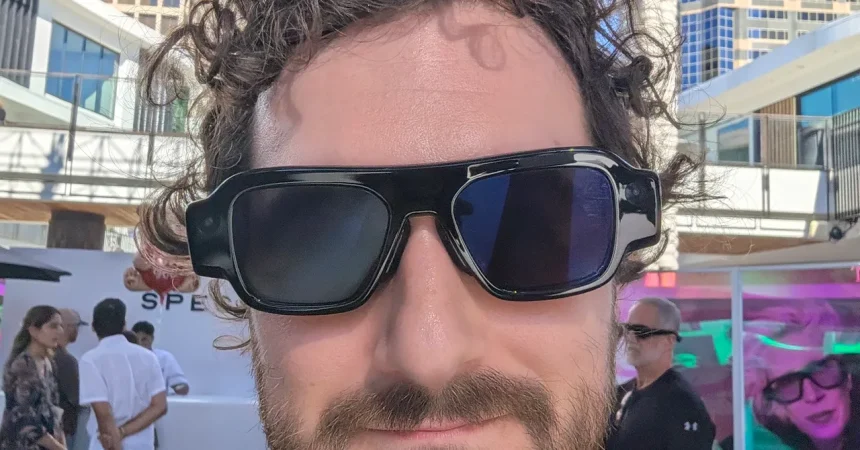
The young Snap representative looked at me with the kind of genuine delight you don’t often see from someone who spends all day handing out expensive tech demos. “You’re the first person who’s tried that one,” he said, and I couldn’t tell if he meant the push-up lens I had just activated or the particular way I’d tilted my head to trigger it. Either way, I felt a little like a pioneer, which is probably exactly how Snap wants visitors to feel at the Specs First Look demo in the Westfield Century City shopping center in Los Angeles. The space had been open for just a couple of weeks when I stumbled into it on a warm Sunday afternoon. It wasn’t a polished, high-security launch event; it was more like a playful pop-up in the middle of the mall, with a steady stream of curious shoppers drifting in and out. Kids were everywhere, and on their smaller faces the chunky glasses looked almost comically large, like props from a sci-fi movie. Snap representatives handed the glasses to anyone who registered and seemed willing to linger, and when people finished their demo, they walked away with a free cup of ice cream topped with a small, chocolate cookie shaped like the Specs themselves. There was something delightfully ordinary about the whole scene, and that contrast—between a futuristic pair of AR glasses and a sunny mall afternoon with free frozen treats—felt like the perfect introduction to what Snap is trying to do.
I had been expecting the glasses to feel heavy and awkward, especially after seeing so many photos of their thick black frame and oversized front. But when the Snap rep handed me a pair, I was pleasantly surprised by how lightweight they felt. The glasses are definitely chunky, no question about it, but the weight is distributed well enough that they stayed on my face without constantly sliding down my nose or pinching the sides of my head. They come in two sizes, and I was grateful for that, because the smaller version fit me just right. I noticed other people in the demo zone adjusting theirs, and the reps were quick to swap sizes for anyone who looked uncomfortable. It was a small but important detail, because a device like this only works if you forget you’re wearing it, at least for a little while. The lenses themselves are dark enough to pass as sunglasses when they’re off, and the overall design feels more like a pair of sporty wraparound shades than a delicate piece of high-tech eyewear. You’re not going to mistake these for a pair of designer glasses, but they don’t look entirely out of place either. Standing there in the bright mall light, watching kids and adults alike wander around with these futuristic lenses over their eyes, I started to understand why Snap chose this setting. The glasses are meant to live in the real world, not just in a sleek demo room.
The dozen or so Lenses available for testing were carefully chosen to show off a range of possibilities, and I tried as many as I could. The push-up lens was the one that had earned me that moment of rep approval. It uses the glasses’ built-in sensors to track your body as you do push-ups, counting your reps and displaying the number directly in your field of view. It sounds simple, but it was surprisingly motivating. Another lens let me finger paint in midair, which felt like a childhood daydream come true. I moved my index finger through the empty space in front of me and watched a trail of virtual color follow my movements, hanging in the air as if I were drawing on invisible glass. There was also a navigation lens that overlaid turn-by-turn directions onto the real world, with arrows and street names floating above the floor and walls around me. It was the kind of experience that makes you realize how quickly you could get used to having digital information woven into your physical surroundings. I even tried a lens that let me draw on a physical notepad while the glasses recognized and enhanced my doodles, and another that analyzed text in a printed book and offered additional information about it. Each experience felt a little rough around the edges, but also genuinely magical in a way that screen-based AR never quite captures. Looking through those glasses, I kept thinking about how much potential there is in this technology, even if it’s still clearly in its early days.
There were also a few sporty features designed to appeal to more active users. One lens, apparently meant to help with golf, seemed to overlay distance and club information onto the course, though I didn’t have a golf club or a fairway handy to test it properly. Another, developed in partnership with the NBA, was designed to guide you through shooting hoops, providing visual cues and feedback as you practiced your form. I tried that one with a few playful jumps and imaginary basketball throws, and even in a crowded mall demo zone, it managed to make me feel like I was doing something athletic. The sports lenses felt a bit gimmicky at first, but they also hinted at a future where AR glasses could be more than just a novelty. Imagine going for a run and seeing your pace displayed in front of you, or practicing your swing with instant feedback from a virtual coach. The possibilities are enormous, and Snap seems to be betting that sports and fitness will be one of the first areas where these glasses genuinely earn their place in everyday life. I wasn’t able to test every lens available, but the variety was impressive. The reps were patient and enthusiastic, encouraging everyone to try the more physical experiences, and the whole atmosphere was one of playful exploration rather than serious product demonstration.
One of the biggest surprises came when I decided to test the glasses in direct sunlight. I had noticed that the lenses were dark, but I wanted to see whether the virtual elements would disappear when I stepped into the bright afternoon sun. The Snap rep had mentioned that the glasses automatically switch into what he called “sunglasses mode,” dimming the lenses to block out harsh light while still keeping the digital display visible. I walked over to a sunny spot near the edge of the mall, tilted my face toward the sky, and looked through the glasses. To my relief, the onscreen elements remained perfectly visible, even with the brightness turned all the way up. The virtual arrows, drawings, and text held their shape against the bright background, and I didn’t have to squint or shield my eyes to see them. The rep also told me that the lenses protect your eyes from UV rays at all times, which is reassuring for a device you might wear outside for long stretches. That combination of bright-day visibility and sun protection feels essential for any AR glasses that hope to become a daily accessory, and it was the moment I started to take the product seriously. The glasses are still big and bulky, and they’re certainly not something you’d wear everywhere, but they handled the outdoor environment better than I expected.
Snap announced the Specs back in June, and they cost a hefty $2,195, with shipping set to begin in the coming weeks. It took a few months for the company to reveal exactly what features would be available on the glasses, and after trying them myself, I can understand why they waited. This is a product that needs to be experienced to be believed, and even then, it’s hard to know exactly how it will fit into your life. My colleague Julian Chokkattu got a dedicated demo with the company, while I accidentally stumbled upon the public pop-up at the mall, and in some ways, I think my experience was closer to what most people will go through. This isn’t a polished, final product for everyone; it’s a bold first step into a world where digital and physical realities blur together. Standing in the Century City mall, watching kids run around with oversized glasses on their faces and grown-ups giggling as they finger-painted in midair, I felt a sense of wonder that’s become increasingly rare in the tech world. The glasses are expensive, imperfect, and probably not for everyone, but they left me genuinely excited about what’s coming next. As I walked away with my free ice cream and a cookie shaped like a piece of future technology, I couldn’t help but feel that I had just gotten a small glimpse of where we’re headed.