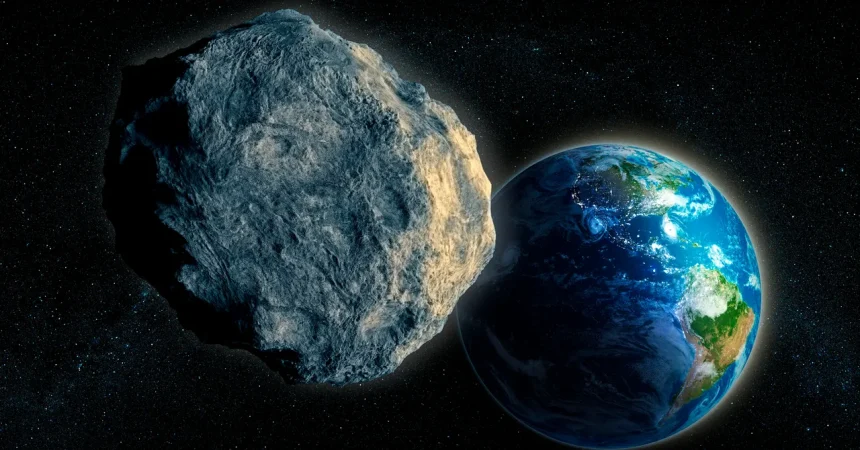
This weekend, the night sky offers us a rare and fascinating visitor: asteroid (152637) 1997 NC1. According to the European Space Agency (ESA), this massive space rock is making its closest approach to our planet in 400 years. It is important to emphasize right from the start that there is absolutely no risk of an impact; the asteroid will safely cruise past us at a distance of approximately 2.56 million kilometers—roughly 6.6 times the distance between Earth and the moon. While this distance is vast, it serves as a unique cosmic opportunity. Given that this space traveler measures between 700 meters and 1.6 kilometers across—larger than any skyscraper on Earth—it is a significant piece of our solar system’s history that won’t visit our neighborhood again until the year 2133.
The moment of peak proximity arrives this Saturday, June 27, at 11:14 UTC, but the viewing window spans several nights depending on where you reside. Astronomers suggest that if you are in Europe, Mexico, or the United States, your best viewing window falls during the night of June 26 into the early hours of June 27. Meanwhile, those in Argentina and the Southern Cone should look toward the southern sky during the night of June 27 into June 28 as the asteroid’s trajectory shifts. Even after the official “closest” moment passes, the object won’t simply vanish; it will remain visible for a few days, though it will gradually dim and drift in its position, making the earliest possible viewing opportunities your best bet.
If you’re hoping to catch a glimpse, it’s important to manage your expectations regarding what you’ll see. Despite its immense size, the asteroid will be invisible to the naked eye. At a brightness magnitude of 10, it is roughly 40 times fainter than the dimmest stars we can perceive without aid, and the presence of a near-full moon will make the sky brighter, further obscuring its light. If you manage to find it with the right gear, it won’t look like a glowing rock or a dramatic shooting star; rather, it will appear as a tiny, steady point of light. However, if you watch that point carefully for a few minutes, you’ll witness a gentle, rhythmic movement across the background of the stars—a subtle reminder of the asteroid’s true nature as a traveler moving at about 40 arc seconds per minute.
To successfully spot this visitor, you’ll definitely need to pull out your astronomical equipment. A telescope is highly recommended, ideally one with an aperture of at least 100 millimeters, though 150 to 200 millimeters will provide a much clearer and more enjoyable experience. If you prefer using binoculars, look for 15×70 or 20×80 models, and it is crucial to mount them on a tripod to keep your view steady. For the best chance of success, try to find a dark patch of sky away from city lights, as light pollution will make it nearly impossible to distinguish such a faint object. If you find yourself struggling to navigate the heavens, modern technology is on your side: apps like Stellarium, Sky Tonight, or SkySafari can help you pinpoint the asteroid’s exact location near the constellations Ophiuchus and Serpens Cauda.
Of course, not everyone has access to a powerful telescope or a perfectly dark, clear night. If the weather doesn’t cooperate, or if you simply prefer to experience the wonders of space from your living room, there is a convenient alternative. The Virtual Telescope Project is hosting dedicated livestreams on June 26 and June 27. These broadcasts will provide a real-time tracking of the asteroid, allowing anyone with an internet connection to witness this rare flyby without ever having to worry about cloudy weather, telescope calibration, or freezing temperatures. It’s a wonderful way for the global community to come together and appreciate the mechanics of a solar system that is usually far beyond our daily concern.
At its heart, the passing of 1997 NC1 is a beautiful reminder of our place in the universe. It’s a moment that bridges the gap between scientific observation and human curiosity, allowing us to watch an object that has been drifting through the void for centuries. While it isn’t an earth-shattering event, it is a rare one—a quiet, graceful passage that highlights the precision of orbital mechanics. Whether you engage with it through a backyard telescope or a digital stream, taking a moment this weekend to consider this massive traveler reminds us how lucky we are to occupy this vibrant, blue corner of the solar system, safely witnessing the cosmic dance from afar.