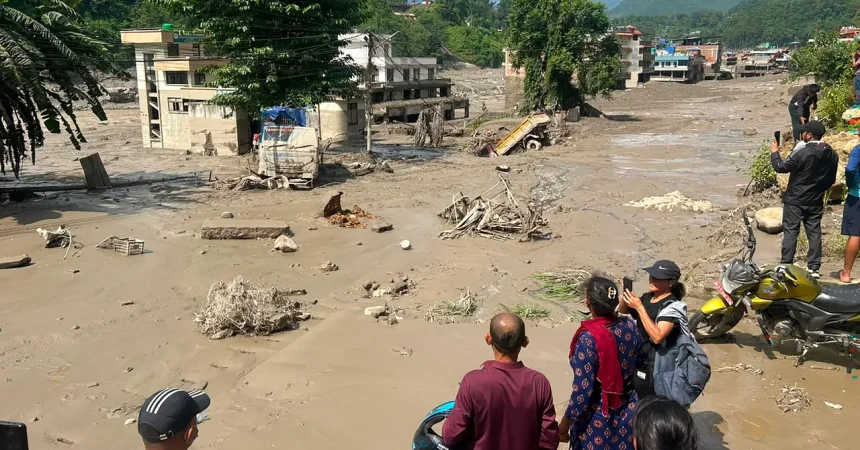
In the rarefied air of the high Himalayas, where the stark border between Nepal and Tibet dissolves into a jagged horizon of rock, snow, and permanent twilight, life has always depended on a delicate balance with the elements. But on a seemingly ordinary Wednesday, that balance shattered with a ferocity that no one could have anticipated. In the high mountain valleys, the sound that began like distant thunder swelled into a relentless roar, and before anyone could react, a wall of water—dark, viscous, and carrying the weight of a disintegrating mountain—came crashing down. Within minutes, entire villages, guesthouses, bridges, and homes were swept away, engulfed by a violent slurry of ice, mud, boulders, and freezing water. The staggering death toll has now reached roughly 160 souls, but that figure is far from final; hundreds more remain missing, whisked away in the black flood. Among the missing are dozens of international tourists—trekkers who had come to marvel at the pristine ancient beauty of this region, only to find themselves caught in the brutal reality of its change. Devastating footage shared across social media shows the visceral, chaotic escape: people scrambling up hillsides, clutching tree branches, their faces frozen in shock as the wall of water consumes everything in its path, erasing physical landmarks and endless dreams in a single, irreparable moment of terror.
In the aftermath, the world’s scientific community turned its attention skyward, seeking explanations for a catastrophe that felt almost impossible. All evidence points to the terrifying fragility of the mountain’s frozen crown. Detailed satellite imagery reviewed by a team of international geologists, including Daniel Shugar of the University of Calgary, revealed a stunning and horrifying mechanism. The flash flood was not caused by a torrent of rainfall, but by a devastating landslide provoked by the sheer mass of a collapsing glacier. A colossal piece of the ice—stretching a full 2,000 feet across—sheared off its bedrock and plummeted nearly 4,000 feet down to the valley floor. The force of that fall was so exquisite that it virtually pulverized the ice, shattering the crystalline structure into millions of pieces, instantly liquefying it into a raging deluge of glacial water. This sudden injection of gargantuan volumes of water gathered speed, mobilizing the neighboring soil and sediment, forming a lethal torrent that had nothing to do with monsoon patterns. The sheer violence of the event was so profound, the kinetic energy so immense, that the International Geological Survey recorded the impact as a temporary magnitude 5.2 seismic event—an extraordinary phenomenon where an avalanche of rubble produces tremors equivalent to an earthquake, shaking the foundation of the earth herself and sending shockwaves across seismographs globally.
To understand why this tragedy occurs, we must look to the intricate, slow-burning changes of the world’s climate, and the fragile nature of the glaciers that hold together these Himalayas. Joseph Shea, a professor of geography at the University of Northern British Columbia, whose work has defined our current understanding of high-mountain hydrology, paints a somber picture. “The glaciers over there are definitely in retreat,” Shea confirms, a conclusion echoed by decades of data which show a dramatic, accelerating loss of ice mass globally. Since the turn of the millennium, our planet’s glaciers have already lost roughly 5 percent of their total ice. In Nepal, this phenomenon is apocalyptic: the nation’s glaciers shrank by nearly a quarter of their land area between 1970 and 2010 alone. Over a hundred and sixty minor glacial bodies in that country have completely disappeared, no longer even marking the landscape where they have stood for millennia. The driving force is atmospheric warming, and the stakes are unsustainable. Recent research predicts that if the global community fails to limit the world’s temperatures to a mere 1.5 degrees Celsius above pre-industrial levels, up to 40 percent of all remaining glacial ice on Earth—irreplaceable, ancient and pale-blue—will vanish. This meltdown doesn’t just mean less ice on the peaks; it directly destabilizes the very structures of the mountains. ice fields that once anchored the permafrost and held sheets of adjoining slopes together fast, are released, making the mountains losing shape.
Experts point out that the Wednesday disaster is a violent manifestation of a chain of events caused directly by these melting behemoths. As glaciers retreat, they leave behind large, dammed lakes at higher elevations, backed by fragile piles of rubble known as moraines. “If you have a landslide suddenly into a lake, you get an overtopping of the dam, and then the whole thing can collapse catastrophically,” Shea explains. These are glacial lake outburst floods (GLOFs), and they are ticking time bombs. Last year alone, two such destructive events battered Nepal. The Wednesday event was not a classic GLOF eruption of the lake; instead, it was the more sudden collapse of the glacier itself, potentially due to the destabilization of a hanging glacier, as well as a melting of snow occurring over a warmer week. Such occurrences are terrifyingly brutal, changing the high mountain valleys across the Himalayas, the Andes, and Tibet, where millions of inhabitants are
living in spreading dangerously zones. What happened speaks of a new reality in the region. The of the stable rock and snow has been replaced by a fundamentally dynamic state where sudden ice avalanches liquefied instantly, are now a new, horrifying regular. There is a certain silence in how this played out. The high waterfalls of the mountain are a promise of eternity. Now, the cold mass is a haunted, unstable crown, ready to snap.
The tragedy transcends numbers to echo through the human experience of grief. The rescue efforts, relentless and grieving, are fighting through a sludge of detritus as tall as the village’s old watchtower, hunting for signs of life in the debris. Yet the human details are devastating—the families hunting for tourists from the United States, Europe, or Japan, countless calls that goes straight to voicemail, their fate uncertain; the local Nepali shopkeepers, caught in their own local shop selling chevassels to strangers, swept away while a moment of horror. The landscape has been irrevocably choreographed in every level; the charming hillside communities, with their quivering prayer flags draped (flamboyant), their stone-slab roofs shining under the sun, now are disintegrated into monstrous piles of gravel. What had been a place of beauty now holds the stiff scent of mud, among the boulders, where a mobile phone screen flickers in distress. Scientists and climate officials can provide charts and computer models, but the true grief index can only be measured hidden in the hazily covered grief of the families, the vacated boat, and a river of filth that continues to scream despite the quiet day after.
In the final analysis, this catastrophe is a stark warning of the world we are actively building—a world where warming atmospheric temperatures directly cause these dramatic, sudden floods. While scientists deduce and cling, to factual analysis, the quintessential truth is that Nepal’s disaster occurred in the face of the very choice we face. These mountains are a prospect. They have defined the geography and spirituality of a region since time began, but now they stand being decayed, collapsing into valleys. The rapidly diluting ice below the high, captive the extra water that will inevitably unleash in a sudden rod of destruction. The faint warning has always been there in tremor; but now it is too strong to ignore. We are seeing the results directly proportional to our carbon footprint, and the cost is paid not only in infrastructure, but in hundreds of lives—yet the relentless hive of families in the cities below, the tourist economy, the ancestral homestays, all must face this. As we grieve for the 160, we must also heed the vital extinction that echoes. The tragedy in the high valley is not the last whisper from the mountains; it is the thunder of a future that will grow louder and more frequent unless we immediately listen to the terrible message of the melting ice.