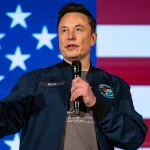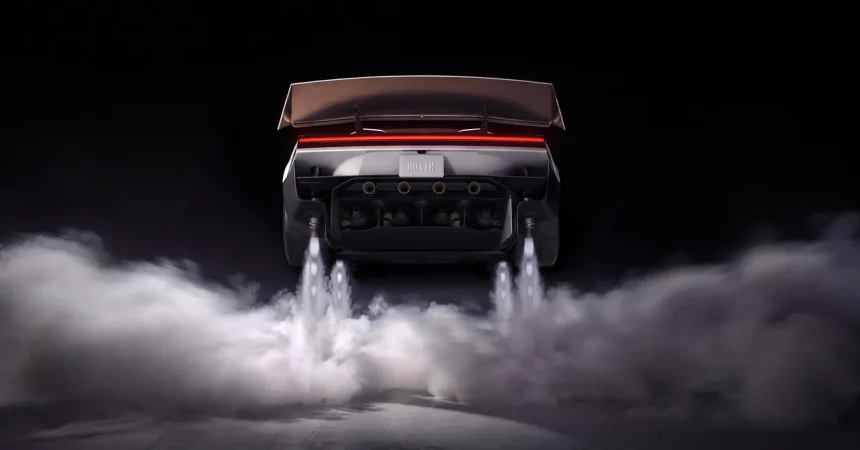
Last night, in the dusty, windswept outskirts of McGregor, Texas, at SpaceX’s rocket development and testing facility, Elon Musk did what he does best: he turned a long-overdue product reveal into a full-blown, cinematic spectacle. It had been nine long years since Tesla first announced the Roadster’s return, and for many, that announcement had started to feel like a beautiful, fading dream. Then, with low lighting, dramatic music, and a sense of occasion that felt more like a science-fiction premiere than a car launch, Tesla finally unveiled the Roadster 2. And it did not simply roll out. It launched. It accelerated from zero to 60 miles per hour in under one second, flew up a steep ramp, drove upside down for a moment under the Texas sky, then flipped in midair and landed back on the ground, cushioned by thrusters that looked like they had been borrowed from a spaceship. It was undeniably breathtaking. It was also, depending on your perspective, a very expensive, very theatrical way to do what Buzz Lightyear would call “falling with style.” Musk, of course, loves that kind of showmanship. He stood there beaming as the car made its improbable leap, and the internet immediately rewarded him with thousands of clips and headlines. But not everyone was impressed. Watching from the business pages, investors seemed to be unmoved; after the event, Tesla’s stock price was actually down. That is the strange contradiction of modern Tesla. The company can make a car do a gravity-defying stunt, yet the market still worries about deliveries, margins, and the bottom line. Still, for the people who have waited nine years, last night was a moment of pure, unapologetic wonder.
But how exactly did Tesla make a two-seater electric car fly? The simple, seductive answer is: thrusters. The more honest answer is that the Roadster 2’s gravity-defying demonstration used a combination of suction and rocket thrust working together, which sounds like something from a comic book but was explained in calm, engineering detail by Tesla’s vehicle engineering chief, Lars Moravy. Before the event, Moravy sat down with Hagerty, the automotive lifestyle and insurance brand, and walked through how the trick works. In the demo, the Roadster 2 did not mysteriously float in the air. It shot off a ramp at high speed, used onboard thrusters to alter its orientation, and then, as it fell back toward the ground, those same thrusters fired downward to soften the landing. The car was essentially using a controlled burst of thrust to manage its own descent, turning a potentially catastrophic crash into a graceful touchdown. The fact that no one was inside made the spectacle easier to pull off, and also safer. Musk, with a mischievous grin, admitted that Tesla wanted “to make sure we don’t kill anyone” during the demonstration. That joke disguised a serious point: the car was pushed to the absolute limits of physics, doing things no production vehicle would ever be asked to do. It was a proof-of-concept, a tech demo dressed in a car’s body, and it served its purpose beautifully. Whether you call it flight, a hover, or simply an elaborate jump, the Roadster 2 did something that no production car has convincingly done before. And it did so with enough showbiz style to make you forget that it was, at heart, a cleverly staged physics experiment.
From a design perspective, the Roadster 2 is the latest vision of Franz von Holzhausen, Tesla’s chief designer since 2008, and the creative hand behind the Cybertruck, the Model S, the Model X, the Model 3, the Model Y, and the Semi. Von Holzhausen has a distinctive, confident aesthetic, one that favors sharp lines, low silhouettes, and a kind of futuristic minimalism that can read as either brilliant or starkly cold, depending on the vehicle. The Roadster 2 sits firmly on the brilliant side of that argument. Its angular exterior looks like it was carved not from metal but from wind itself, with a body that seems to lean forward even when standing still. The car’s windows were blacked out, which served two purposes: it deliberately obscured any view of the cabin, leaving the interior design a mystery for another day, and it also made the absence of a human driver almost irrelevant. There was no one inside, because no one needed to be. The Roadster 2 was performing for the cameras, not for a passenger, and the black glass gave it an aggressive, almost robotic presence. It also fit the broader character of the vehicle. The Roadster has always been a halo car, a statement piece, something to remind the world that Tesla is not just another automaker but a company that reimagines what a car can be. Von Holzhausen’s design language has become instantly recognizable, and the Roadster 2 is perhaps its purest expression yet. Every crease and curve seems intentional, every surface designed to manage airflow and make the car look fast even when it is parked, gleaming under floodlights in the middle of a rocket facility.
Beneath that stunning exterior, the Roadster 2’s powertrain is a deliberate and fascinating departure for Tesla. It is rear-wheel drive only, a surprising choice from a company that has built its modern reputation, and much of its sales success, on all-wheel drive. But Tesla clearly believes that the Roadster’s rear-mounted power is enough to make traction a non-issue. That belief is backed by staggering numbers. Two electric motors will deliver more than a megawatt of power, which translates to roughly 1,341 horsepower and over 1,400 Newton-meters of torque. To put that in context, that is more power and more torque than Tesla’s own three-motor Model S Plaid, one of the most ferocious production cars ever built. And all of that force will be sent exclusively through the rear wheels. That promises a driving experience that is raw, aggressive, and possibly a little intimidating. It is not the kind of car you ease into; it is the kind of car that grabs you by the collar and dares you to hold on. The 0-to-60 time of under one second is not just a marketing boast; it is an absurd number that rivals things with wings and afterburners. The Roadster 2 is effectively a street-legal rocket, or at least as close to one as the world has ever seen. Moravy’s explanations to Hagerty made the engineering sound almost calm: two motors, rear wheels, more than a megawatt of power, and a chassis designed to handle the violence. The result is a car that promises to be both historically fast and technically fascinating, a machine that forces the entire industry to pay attention.
Of course, all of that power and torque would mean little if the car were too heavy to control. Weight is often the quiet killer of performance cars, especially electric ones, and Tesla has struggled with it in the past. But the Roadster 2 appears to take that challenge seriously. Moravy confirmed that the car weighs just under 1,700 kilograms, or nearly two tons. That may sound heavy, but it is only about 400 kilograms more than the original Roadster, which was a much smaller and far less powerful machine. Considering that the new Roadster is larger, comes with modern batteries, and packs more than a megawatt of power, keeping the weight under two tons is a remarkable engineering achievement. It means that Tesla has managed to improve the energy density of its battery packs, lighten the body structure, and still produce a car that can withstand the forces of a midair flip. The weight also helps explain why the thrusters were able to work their magic. A car that weighs less is a car that can be more easily manipulated, whether on the road or in the air. The Roadster 2 is not a featherweight; it is not a tiny sports car from the 1990s. But for a modern electric grand tourer with this much tech aboard, it is impressively lean. That lightness should translate into sharper handling, more responsive steering, and a sense of agility that many heavy electric supercars lack. It may also give the Roadster 2 a genuine advantage on the track, where weight is everything. Tesla has always been obsessed with straight-line speed, but the Roadster 2 hints that the company is finally thinking just as seriously about the corners.
What does this spectacular, slightly bonkers evening ultimately mean for Tesla? On one level, the Roadster 2 is the ultimate halo car, a machine designed not for huge sales volume but for proving what the company can do. For nine years, skeptics have mocked the Roadster project as vaporware, a dream that would never materialize. Last night, Tesla answered those skeptics with a car that literally jumps into the air, flips over, and lands with the help of rocket thrusters. That is not just a product; it is a statement. It says that Tesla still wants to push the boundaries of automotive physics, even while the rest of the company focuses on mass-market vehicles and robot taxis. It also says that Musk understands the power of spectacle. In the middle of a rocket facility, with the stars overhead and a car soaring through the air, it was impossible not to feel a jolt of excitement. Social media immediately filled with clips of the Roadster 2’s flight, and for one evening, the conversation was about magic, not margins. But the stock market’s muted reaction after the event was a reminder of a harder truth. Investors have heard these promises before. They have watched Tesla reveal incredible vehicles, only to wait years for them to appear. The original Roadster itself took years longer than promised to reach production, and the Roadster 2 may face a similar journey. Musk and Moravy have provided enough technical detail to make the car feel real, and the prototype is clearly functional. But producing it in quantity, at a price people will pay, and with the reliability customers expect, is another matter entirely. For one night, though, none of that seemed to matter. The Roadster 2 soared, and even if it technically fell with style, it fell straight into the imaginations of everyone watching. That is the real magic of Tesla, and last night, it was on full display.