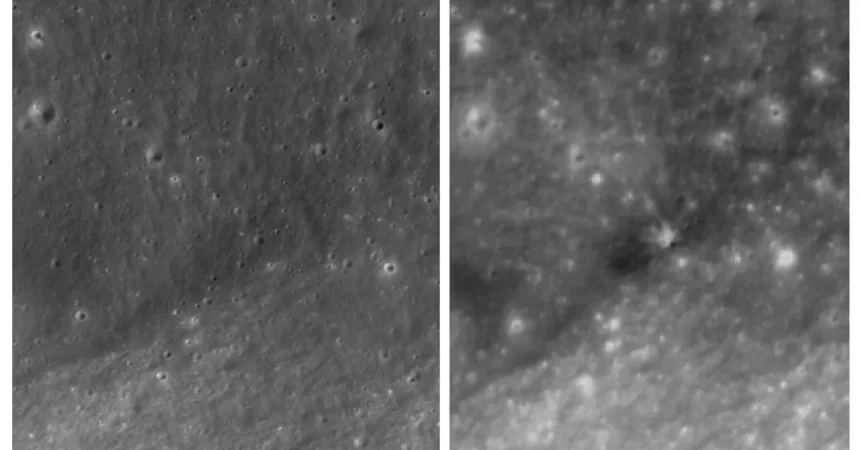
The recent confirmation of a SpaceX Falcon 9 rocket stage striking the lunar surface marks a fascinating intersection of modern space exploration and the unintended consequences of our reach into the cosmos. For over a year, this discarded piece of hardware drifted through the gravitational tug-of-war between Earth, the moon, and the sun. Finally, the object found its resting place on the moon, leaving behind a scarred impact site that has now been captured by South Korea’s Danuri orbiter. These images are more than just scientific data; they represent a rare, documented moment where the remnants of human industry make physical contact with our nearest celestial neighbor, serving as a stark reminder of the debris we inevitably leave behind in our pursuit of the stars.
The visual evidence provided by the Korea Aerospace Research Institute (KARI) offers a sobering perspective on the scale of space exploration. By comparing photographs taken of the impact region both before and after the collision, researchers have identified a crater roughly 12 feet deep and spanning the width of several cars. While this sounds significant in terrestrial terms, the images also highlight the sheer vastness of the moon itself. Hovering just 62 miles above the surface, the Danuri orbiter provides a vantage point that shrinks our technological achievements down to a mere speck. It humbles the observer to realize that, despite the massive energy involved in a rocket crash, the crater remains a tiny, almost inconspicuous blemish on the lunar landscape, emphasizing the moon’s immense, silent scale.
Scientific verification of the impact went beyond simple photography. Astronomers utilizing the Very Large Telescope had previously detected plumes of sodium and lithium rising from the lunar dust, providing a chemical signature that corroborated the collision. This multi-layered approach to observation—combining ground-based spectroscopy with orbital imaging—demonstrates the incredible precision of modern space tracking. Though NASA and other international agencies had warned that capturing the exact moment of impact would be nearly impossible due to challenging timing and atmospheric conditions, the collaborative effort between these global institutions ultimately allowed us to “see” the aftermath of a journey that began with a launch in early 2025.
The story behind this crash is one of physics overcoming ambition. When the Falcon 9 launched its payload toward the moon, it was on a mission that required every ounce of the vehicle’s performance. As SpaceX has explained, these “high-energy” missions often do not have the fuel reserves required for a controlled deorbit back to Earth’s oceans. Once the mission objective was met, the rocket stage was left in an unstable, long-term orbit. Over many months, the unpredictable forces of solar radiation pressure and the shifting gravitational influence of the lunar-Earth system slowly coaxed the debris toward the moon, turning an active piece of technology into an accidental impactor.
SpaceX’s response to the event underscores a growing global conversation about space sustainability and the “litter” we leave in orbit. The company has acknowledged that while such impacts are statistically rare, they are a byproduct of the complex nature of deep-space logistics. They are currently working alongside agencies like NASA to develop more optimal disposal strategies to prevent future occurrences. It is a necessary evolution in our space-faring identity; as we push further into the solar system, we can no longer afford to treat the space between planets as a bottomless void where discarded parts simply vanish. We are learning that space is a shared environment, and every action—or inaction—leaves a mark that lasts for eons.
Ultimately, these photos from the Danuri orbiter are a call for reflection. We live in an era where we can track a piece of metal across the vacuum of space, predict its trajectory with mathematical certainty, and document its final descent onto a cratered world hundreds of thousands of miles away. Yet, this achievement is tempered by the realization that we are filling the sky with relics of our curiosity. As we look at these black-and-white snapshots of a fresh lunar crater, we aren’t just looking at the end of a rocket’s life; we are looking at the footprint of humanity’s expansion. It is a reminder that as our reach grows longer, our responsibility for the impact we have—both literally and figuratively—must grow just as quickly.