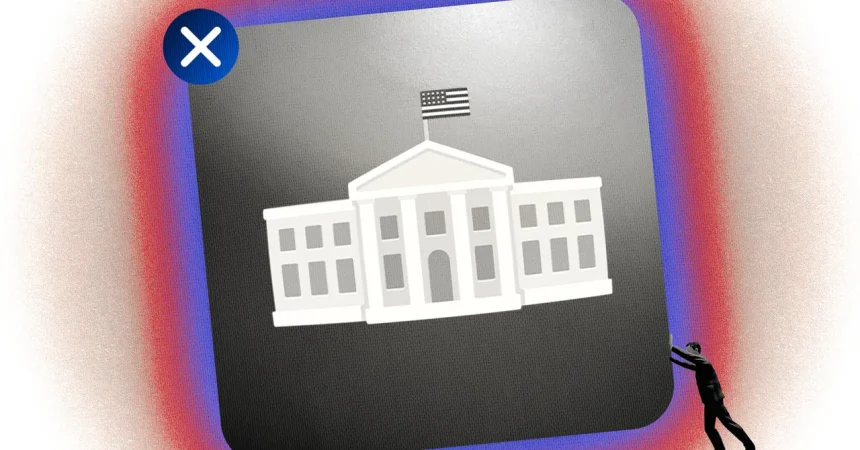
The recent rollout of the White House mobile app has sparked significant unrest within the federal workforce, primarily because of its intrusive nature. In May, millions of government employees—spanning agencies like the USDA, the State Department, and the Department of Labor—discovered the application pre-installed on their work-issued mobile devices. What made this deployment particularly infuriating for staff was not just the unexpected forced installation, but the fact that the software was designed to be persistent. When employees attempted to uninstall the app to regain control of their own work tools, they found it would simply reinstall itself moments later, signaling a level of override that feels alienating and invasive to those tasked with professional public service.
At its core, the app serves as a high-velocity stream of administration-focused content. It integrates a direct line for “texting the President”—which defaults to a message praising him—alongside a curated news feed that pulls from platforms like Truth Social, Fox News, and Breitbart. For many government employees who pride themselves on the traditional neutrality of the civil service, this feels less like a functional tool and more like an mandatory ideological broadcast. One employee went as far as describing it as “pure unadulterated propaganda,” highlighting a deep-seated frustration among staff who feel that their government-issued equipment, which is meant to be a workspace for non-partisan service, is being used to broadcast curated political messaging directly into their daily routines.
Beyond the ideological friction, there are mounting technical and privacy concerns that have left many employees feeling vulnerable. When questioned about the lack of transparency, the White House maintained that the app is secure and does not require personal information. However, this assertion clashes with the experiences of cybersecurity experts who examined the app shortly after its launch. These experts raised early red flags regarding the app’s tendency to share IP addresses and location data with third parties. For individuals working in high-stakes environments like the State Department, the idea that a mandatory, unremovable app could be leaking their location data or digital footprint is not just a nuisance; it is a significant security liability.
Adding to this anxiety is the opaque background of the developer behind the software, 45Press. Despite being a major recipient of government contracts—eligible for up to $8 million—the firm’s professional origins seem unconventional, with the founder’s portfolio including projects as varied as paranormal location guides and WordPress design. This mismatch between the sensitive nature of government work and the background of the developers creates a culture of distrust. When a taxpayer-funded project lacks a clear, robust privacy policy and is managed by a company with little experience in government-grade cybersecurity, it’s understandable why federal workers would view the software as a “black box” that they are forced to carry in their pockets at all times.
The situation took an even more concerning turn with reports of a vulnerability tied to a Russia-based company called Elfsight. An investigation revealed that the app incorporated widgets that potentially exposed the personal information of White House officials. While the administration noted that the vendor had been alerted to the issue, for an employee at the State Department, the damage to trust is already done. When a piece of forced software presents a structural security risk involving foreign-linked vendors, the line between an “official tool” and an “operational risk” becomes blurred. Employees are left wondering why a tool that provides no actual utility for their daily administrative duties is being prioritized over the security and integrity of their devices.
Ultimately, this situation highlights a profound disconnect between the executive branch’s digital ambitions and the reality of the federal workforce. By forcing an unremoveable, politically charged, and security-questionable application onto staff phones, the administration has inadvertently triggered a wave of resentment and concern. For many civil servants, those phones are their primary connection to their work and the public they serve; turning them into platforms for political messaging and potentially compromising their security undermines the very sense of professional autonomy required to keep the government running. As these employees continue to grapple with the app’s persistence, the incident serves as a cautionary tale about the dangers of prioritizing optics over the core digital security and morale of the public sector.