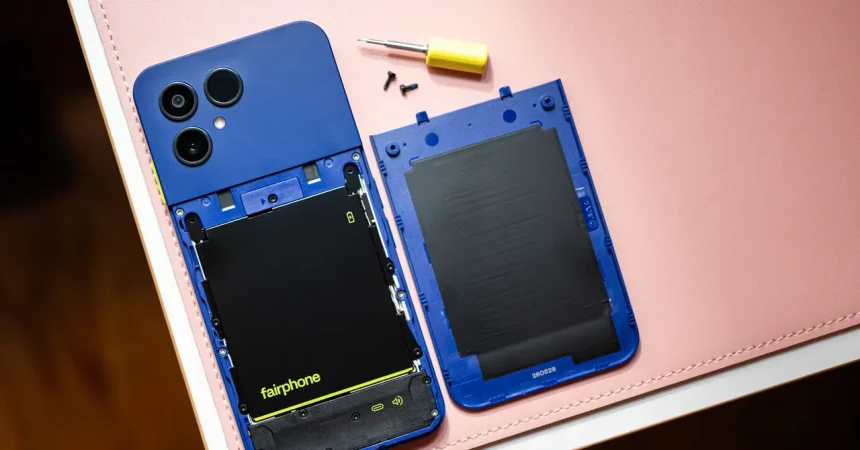
Raymond van Eck sounds less like a typical tech executive and more like someone who genuinely wants you to stop wasting your money. As the CEO of Fairphone, he sees his company’s products as a real alternative for consumers who are feeling the economic squeeze. “If you look to the US market, it’s heavily duopolistic with very little real consumer choice,” van Eck says. “Americans are exhausted by planned obsolescence, closed-box ecosystems, and expensive yearly upgrades.” That line captures a frustration that has been building for years. You know the feeling: a phone that slows down just after the warranty expires, batteries you can’t replace, screens that cost half the price of the device to repair, and a constant drumbeat of new models offering only tiny improvements. In a tight economy, that exhaustion becomes even harder to ignore. People are holding onto their phones longer, repairing them when they can, and feeling increasingly trapped by products that seem designed to fail. Fairphone offers a different story: modular phones you can open with a simple screwdriver, replacement parts you can order, and software that stays supported for years. For van Eck, this is not just a mission statement. It’s a practical, human-centered answer to a system that treats customers as cash flows rather than people. The message is simple, honest, and welcome: you don’t need to upgrade every year. You need a phone that respects your budget, your time, and your conscience. That message may finally be resonating, even in a country as difficult to crack as the United States.
The US market is notoriously hostile to smartphone challengers. Apple and Samsung control the vast majority of sales, and most Americans don’t buy phones directly from manufacturers; they get them through carriers. According to a 2025 report from the International Data Corporation, carriers drive as much as 66 percent of smartphone sales. That means any brand without a strong relationship to AT&T, Verizon, or T-Mobile is effectively invisible. Over the years, this has forced out a long list of once-promising names. OnePlus recently announced its decision to exit North America, following HMD Mobile, Sony, and LG Mobile. Each of those companies had passionate fans, but passion isn’t enough when carrier shelves are controlled by two giants. Fairphone is trying a different approach. Van Eck says the company is already in talks with major carriers and mobile virtual network operators, or MVNOs, to get its devices into their stores. This is a smart and necessary move. It’s one thing to sell a few thousand phones online to people who already care about sustainability; it’s another to make it available to the person walking into a store and asking for a phone that lasts. If Fairphone can win even a sliver of carrier retail space, it could change the conversation. But the company understands the odds. It doesn’t need to beat Apple and Samsung at their own game. It just needs enough visibility to let people make their own choice, and that begins with being seen in the places Americans actually shop.
Underneath the talking points, Fairphone is building something genuinely distinctive. The Gen 6+ includes a feature that reveals the company’s priorities: a physical switch on the device that you can flip to enable “Fairphone Moments.” This is a minimal interface designed to reduce digital distractions. Think of it as a way to turn your smartphone into a calm device when you need focus, without deleting apps or going full digital detox. In a world where every notification is engineered to grab your attention, having a physical switch that changes your relationship with the device is not just a gimmick; it’s an act of care. Van Eck also points to a modest performance boost in the Gen 6+ that allows for more advanced software features, including AI-powered capabilities that require more RAM. He acknowledges that Fairphone isn’t immune to the global memory crisis, but says the company’s “deep relationships” with suppliers have helped it secure the components it needs. That kind of supply chain honesty is rare. Many companies pretend everything is fine until products arrive late or in limited quantities. Fairphone is open about the challenges while also emphasizing the partnerships that make production possible. This is a company that thinks of itself as part of an ecosystem of people, not just a factory turning out units. Even its relationship with Google’s Android, the software that powers its phones, is seen as a partnership rather than a compromise. Van Eck describes it as taking the best of American innovation and wrapping it with European care for people and planet. For him, that’s not a defensive argument; it’s a source of strength.
That attitude toward American technology is worth pausing on. Many European companies resent their dependence on US platforms, whether it’s Android, iOS, or cloud services. They talk about digital sovereignty and act as if reliance on American tech is a dangerous weakness. Van Eck sees it differently. “We do not view our codependence on US technology as a compromise or a downside, but as a powerful synergy,” he says. “You could say we take the best of US innovation, which drives the industry performance, and we wrap it with European care for planet and people. This creates, I would say, a stronger product than either side could build in isolation.” That is a surprisingly mature and refreshing position. Instead of pretending his company exists in a vacuum, van Eck embraces the reality of global supply chains and shared platforms. He sees no contradiction in using American software while also fighting planned obsolescence. The software is a tool, not an identity. What distinguishes Fairphone is not the origin of its components but how those components are treated: repaired, upgraded, reused, and ultimately kept out of landfills. This pragmatic humility makes the company feel more trustworthy. It isn’t claiming to have invented the future. It’s saying that the future should be built with a little more thought. That’s a compelling message for consumers who are tired of false promises and endless hype. It also helps explain why Fairphone is finally gaining momentum, not just among environmentalists, but among ordinary people who simply want a phone that behaves itself and lasts.
The company’s growth reflects this shift in strategy. For years, Fairphone was known primarily as an ethical brand, and marketing often centered on sustainability, conflict-free minerals, and fair labor practices. Those things are still important, but they don’t necessarily make people open their wallets. Van Eck says the company has changed its approach to focus on the quality and usability of the product itself. That might sound obvious, but for a mission-driven company, it can be easy to assume that good intentions are enough. The results speak for themselves. Fairphone has seen year-over-year growth for four consecutive quarters, with phone shipments jumping 74 percent in the first half of 2026 compared to the prior year. Even more telling, 80 percent of people who bought the Fairphone Gen 6 are new to the brand. That means the company is no longer preaching to the choir. It’s attracting people who may have heard about Fairphone’s ethics but decided to buy it because it’s genuinely good. Van Eck says the company is “now expanding toward a more mainstream crowd,” and that this shift is giving him confidence that they are on the right path. It’s a powerful reminder that consumers don’t have to choose between sustainability and quality. The best products can have both. Fairphone is proving that doing the right thing can actually be good business, not because customers are guilted into paying more, but because they’re getting a phone they can rely on for years.
Looking ahead, Fairphone is making a conscious choice to resist the industry’s breakneck upgrade schedule. The Gen 6+ arrives only a year after the Gen 6, which might sound like a departure from its values. But van Eck insists the company still plans to launch new phone generations every two years, not annually like many of its big tech counterparts. The Gen 6+ is more of a refresh than a new generation. It offers meaningful improvements, such as the performance boost needed for AI features and the physical switch for Fairphone Moments, but it doesn’t ask customers to throw away a perfectly good phone. That restraint is central to Fairphone’s identity. In an economy where companies push annual upgrades and design phones that fail within two years, choosing a longer cycle is a quiet act of rebellion. It also aligns with the company’s core message: buy less, use longer, repair more. Van Eck’s vision is not just about one model; it’s about changing the relationship people have with their devices. He wants to give consumers a real choice, especially in a US market dominated by two giants and a carrier system that makes it hard for outsiders to survive. Fairphone may never become the best-selling phone in America. But it doesn’t have to be. If it can create a space where thoughtful consumers feel seen, where repairability is normal, and where technology serves human beings rather than the other way around, it will have succeeded at something far more important. In a tired and repetitive market, that is a genuinely hopeful story.