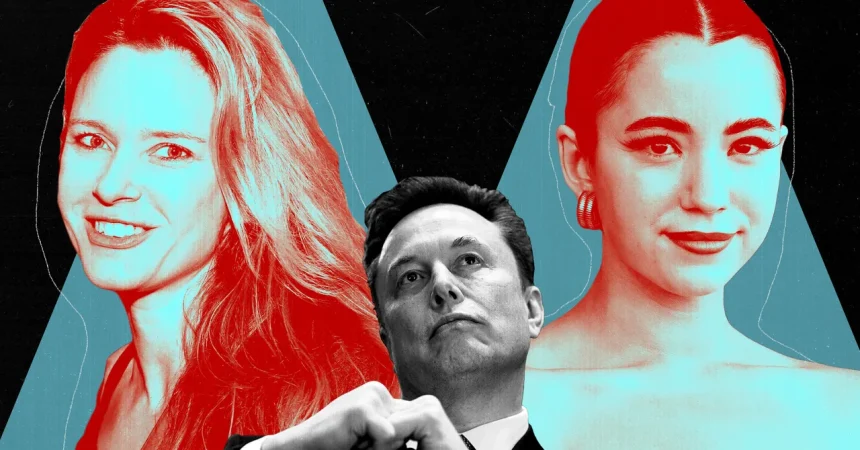
On Friday morning, Shivon Zilis—one of Elon Musk’s closest lieutenants at Neuralink, and the mother of four of his fourteen known children—did something that would have been unthinkable for most people in her position. She took to X, the social media platform he owns, to tell the world that her intimate relationship with the world’s richest man had just come apart, apparently in the span of a single week. “It’s hard to go from in love to let go in a week with no warning, but that’s just how it is sometimes,” she wrote, alongside a screenshot showing that Musk had unfollowed her on the platform. The screenshot, from an account called @BigTechAlert, was a small but devastating piece of evidence: the most powerful man on Earth had ended a romantic relationship with the mother of his children not with a conversation or a phone call, but with the click of a button. What made it even more surreal was that Zilis didn’t seem angry. She wrote about how happy she was to have shown Musk “how it feels to be deeply understood, nurtured, and peacefully loved with stability and gentleness,” and she ended with a wish: “I do hope and pray he and I can be great friends and coparents.” It was a strange window into a private matter, made stranger by the fact that she was broadcasting it on his own platform, to his own audience, with no clear explanation of what had changed. She left ambiguous whether she still holds her role as director of operations and special projects at Neuralink, though nothing suggests she has resigned. For anyone watching, it felt less like a breakup announcement and more like a glimpse into a relationship where the personal and the corporate are tangled beyond recognition.
As bizarre as Zilis’s public note was, it was hardly out of place in the dizzyingly complicated world of Elon Musk’s family life. At this point, all four women confirmed to have had children with him—Zilis, his first wife Justine Wilson, the musician Claire Boucher known as Grimes, and the conservative influencer Ashley St. Clair—have at one time or another used X to share their side of the story, correct the record, or push back against his version of events. Wilson, who was married to Musk in his early years and had six children with him, has spoken openly about the emotional toll of being married to someone so driven and detached. Grimes, who has three children with Musk, has engaged with him publicly in a long, confusing, and sometimes bitter back-and-forth over their relationship, their children, and even the nature of their love. St. Clair, whose son with Musk became public knowledge after she filed a paternity suit, has challenged his accounts and fought to tell her story on her own terms. In a normal family, these conflicts would stay behind closed doors. In the Musk extended universe, they happen out in the open, on the same platform he owns, where thousands of followers can weigh in and where nothing remains private for long. Zilis’s message on Friday was just the latest chapter in a saga that feels strangely modern and completely absurd at the same time. It was a reminder that no matter how far Musk has traveled from ordinary life—into space, into the White House, into the business of reshaping government itself—his relationships still end the way other people’s do, or maybe worse: silently, awkwardly, and in public, with the digital equivalent of a slammed door.
The context for all of this is bigger than one breakup, and it’s the subject of a sprawling new documentary called Musk, directed by Alex Gibney. The film, which opens in theaters nationwide on October 16 and will also screen at the WIRED World Fair in Miami next month, tries to make sense of the man behind the headlines by gathering an unusual ensemble of voices: tech entrepreneurs, journalists, former employees, and, notably, two of the women who know him most intimately. Justine Wilson and Ashley St. Clair both appear in the film, and they emerge as two of the most important critical voices in it. St. Clair, who was once a conservative influencer before her relationship with Musk became a scandal, alleges in the documentary that she rejected a $40 million nondisclosure agreement that would have silenced her about her time with Musk. That kind of money would change almost anyone’s life, but she says she turned it down because she wanted the freedom to speak honestly about what happened. Wilson, for her part, offers a longer view, describing what it was like to be with Musk before he became a household name, before the rockets and the electric cars and the political crusades. Together, their testimonies add something that the business journalists and tech insiders cannot: a personal perspective on his character, his shifting loyalties, and the way he treats the people closest to him. In a film that might otherwise feel like an endless stream of scandals, lawsuits, and corporate victories, their presence humanizes the story, even as it makes Musk look more complicated and, in some ways, more devastating.
Given its nearly four-hour runtime, Musk sounds like an exhausting watch. Yet once it’s over, you’ll probably find yourself thinking that it could have been a ten-part miniseries. There is simply that much material to cover. Gibney traces Musk’s career from his early ambitions in Silicon Valley to his current status as an untouchable oligarch, and he doesn’t flinch from the darker chapters along the way. The documentary tackles the unrealistic ambition of colonizing Mars and the corporate colonization of Texas, where Musk has built his own little kingdom of factories and launch sites. It examines the fatal collisions involving “self-driving” Teslas, asking hard questions about who is responsible when a machine makes a life-or-death decision. And it follows the destruction of the US Agency for International Development by the so-called Department of Government Efficiency, known as DOGE, which Musk led during the start of Donald Trump’s second term. The film also incorporates reporting from WIRED, including interviews with Katie Drummond, the publication’s global editorial director, and contributing editor Zoë Schiffer, whose work has been cited in the documentary. Alongside all of this, there is the personal story—the children, the ex-partners, the public feuds, the unfollowings. What emerges is a portrait of a man who seems to operate by his own rules, not just in business but in love, in family, and in his relationships with everyone around him. The documentary doesn’t offer easy answers, but it does something arguably more valuable: it shows how the same patterns that play out in his public life—the impulsive decisions, the disregard for norms, the sense that ordinary rules don’t apply—also play out in his private life, with real consequences for the people who love him.
What is perhaps most striking about Zilis’s announcement, and what makes it so fitting for the world Gibney documents, is how perfectly it encapsulates the power imbalance at the heart of Musk’s relationships. To “let go” of someone by unfollowing them on social media is not just a breakup—it is a performance of power, a way of saying that the connection no longer exists without having to explain why. And to receive that message in the public eye, and then respond with grace and warmth, is an act of emotional labor that few would have the strength to pull off. Zilis’s words were heartbreaking in their gentleness: she said she wanted Musk to know what it felt like to be deeply understood and peacefully loved, as if she were giving him a gift he had never received before and might never receive again. It’s hard to imagine a more vulnerable sentence to post for millions of people to read. But it also fits a pattern. Wilson has described the loneliness of being married to Musk, the way his extraordinary mind and ambition could make the people around him feel small. Grimes has gone back and forth between expressions of love and frustration, occasionally implying that Musk’s public persona and his private behavior are two very different things. St. Clair’s story, as told in the documentary, involves the same contradiction: a man who can be charming and visionary in one moment, and cold and transactional in the next. Seen through this lens, Zilis’s public farewell is not just a strange celebrity story—it is a window into what it means to be in an intimate relationship with someone who sees the world differently from everyone else, someone who can change the course of history on Tuesday and unfollow you on Friday without warning.
In the end, the story of Zilis and Musk is not just about a breakup, and Musk is not just a biography. Together, they force us to confront a question that has become impossible to ignore: what does it mean when one person has so much power, not just over the economy and the government, but over the emotional lives of the people closest to him? The documentary gives us the grand sweep of that power, from Mars missions to the dismantling of federal agencies. Zilis’s post gives us its quiet, intimate wreckage. There is something almost unbearably sad about her hope that she and Musk can still be great friends and coparents, especially when the evidence suggests that his way of ending things is to simply look away, to unfollow, to move on. And yet there is also something heroic in her refusal to respond with bitterness. She chose, publicly, to remember the love rather than the loss, to speak of him with tenderness even as he had just shown her how little he was willing to protect her from the coldness of his attention. In a strange way, her words humanize Musk more than any documentary could, because they remind us that even the most powerful man on Earth is still someone who can hurt another person, and be hurt by them, and that these stories are never just about politics or business or fame. They are about people trying to love each other, failing, and then having to live with the consequences—usually, in Musk’s world, with millions of people watching. That may be the most unsettling part of all: not that Musk ended things so abruptly, but that we could see it happening, and that we could feel, somewhere underneath the absurdity, that this is just another ordinary tragedy, magnified to the scale of the man who caused it.