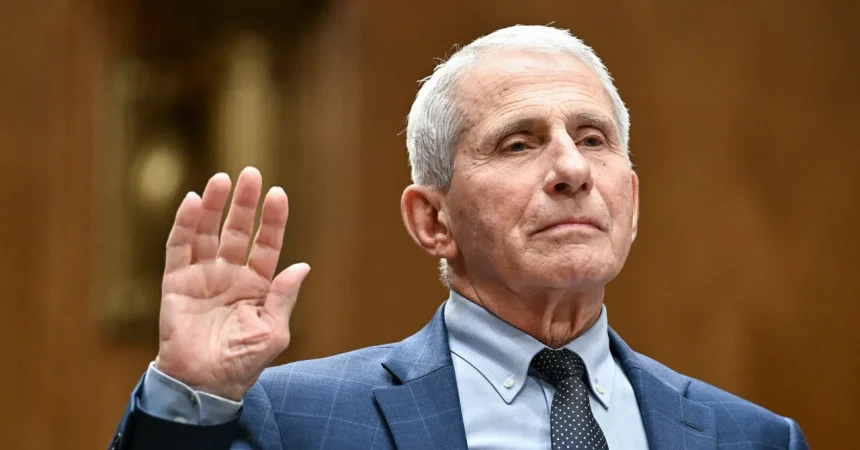
The recent congressional hearing featuring Dr. Anthony Fauci has sparked a firestorm of political rhetoric that highlights the deep, ongoing divisions within American discourse regarding the COVID-19 pandemic. Following the hearing, where Fauci invoked his Fifth Amendment right against self-incrimination over 100 times, prominent figures in the MAGA movement and various Republican lawmakers reacted with intense vitriol, openly calling for his imprisonment. Influencers like Steve Bannon and Matt Walsh questioned why the former White House medical advisor was not immediately detained, reflecting a broader sentiment among his critics that his silence was an admission of wrongdoing. This reaction underscores how the legacy of the pandemic has morphed into a battleground for political vengeance, where public trust has been replaced by demands for criminal accountability.
Dr. Fauci’s decision to remain silent was, in his view, a necessary shield against what he characterized as an “unhinged obsession” on the part of Senator Rand Paul. In his opening statement, Fauci argued that the hearing was not a legitimate fact-finding mission but a calculated attempt to coerce him into making statements that could be used as a pretext for imprisonment. He framed Senator Paul’s persistent accusations—particularly those surrounding the origins of the virus—as a political vendetta rather than an earnest pursuit of scientific truth. By invoking his constitutional protections, Fauci signaled that he viewed the committee’s environment as inherently hostile and legally precarious, effectively choosing to endure the optics of silence rather than participate in what he deemed a performative interrogation.
Legal analysts, however, are now left to parse the complex reality of whether this political theater could ever translate into actual legal consequences. The conversation has been complicated significantly by the fact that Fauci was granted a preemptive pardon by President Joe Biden last year. This executive action shields him from federal prosecution for any actions taken between 2014 and 2025. While this pardon serves as a substantial barrier, some Republican lawmakers are attempting to challenge its reach, arguing that the acceptance of a pardon might invalidate an individual’s right to invoke the Fifth Amendment. Senator Paul, in particular, is leaning on 19th-century legal precedents, suggesting that if the legal protections of the Fifth Amendment are stripped away, Fauci could theoretically face a pathway to prosecution.
Despite the bravado from some GOP figures, the practical path to jailing Dr. Fauci remains incredibly narrow and arguably blocked by political reality. The committee is moving toward a vote on holding Fauci in contempt of Congress, which could theoretically lead to a one-year prison sentence and heavy fines. However, for this charge to carry any weight, it would have to pass a vote on the Senate floor, requiring a 60-vote threshold. Given the current composition of the Senate and the strong partisan divide, securing enough Democratic support to force such a measure through is virtually impossible. The entire exercise, therefore, appears to be as much about signaling to a base of voters as it is about actual legislative or judicial outcomes.
Historical context provides an interesting, if somewhat contradictory, mirror to these proceedings. Comparisons have been drawn to the pardons issued by former President Donald Trump, such as those for Mike Flynn and Paul Manafort, which legal scholars previously suggested might have stripped those individuals of their ability to plead the Fifth regarding certain activities. The case of Steve Bannon is particularly illustrative; having been pardoned for specific federal crimes, he was later held in contempt and jailed for refusing to cooperate with the January 6 committee regarding entirely different matters. This shows that while pardons provide a shield against past charges, they do not grant immunity from the procedural requirements of future congressional investigations, a point that Republican strategists are clearly hoping to exploit.
Ultimately, the spectacle surrounding Dr. Fauci serves as a stark reminder of how polarized the American landscape has become. We are witnessing a collision between the public health establishment and a segment of the government that views the pandemic response as a historic abuse of power. While the noise level—filled with cries for handcuffs and jail cells—is deafening, the legal system remains anchored by constitutional protections and complex executive precedents. Whether one views Fauci as a hero of public health or a bureaucratic villain, the current situation suggests that the battle over his legacy will continue to be fought in the court of public opinion for years to come, long after the committee gavel has stopped falling.