Ah, September. The air is finally starting to get that crisp, end-of-summer bite, pumpkin spice is back on every menu, and the aisles of every big-box store are a strange, delightful graveyard of skeletons and inflatable ghosts. It’s also the season when tech companies decide we’ve had enough quiet time and start throwing new gadgets at us with the urgency of a squirrel hoarding acorns. Last week alone, Apple held its annual September iPhone event, and if you’re the kind of person who watches those keynotes with a bowl of popcorn and a healthy dose of skepticism, you know the drill by now: bigger cameras, brighter screens, faster chips, and at least one color that looks suspiciously like the one from two years ago. But last night, something a little more niche landed in the tech news cycle, and honestly, it’s the kind of thing that gets me—a person who spends way too much time staring at screens—genuinely excited. I’m talking about folding smartphones, which are still very much in their early days, but more importantly, I’m talking about E Ink devices. If you’ve ever wanted a tablet that feels less like a glowing rectangle and more like a beautifully bound book, you’ve probably wandered into the world of Boox, a company that makes some of the most interesting e-paper gadgets on the market. Last night, Boox announced its third-generation Palma, along with two other new E Ink products, and as WIRED’s resident E Ink device tester, I had to sit down and unpack all of it.
Before we get into the new releases, let’s talk about why anyone would care about E Ink in the first place. E Ink, or electronic ink, is a display technology that mimics the appearance of ink on paper. Unlike the backlit LCD or OLED screens on your phone or laptop, E Ink displays reflect light instead of emitting it, which means they’re a lot easier on the eyes, especially if you’re reading for hours before bed. They also use a fraction of the power, so devices can go weeks on a single charge, which feels almost rebellious in an era where we’re all tethered to chargers by the end of the day. The reading experience is genuinely lovely—it’s sharp, matte, and surprisingly comfortable, even in direct sunlight. Boox has been one of the biggest names in this space for years, offering a wide range of E Ink digital notebooks and tablets that run on a modified version of Android. That’s the killer feature, really. While many e-readers are locked into their own ecosystems, Boox devices let you install regular Android apps, which means you can read Kindle books, scroll through news apps, take notes in OneNote, and even check your email if you’re feeling brave enough to live a truly low-distraction lifestyle. The company’s most popular model is the Palma, a smartphone-sized E Ink device that has developed something of a cult following. It’s not a phone, but it fits in your pocket and gives you that same portable convenience while sparing you the constant buzz of notifications. If you’ve ever wanted to carry an entire library in your jacket without also carrying your doomscrolling machine, the Palma is exactly the kind of weird, wonderful gadget that makes sense.
So, what did Boox actually announce last night? Three new products: the Boox Note Air6 C, the Note Mini C, and the Palma 3. Let’s start with the Note Air6 C, because it’s the one you can actually buy right now. Priced at $580, the Note Air6 C is a new addition to the Note Air line, which I’ve spent a lot of time with while testing digital notebooks for WIRED’s buying guides. These devices are essentially E Ink Android tablets that come with a stylus, and they’re built for people who want to replace stacks of paper notebooks with something that can do a whole lot more. The Note Air6 C keeps that spirit alive and kicks things up a notch by running on Android 16, which gives it a much more tablet-like user interface and opens the door to even more apps. The C in its name stands for color, because this model features a 10.3-inch Kaleido 3 color display—a big deal for anyone who wants to mark up documents, draw diagrams, or just enjoy a colorful cover on their e-books. The new firmware also includes a feature called Dual Notes, which lets you annotate two documents side by side, making research and note-taking feel much more like working on a proper desktop setup. There are also some new AI-powered tools tucked into the software, including meeting and audio insights, which can transcribe or summarize conversations, and a document summary feature that can distill long files down to their core points.
Now, if the Note Air6 C is the full desktop-sized digital notebook, the Note Mini C is its more portable sibling, and it’s going to be a tough choice for anyone who likes the idea of a color E Ink tablet but wants to carry it around more easily. The Note Mini C also costs $580, which is interesting because you’re paying the same exact price for a smaller screen. But in this case, smaller doesn’t necessarily mean less capable. The Mini C has an 8.52-inch screen, still using that same gorgeous Kaleido 3 color display, but it’s designed for on-the-go work and for holding in one hand. It’s the kind of device you can slip into a small bag or keep by the couch, and it feels a lot more like a physical notebook than a full tablet. When it comes to power, the Mini C and the Air6 C are surprisingly evenly matched. Both models run on an octa-core processor, both come with 6 GB of RAM, and both offer 64 GB of storage. You can also expand that storage on either device up to 2 TB with a microSD card, which means you’ll never have to make agonizing decisions about which books, PDFs, or personal notes stay on the device. Honestly, the biggest difference between the Air6 C and the Mini C is the size and how you plan to use it. If you want a desk-friendly digital notebook with a generous canvas, go for the Air6 C. If you want something that feels more like a premium paperback you can pull out on the bus, the Mini C is probably the better fit. The catch is that the Note Mini C isn’t on sale yet. Boox says it’s coming soon, but for now, it’s a tantalizing gorilla on the horizon while the Air6 C is already available for purchase.
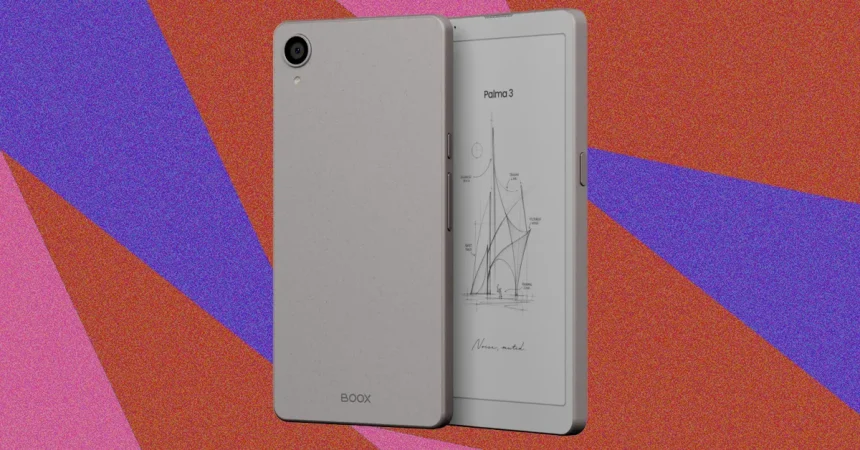
Then there’s the Palma 3, and this is the one that has my full attention. The original Palma, and its second-generation follow-up, became beloved for a very specific reason: it’s a smartphone-sized E Ink device that lets you carry your reading life in your pocket without turning into a tiny phone addict. It doesn’t make calls, but it does the things you actually want a pocket device for—reading, listening to audiobooks, jotting down quick notes, and checking a few low-stakes apps—all on a screen that feels like paper. The third-generation Palma is priced at $340, which keeps it in that sweet spot of being a serious gadget but not a major luxury purchase. What makes the Palma 3 exciting, at least to me, is that Boox has had time to refine the design, improve the software, and really think about what made people fall in love with the first two models. The announcement didn’t go super deep into every spec, which is often the case with Boox’s more teasing reveals, but for anyone who has been waiting for a worthy upgrade, the promise is already enough. I’m most excited to test this one because it represents the most unique piece of the lineup. The Note Air6 C and Note Mini C are both gorgeous, functional tablets, but they operate in a space that already has some established players. The Palma 3, on the other hand, is a genuinely distinctive device. It’s small, focused, and almost defiantly anti-distraction in a world that constantly wants our attention. I want to see how its battery holds up, how the color display looks in everyday use, and whether it can truly replace the pocket-dwelling anxiety machine we all carry around.
As the dust settles on this latest Boox launch, it’s clear that E Ink is having something of a moment. The fall tech season tends to reward flashy flagship phones and laptops, but there’s a growing group of people who are quietly looking for something different—something that feels less urgent, less glowing, and more thoughtful. Boox understands that audience. With the Note Air6 C available now for $580, the Note Mini C coming soon at the same price, and the Palma 3 arriving at $340, there’s a device for just about every kind of digital minimalist. The Air6 C is the all-rounder, the Mini C is the compact companion, and the Palma 3 is the pocket-sized escape hatch from your phone. As someone who has spent the better part of my time as WIRED’s resident E Ink device tester shoving e-readers into bags, scribbling stylus notes, and waiting for screens to refresh, I can tell you that this lineup feels genuinely promising. The color displays are getting better, the Android integration is getting smoother, and the prices, while not cheap, are starting to reflect real value. Whether you’re a student drowning in PDFs, a professional trying to keep meetings from becoming chaos, or just a reader who wants a device that doesn’t feel like another screen to stare at, Boox is making a strong case that the future of reading and note-taking doesn’t have to be as bright and buzzing as everything else in your life. I, for one, have already started clearing out space on my desk, and I can’t wait to get my hands on all three of these strange, wonderful E Ink machines.