Let’s be honest: this summer was brutal. If you stepped outside in most parts of the world, it felt less like ordinary weather and more like the planet running a persistent fever. And now we have the numbers to prove it. Copernicus, the European Union’s climate agency, reported that the month just measured tied with July 2023 as the hottest month ever recorded. Not just the hottest August, not just the hottest summer month, but the hottest month in any year since reliable global record-keeping began. The global average temperature for the month was a staggering 1.65 degrees Celsius—roughly 3 degrees Fahrenheit—above the preindustrial average. That means the kind of heat that used to be rare has become the backdrop; what we once considered a dangerous heat wave is now part of the baseline. The record book didn’t stop there. The most recent July also tied with July 2024 as the second-hottest July ever measured, and the most recent June was the second-hottest June on record. These aren’t just abstract statistics. Behind every number is a person who struggled through a suffocating night without air conditioning, a family forced to evacuate from a wildfire, a farmer watching crops wither, or a city worker trying to keep the subway system from baking. The summer of this record was not a random anomaly. It was a warning, written in weather, about the direction we are heading.
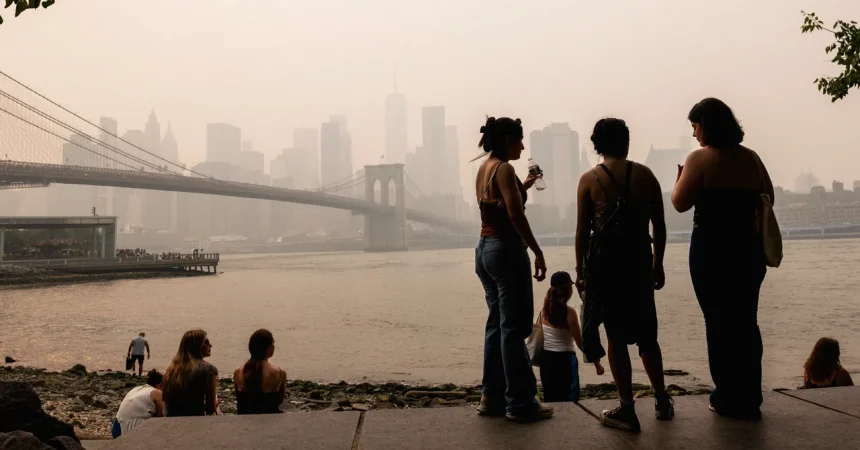
Those warnings were impossible to ignore on the ground. The National Oceanic and Atmospheric Administration announced that this was the hottest summer on record for the United States, beating a record set during the Dust Bowl of the 1930s. That comparison matters because the Dust Bowl was already a climate catastrophe—a terrifying combination of extreme heat, drought, and dust storms that destroyed livelihoods across the Great Plains. To surpass that record is not a minor achievement; it is a measure of how much extra heat fossil fuels have added to our world. Europe had its own horror story. Western Europe experienced its warmest summer ever recorded, with extreme temperatures that turned familiar cities into heat traps. Researchers estimate that as many as 35,000 people died during heat waves in Germany, France, and Spain this summer. That is a staggering toll, and it reminds us that extreme heat is not merely an inconvenience or a topic for weather forecasts. It is deadly, especially for elderly people, for those with chronic illness, and for anyone who cannot escape to a cool place. The heat also fueled wildfires that raced across parts of Europe, including the first documented fire cloud in France—a rare and terrifying phenomenon in which a massive fire creates its own weather system—and fires that threatened a key NASA observatory in Spain. In North America, wildfires in Canada and the northern United States sent thick smoke drifting into the Northeast, turning skies hazy and air unhealthy in places hundreds of miles from the flames. These fires were not isolated events; they were connected by the same overheated atmosphere.
The root cause is not mysterious. For more than a century, we have been burning coal, oil, and natural gas, releasing carbon dioxide and other greenhouse gases that wrap the planet in an ever-thicker thermal blanket. The sun’s energy arrives as sunlight, warms the Earth, and then tries to radiate back into space. But those greenhouse gases trap much of that heat, and the result is a slow, steady rise in global temperatures. This summer, that rise was made worse by El Niño, a natural climate pattern that begins with unusually warm water in the tropical Pacific Ocean. El Niño acts like a giant radiator for the atmosphere: it releases stored ocean heat, and historical experience suggests it tends to add about 0.1 to 0.2 degrees Celsius to global temperatures. That may not sound like much, but when it piles on top of decades of human-caused warming, the extra push is enough to turn ordinary hot weather into lethal heat waves and to nudge an already warm planet across critical thresholds. Samantha Burgess, the strategic lead for climate at the European Center for Medium-Range Weather Forecasts, described the past month as a remarkable moment in the global climate record. She pointed to record global sea surface temperatures and the warmest summer ever recorded in Western Europe as evidence that climate change is driving extremes across both the atmosphere and the oceans. Communities, economies, and ecosystems, she said, are feeling the impacts—and we are seeing that play out in real time.
Here is the uncomfortable twist: El Niño is not finished with us yet. Forecasts suggest that this year’s El Niño could reach record strength, but its full effects on global temperatures tend to lag behind the actual warming of the Pacific. The ocean is enormous; it takes time for all that stored heat to work its way through the world’s weather systems. That means some of the heaviest impacts of the current El Niño may not be fully felt until next year. So even though this summer was miserable, the next one could be even hotter. Scientists have long warned that crossing the 1.5 degrees Celsius threshold of long-term average warming would bring significantly worse impacts, and this summer’s readings are a sign that the world is moving rapidly toward that line. Earlier this month, the United Nations warned in a major report that the world is likely to cross the 1.5 degrees Celsius marker within a few years if emissions continue at their current rate. To be clear, a single month above 1.5 degrees does not mean the world has permanently failed that target; the threshold is measured over decades, not individual weather events. But every record-breaking month, every deadly heat wave, and every wildfire season brings us closer to a world where such extremes become routine rather than remarkable. António Guterres, the UN Secretary-General, put it bluntly: this summer’s scorching heat, raging wildfires, and deadly floods are a warning of what lies ahead. He called on the world to make the overshoot above 1.5 degrees as small and short as possible. That demands an overshoot of ambition—not more promises, but real, measurable action.
The good news, if there is any, is that the tools to prevent the worst outcomes are already available. We know how to produce electricity from the sun and the wind. We know how to make buildings more efficient and transportation cleaner. We know how to protect forests, restore wetlands, and improve farming practices that pull carbon out of the atmosphere. The obstacle is not technological; it is political, social, and economic. Fossil fuel companies hold enormous power, and our lives are built around cheap energy, but that does not change the basic arithmetic. The longer we wait, the more heat we lock into the system, the higher the seas rise, and the more dangerous every additional fraction of a degree becomes. The UN’s warning about a likely breach of 1.5 degrees Celsius is not a reason to give up; it is a reason to work harder and faster. Every tenth of a degree matters. It is the difference between a world where cities are livable and one where enormous regions become uninhabitable. It is the difference between ecosystems that can recover and those that collapse. It is the difference between summers that are stressful and summers that are dangerous. As Guterres said, we need to make the overshoot as small and short as possible. That means phasing out coal, oil, and natural gas far more rapidly than current policies suggest, investing heavily in clean energy, and helping vulnerable communities adapt to changes that are already unavoidable. It also means doing the hard work of building a world where a summer like this is not accepted as the new normal, but remembered as a wake-up call we actually answered.
So where does that leave ordinary people? It would be easy to read these stories and feel overwhelmed, or to retreat into denial. But the human response matters. We can grieve for the people who died in the heat, for the forests that burned, for the smoke-filled skies and the lost homes. Grief is appropriate. Anger is appropriate. But we cannot let those feelings turn into paralysis. We can use this summer as a reason to have honest conversations with friends and family, to support climate policies at every level of government, and to demand that companies and political leaders take the crisis seriously. We can also make changes in our own communities: planting trees, creating shaded public spaces, checking on vulnerable neighbors during heat waves, and reducing our own energy waste. No single action is enough, but together they build momentum. The climate has changed, and it will keep changing for the rest of our lives. But the future is not already written. The difference between a world that warms by 1.5 degrees and one that warms by 2 or 3 degrees is still within our power to decide. This summer’s records are a symptom of a deeper problem, and they should make us uncomfortable. Discomfort can be the beginning of action. We are the first generation to feel climate change and the last generation with a real chance to stop it. We should not waste that chance.