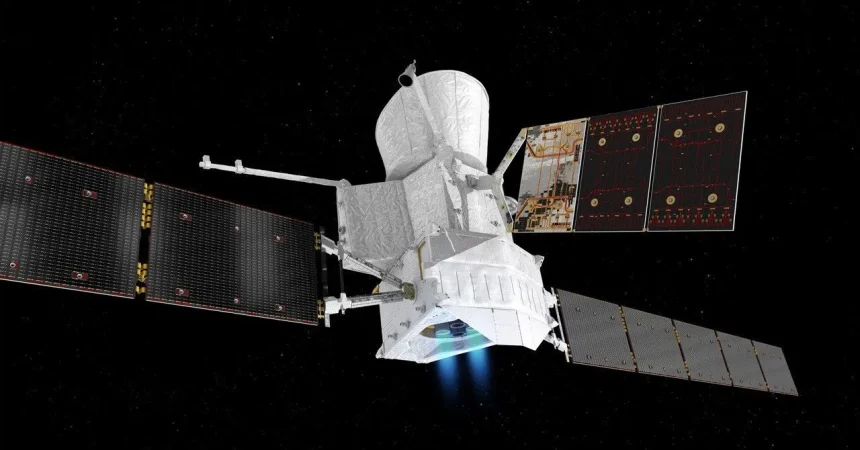
Here is the story of BepiColombo, told in six parts.
BepiColombo has been on a bit of an odyssey—and that’s not just a convenient metaphor for a long journey. The space probe is named after Giuseppe “Bepi” Colombo, the brilliant Italian scientist who figured out how to use a planet’s gravity to fling a spacecraft in a new direction, a trick that opened up the solar system to exploration. Yet even with that visionary namesake, the mission has not been smooth sailing. Originally scheduled to arrive at Mercury last year, BepiColombo hit a snag: a malfunction in its propulsion system forced mission controllers to recalculate everything. Rather than arriving on schedule, the spacecraft had to take a slower, more fuel-efficient route, pushing its arrival back by nearly a year. Now, after eight long years of traveling through the inner solar system, the plucky probe is finally beginning its descent into low orbit around Mercury. It has been a deeply human story, too, full of tense moments, setbacks, and the quiet determination of the engineers and scientists who have guided it from millions of miles away. With every delay, the team had to exercise patience; with every unexpected challenge, they had to find a creative fix. BepiColombo’s journey has never just been about reaching a destination. It has been a testament to the persistence that defines all great exploration.
On September 3, the mission crossed a major milestone. Ground control confirmed that the propulsion module—the part of the spacecraft that had steered BepiColombo through nearly a decade of interplanetary travel—had successfully separated from the rest of the craft. That separation marked the beginning of the final phase of this joint European Space Agency and Japan Aerospace Exploration Agency mission. It was a nail-biting moment, especially because the probe was more than 200 million kilometers, roughly 124 million miles, from Earth. There is no quick fix at that distance; radio signals take more than 20 minutes to travel each way, so the team could only watch and wait. When the telemetry finally arrived, confirming that all had gone smoothly, there must have been a collective exhale in mission control. After years of navigating through the darkness, the spacecraft had shed one more piece of its traveler’s gear and was now ready to face the final stretch alone. That separation was more than just a mechanical step; it was the moment BepiColombo truly became an orbiter. No longer a deep-space nomad dependent on its own thrusters, it now needs to rely on the delicate gravity of Mercury itself to hold it in place. For the engineers, it was also a bittersweet moment—bittersweet because letting go of the propulsion module is a little like cutting the last string holding a kite during a storm. Yet they knew the spacecraft was exactly where it needed to be.
To understand why this mission is so difficult, you have to appreciate just how strange it is to travel toward the Sun. Mercury is the closest planet to our star, and when you head inward from Earth, you are essentially falling. The Sun’s gravity pulls you in—powerfully, relentlessly. Reaching the small, scorched world is therefore not a matter of traveling in a straight line; it is a matter of not falling into the Sun. A spacecraft leaving Earth is already moving sideways at about 30 kilometers per second. As it gets closer to the Sun, it speeds up even more. To enter orbit around Mercury, that spacecraft has to shed an enormous amount of speed—otherwise it will just whip around the Sun and hurtle right back past its destination. This is why BepiColombo has carried so much fuel and why it has taken such a winding path. The easiest way to slow down is to use the gravity of other planets, a technique invented by BepiColombo’s namesake. By looping around Earth once, Venus twice, and Mercury six times, the probe has made nine gravity-assist maneuvers in total, using each close encounter to either slingshot itself forward or, crucially, to put on the brakes. All of that looping and swinging has added up to an astonishing 6 billion miles—nearly 10 billion kilometers—traveled since launch. It is a journey that would take a rocket traveling straight at top speed a few months, but BepiColombo has spent eight patient years tracing these graceful, complicated loops through the inner solar system.
Mercury is a world of unbearable extremes, and surviving there is a challenge that pushes the limits of engineering. During the day, the planet’s surface can reach more than 800 degrees Fahrenheit, hot enough to melt lead. At night, because Mercury has essentially no atmosphere to hold in heat, temperatures plummet to nearly 300 degrees below zero. That means a spacecraft on or near Mercury has to survive not just the most intense sunlight in the inner solar system, but also the brutal, daily plunge into the deep cold of space. It is like holding a cup of hot coffee on the surface of the Moon, watching it freeze on one side while it boils on the other. BepiColombo is designed to cope with these swings through elaborate sunshades, reflective coatings, and careful positioning—its instruments are kept in the shade of a specially designed heat shield, while solar panels are angled to avoid overheating. But even with all that technology, the probe will have to make constant adjustments to stay cool. Only two spacecraft have ever explored Mercury before BepiColombo, both launched by NASA: Mariner 10 in the 1970s and Messenger in the 2010s. Neither of them was able to stay for long, and neither circled the planet as comprehensively as BepiColombo will. The fact that we have sent anything to this scorched, inhospitable world at all is a wonder. That we now have a two-spacecraft mission on the verge of orbit is a near-miracle of human ingenuity.
Once BepiColombo arrives and settles into orbit, it will split into two separate spacecraft, each with its own mission. The Mercury Planetary Orbiter, built by ESA, will spend its time studying the planet’s surface and internal structure. It will map the craters, scarps, and volcanic plains; measure the chemical composition of the rocks; and help scientists understand how the planet formed and evolved. The other orbiter, a Japanese-led spacecraft nicknamed Mio, will focus on the environment around Mercury—specifically, the planet’s magnetic field and its extremely tenuous atmosphere, known as an exosphere. Mercury is the only other rocky planet in the inner solar system with a global magnetic field, but it is far weaker than Earth’s. By studying how that field interacts with the solar wind, scientists hope to learn more about how magnetic fields work on planets so close to a star. The two orbiters will work together, taking simultaneous measurements from slightly different vantage points, which is something no mission has ever done at Mercury before. This teamwork will allow scientists to separate the planet’s true surface features from the effects of the space environment around it, giving them a far richer, more three-dimensional picture than any single probe could capture. It is a bit like having two synchronized cameras on a safari: one looking at the lion, another watching the grass around the lion, both together revealing the full story.
The scientific observations won’t begin in full until April 2027, after the long and painstaking process of preparing the spacecraft for its new environment. That means there is still years of patient waiting ahead—years of testing instruments, calibrating sensors, and gradually easing the orbit down to its final operational altitude. The mission team has already been at this for a long time, and they know better than anyone how much can go wrong in the next few years. But they also know what is at stake. For the first time in history, we will have multiple spacecraft orbiting Mercury at the same time, watching the planet’s magnetic field and atmosphere in ways that no previous mission has been able to do. We will be able to ask fundamental questions about how planets form so close to a star, why Mercury’s core is so large relative to its crust, and whether the ice that may exist in permanently shadowed craters at its poles is real. These are more than just technical questions; they touch on the very nature of our solar system and how Earth came to be. BepiColombo’s journey has been long, difficult, and full of detours. But as it approaches the final phase of its epic voyage, the little probe named after a visionary Italian physicist serves as a reminder that great discoveries are never made by taking the easy road. They are made by those who are willing to loop back, to slow down, to endure the heat and the cold, and to trust that eventually, after all these years, they will arrive somewhere extraordinary.