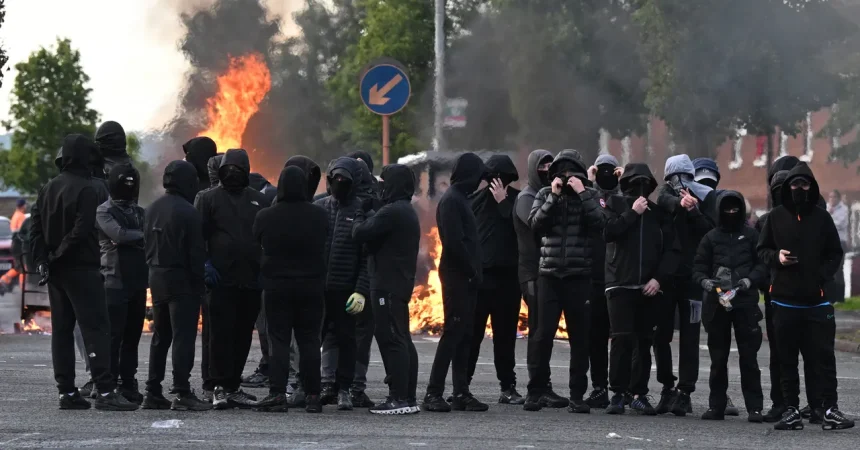
The rapid escalation of violence in Belfast following a brutal knife attack last Monday serves as a chilling case study in how digital platforms and extremist networks now function in tandem to turn local tragedies into global conflagrations. Within sixty minutes of the incident, far-right activist Tommy Robinson amplified footage of the attack to millions on X, triggering a cascade of engagement that even platform owner Elon Musk joined. This digital amplification acted as a match dropped into a powder keg; by Tuesday, the incident had been re-contextualized by international far-right figures as a symbol of an alleged “anti-white agenda.” What began as a local criminal act was effectively weaponized by an algorithmic ecosystem designed to prioritize shock value and rage over truth, setting the stage for the chaotic scenes that would erupt on the streets of Northern Ireland.
As the inflammatory rhetoric migrated from X to Facebook groups, the transition from online vitriol to physical violence became chillingly efficient. By Tuesday evening, the situation in Belfast had dissolved into acts of terror, with masked rioters targeting innocent lives. Homes believed to belong to immigrants were kicked in, set ablaze, and besieged, transforming residential streets into scenes of anarchy. While mainstream political discourse focused on the undeniable role of high-profile agitators like Robinson and the platform’s owner, the deeper, more coordinated machinery driving this unrest remained largely in the shadows. The violence was not merely a spontaneous outburst of anger; it was a targeted campaign, fueled by organized groups who saw the chaos as an opportunity to push a radical ideological agenda.
A deep investigation has revealed that the “Active Club” movement—a decentralized but potent neo-Nazi network—played a critical role in orchestrating the violence. While analysts and politicians argued over the responsibility of mainstream platforms, this global network of white supremacists was actively advising, inciting, and managing the masked youths on the ground. These groups have adapted to the digital age by creating a seamless supply chain of agitation: US-based extremist channels provided the ideological framework and tactical encouragement, while local foot soldiers translated that sentiment into domestic terrorism. This was not a localized riot; it was a collaborative project between international white supremacist factions using Belfast as a testing ground for future urban instability.
Expert observers, such as Wendy Via of the Global Project Against Hate and Extremism, warn that the Active Club model is specifically designed to exploit tragedies for recruitment and momentum. Rather than remaining passive observers, these groups functioned as a tactical support network, broadcasting guidance on how to maximize the impact of the riots and encouraging similar movements in other countries to view Belfast as a “template.” The speed with which these groups mobilized suggests a high level of professionalization. They are no longer just fringe elements sharing memes; they have evolved into a sophisticated paramilitary-adjacent infrastructure that views public disorder as a vital tool in their struggle for geopolitical relevance.
The incident that triggered this firestorm—a horrific stabbing of a local man by a Sudanese suspect—has now been buried under a mountain of propaganda. While the perpetrator was arrested and charged with attempted murder, the facts of the case were secondary to the narrative-building efforts of accounts like “End Wokeness” and channels such as “White Youth In Revolt.” On these platforms, the reality of a crime was stripped of its judicial context and reconstructed into hyper-graphic, race-based ragebait. By the time the message reached the ears of those organizing in Northern Ireland, it had been distilled into a call to arms, framed not as a pursuit of justice, but as a crusade for racial survival.
The tragedy in Belfast underscores a terrifying new reality: we are living in an era where extremist organizations can use global connectivity to achieve local devastation. When algorithmic promotion meets the disciplined, tactical coordination of neo-Nazi movements, the result is an almost immediate erosion of public safety. The “Active Club” network is not merely shouting into the digital void; they are actively training their membership to weaponize tragedy and incite real-world harm. As we look at the ruins left behind in Belfast, it is clear that until we recognize the distinction between organic social protest and the professionally orchestrated violence of radicalized networks, these “templates” for chaos will continue to be replicated across the Western world.