Imagine trying to build a faster, more powerful computer without building a entire new factory from scratch. That is the central bet of Kepler Computing, a startup that believes the future of high-performance memory lies not in endlessly shrinking transistors or constructing ever more expensive fabrication plants, but in changing the materials used to store data. Kepler is focused on a type of memory called SRAM, or static random-access memory, which sits very close to processors and acts as a super-fast short-term workspace for calculations. SRAM is essential for tasks like running artificial intelligence models, where massive amounts of data need to be read and written in the blink of an eye. But conventional SRAM is bulky, power-hungry, and difficult to scale without huge energy costs. Kepler’s answer is to use ferroelectrics, a class of materials that can switch their electric polarization under an applied voltage and hold their state without constantly drawing power. This allows memory cells to be packed more tightly, and importantly, to read and write data at lower voltages than the mechanisms traditionally used in semiconductors. For anyone who has watched chip costs climb and factories become more expensive, Kepler’s approach is refreshingly pragmatic. Rather than requiring a brand-new, billion-dollar fabrication plant, the company wants to use the manufacturing infrastructure already in place, retrofit it, and push it to the physical limits of what is possible. It is an idea that sounds simple, but behind it lies years of materials research, dozens of failed experiments, and a strong dose of engineering stubbornness.
The heart of Kepler’s technical breakthrough is a new, low-voltage composite material that works with ferroelectric switching. The company’s cofounder and chief technology officer, Sasi Manipatruni, says the team went through 35 iterations of composites before landing on a material class that they believed would make memory chips easier and cheaper to produce. That number matters, because it reveals the painstaking trial-and-error nature of chip innovation. Finding the right material is not just about chemistry; it is about making sure the material can be manufactured consistently, integrated into existing semiconductor processes, and still deliver the performance needed for demanding AI workloads. Manipatruni explains that once they solved the physics problem, especially the physical limitations of high-bandwidth memory, or HBM, the material innovation allowed them to increase the amount of memory that can fit between chips. HBM is the kind of memory used in advanced AI accelerators, and it is a major bottleneck for performance. Put simply, AI systems need to move huge amounts of data around quickly, and the memory placed next to the processor is often the thing that slows everything down. By using a ferroelectric composite that operates at lower voltage, Kepler says it can pack much more memory into the spaces between chips, while also reducing the energy required to write and read data. That is a double win in a world where performance and power efficiency are both critical.
Perhaps the most striking part of Kepler’s strategy is its relationship with existing semiconductor factories. The company has worked with GlobalFoundries, one of the world’s major chip manufacturers, and says it managed to convert an ordinary fab into what it calls a “next-generation” fab in just eight months. That may not sound dramatic, but in the semiconductor industry, typical transitions to new materials or processes can take two years or more. The difference matters because time is money, and in fast-moving fields like artificial intelligence, eighteen months can be the difference between leading and being left behind. David Olaosebikan, another Kepler cofounder, says the company’s goal is to take the fabs and architectures already built and push them to the limits of physics. This is also a deeply economic decision. Building a brand-new semiconductor plant today costs anywhere from $20 billion to $40 billion, and outfitting it with cutting-edge equipment can add hundreds of millions more. Kepler is betting that the cost of introducing new materials, retooling existing lines, and adapting established factories will be far lower than that enormous price tag. In a sense, they are saying: the factory is the asset; let’s make the most of it instead of starting over.
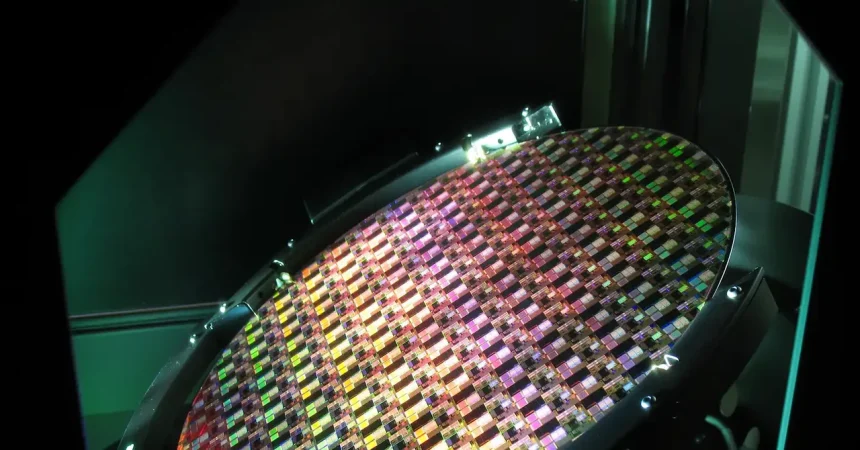
Still, Kepler has a long road ahead before it reaches full-scale production, assuming it can get there at all. To date, the company has run its technology on roughly two thousand wafers, which is a meaningful but modest amount in the semiconductor world. The startup plans to ship its first samples of HBM chips later this year, begin ramping up production in Singapore next year, and start chip production in the United States in 2028. That timeline gives a sense of how carefully the company is trying to step through the usual challenges of bringing a new technology to market. Mike Kaste, a GlobalFoundries executive involved in the collaboration, says he is confident that the fundamental breakthroughs have already happened. What remains, he says, is getting good results on thousands of wafers and millions of individual devices. This is the unglamorous part of semiconductor innovation. A lab experiment can work beautifully, but scaling it into a product that works reliably every single time, in massive volumes, at an acceptable price, is a completely different challenge. Kepler’s first samples will be watched closely, because they will show whether the material truly performs outside of a controlled research environment.
One of the biggest practical hurdles is less about physics and more about cleanliness. In a semiconductor factory, even tiny amounts of contamination can ruin entire batches of chips. Kaste points out that Kepler’s composite material includes iron in its formulation, and iron is a notoriously tough contaminant to introduce into a production facility. Once iron gets into the air or onto equipment, it can spread and damage other chips being made in the same fab. That means Kepler’s solution either has to run on dedicated equipment or be fully encapsulated so that the iron cannot escape into the surrounding environment. Kaste describes the art of the process as keeping that material really well isolated through the entire production flow. This is a reminder that innovation in chips is not only about clever science; it is about engineering discipline, facility design, and process control. The automated wafer-handling equipment used by Kepler in its dedicated test fab is part of that careful dance. Every step is designed to protect both the product and the factory, and one small mistake could carry a high price. In human terms, it is like introducing a very useful but very messy ingredient into a spotless kitchen, and making sure it never leaves the pot.
In the end, Kepler Computing is making a high-risk, high-reward gamble on a very human level. The founders are betting that cleverness, persistence, and material science can beat sheer spending power, and that the path to a faster computing future does not have to run through the construction of massive new factories. If their technology works, the implications are significant. AI systems could run faster while using less energy, memory chips could become cheaper and more abundant, and the entire industry could unlock a new wave of innovation without the crippling costs that now define cutting-edge chipmaking. But there is still plenty of uncertainty. The company has to prove that its material can be mass-produced, safely contained, and integrated into real products at scale. That means more wafers, more testing, more iteration, and the kind of patient, unglamorous work that often determines whether a brilliant idea becomes a revolution or a footnote. The story of Kepler is not just a story about technology; it is a story about people who spent months refining composites, who believed in a different path, and who are now waiting to see if the world is ready for a memory chip made from a substance that almost no one thought could work.