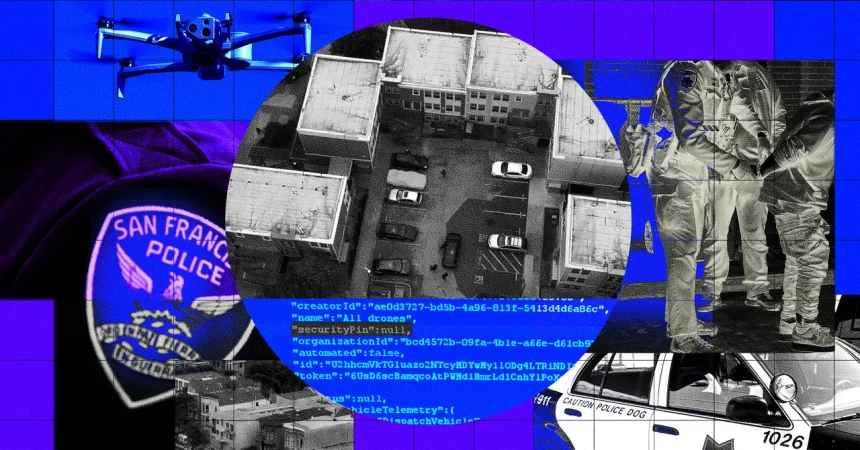
The recent, high-tech surveillance of a San Francisco man suspected of a minor vehicle-related crime reads like a scene from an Orwellian thriller, yet it represents the unfolding reality of modern urban policing. Last month, a five-pound Skydio X10 quadcopter hovered silently 200 feet above a San Francisco apartment complex, locking its zoom onto a man hiding behind a parked car. Unbeknownst to him, he had been tracked across the city by a fleet of four drones, which captured everything from his license plate to his desperate attempts to evade capture. The aerial eye remained fixed on him until police units surrounded, tackled, and detained him. This methodical, multispectral hunt, sparked by what was described as an “auto boost/strip” incident, reveals just how seamlessly police are now integrating persistent, automated surveillance into the fabric of daily life.
What makes this incident truly chilling, however, is not just the sophistication of the technology, but the massive, accidental breach of privacy that allowed it to come to light. The footage wasn’t released by the San Francisco Police Department through official channels; instead, it was leaked to the open internet via an unsecured public web address hosted by Skydio. Security researchers Sam Curry and Maik Robert stumbled upon the feed, finding that five of the city’s drones were broadcasting their real-time maneuvers—including high-definition color and thermal imaging—directly to the public. For two days, anyone with the link could watch the police conduct arrests, search through homeless encampments, and peer into the windows of high-rise apartments, turning the fundamental promise of “law and order” into a voyeuristic, unmoderated spectacle.
The scope of the exposed data is staggering, painting a portrait of a city under an constant, invisible gaze. The researchers archived 48 hours of footage, which included 60 separate video files across 20 distinct missions. Because the drones utilize both color and thermal imaging—which renders human beings as stark, glowing heat signatures—the potential for invasive monitoring is immense. Software analysis of the footage revealed that the drones had filmed hundreds of unsuspecting civilians. In a single frame captured over a bustling downtown intersection, the technology identified 34 different people, many with their faces clearly visible. This level of granular detail, captured from the clouds without a warrant or public awareness, transforms the city street into a recorded exhibition where privacy is no longer a given.
Beyond the disturbing imagery, the leak exposed the intimate technical logs that define how police engage with citizens. The archived data contained over 5,000 GPS points, mapping nearly 44 miles of flight paths, along with the precise altitude, speed, and battery status of the drones. Even the internal bureaucracy of the department was compromised, as the names and professional email addresses of six police pilots were left vulnerable within the metadata. By the time Skydio removed the feed, the researchers had amassed hours of both color and infrared footage, providing a rare and unsettling “behind the scenes” look at how these tools are deployed to track vehicles, monitor buildings, and manage citizens during routine interactions.
For privacy advocates and the researchers involved, the discovery of this open stream is a massive wake-up call regarding the unchecked expansion of surveillance technology. As Sam Curry noted, there is an implicit trust given to law enforcement to use these tools with discretion and purpose; however, when that data is mishandled or left exposed, that trust evaporates. The ease with which a random internet user could watch police zoom in on individuals—often for minor suspected offenses—highlights a fundamental shift in the relationship between the state and the public. When police departments treat drones as standard equipment yet struggle to secure the digital footprint of their operations, they are not just catching suspects; they are casting an indiscriminate, permanent, and vulnerable net over the entire civilian population.
Ultimately, this incident serves as a sobering case study on the lack of oversight inherent in the rapid adoption of drone technology by local law enforcement. SFPD, like many departments across the United States, rarely releases this footage, maintaining a cloak of secrecy over their aerial tactics. The fact that this surveillance data was broadcast to the world by accident exposes a dangerous disconnect between the capabilities of modern hardware and the security protocols meant to protect the rights of those below. As cities continue to embrace these “eyes in the sky,” the question remains whether the public is willing to sacrifice the sanctity of their daily lives for the sake of the increased monitoring power that police now hold in their hands.