Paragraph 1: The Unseen Stalker and the Silent Witness
In the quiet, predictable suburbs of Alpharetta, Georgia, a digital phantom was at work. It wasn’t lurking in the shadows of a dark alley, but rather operating within the seemingly legitimate framework of law enforcement data. This phantom was a patrolman named Dustin Bozzo, who, for months, had been engaged in a secret and, as it would turn out, deeply problematic double life. While his public persona was that of a protector of the community, a guardian with a badge, his private actions told a far more disturbing story. He was using the very tools meant to safeguard the public—sophisticated automatic license plate readers sold by the surveillance company Flock Safety—not to solve crimes, but to systematically track the movements of a former lover. It’s a scenario that many of us can relate to on a smaller, less sinister scale: the urge to check up on an ex, to scroll through their social media, to wonder who they are with. But Bozzo had access to a far more powerful, invasive, and frightening mechanism. Instead of a quick peek at a Facebook profile, he could summon up a real-time, GPS-like history of the woman’s car, a digital trail of every grocery store run, every visit to a friend’s house, every moment of her day. This wasn’t just curiosity; it was a sophisticated technological stalking campaign, and the details of its discovery and the subsequent fallout, revealed in documents obtained by WIRED, paint a chilling picture of how easily powerful surveillance tools can be twisted to serve the most personal and darkest of human impulses.
Paragraph 2: The Digital Paper Trail of a Broken Heart
The mechanics of Bozzo’s alleged misuse are staggering in their frequency and obsessive nature. The documents reveal a damning digital paper trail: between the months of March and May, Bozzo allegedly used his access to Flock’s ALPR system a staggering 56 times just to search for the license plate of his former romantic partner. And this was not a simple, one-time slip-up. It was a persistent, almost ritualistic pattern of behavior. But his surveillance didn’t stop there. In a chilling escalation that demonstrates how easily this kind of obsession can spiral, Bozzo began to notice something that troubled him. His ex’s car was frequently located in the vicinity of another police officer’s vehicle. This observation, gleaned from the very same surveillance system, triggered a new wave of obsessive checking. He then began searching for that officer’s license plate as well, adding an additional 29 searches to his already extensive list of violations during the same three-month period. The image this creates is of a man hunched over a screen, running query after query, connecting dots that likely existed only in his own head, weaving a narrative of jealousy and suspicion from scraps of location data. The power dynamic is what makes this so unsettling. This wasn’t a private investigator or a suspicious spouse; this was a sworn law enforcement officer, entrusted with a powerful tool, using it to construct a surveillance profile of a woman who had dared to move on from him. He wasn’t just looking her up; he was investigating her, treating her life as a case file for a crime she never committed—the crime of no longer being with him.
Paragraph 3: A Scandal Within the Ranks and the Inevitable Investigation
The story, however, is not just about a single officer’s misconduct; it’s a tale of a workplace scandal that had been brewing for some time. The internal investigation revealed that the relationship between Bozzo and his colleague, who served with him on the Alpharetta Police Department, was not just a personal matter. It was a direct violation of the city’s policies against workplace dating, a rule put in place to prevent exactly the kind of emotional turmoil and conflict of interest that this case exemplifies. The relationship was an open secret of sorts, with multiple colleagues reporting that the pair frequently spent an inappropriate amount of personal time together while on duty, neglecting their assigned responsibilities. This prompted a formal response from the department: the two officers were separated from their shared squad and patrol beat and issued a written directive about maintaining acceptable workplace interactions. It was a clear attempt to put a halt to the affair before it became a liability. Yet, the directive was seemingly ignored. The internal report, written by Sergeant Jabbar Braithwaite, notes a sergeant reported seeing the pair together again, this time at a “dark, secluded park” at around 2:30 in the morning. The fact that Bozzo was on duty at that hour, while his colleague was not, only added to the accumulating evidence of a pattern of behavior that was both unprofessional and a dereliction of duty. Eventually, the bureaucratic walls of a written warning proved to be no match for the powerful pull of Bozzo’s obsession, setting the stage for his fall from grace.
Paragraph 4: The Reckoning: Resignation, Denial, and the Fallout
When confronted with the evidence, Bozzo’s defense was a familiar one in cases of misconduct: he claimed his intentions were not malicious. According to the internal report, he admitted to the sexual relationship with his colleague but insisted that his use of the Flock system was not intended to cause harm or intimidation. This kind of denial—”I wasn’t trying to hurt anyone”—is a visceral attempt to downplay the profound violation of privacy and safety that his actions represented. He also claimed that their sexual relationship never occurred while they were on duty, a claim that seems to conveniently sidestep the spirit of the workplace policies they had already been warned about. It’s a classic argument of technicality versus intent. However, the sheer volume of his searches—85 in total—tells a story of its own. This was not a single, ill-conceived moment of weakness. It was a calculated and sustained campaign of digital surveillance. It transforms an illicit affair into a hostile situation, one that likely made his former partner feel watched, hunted, and unsafe in her own community. In the end, the internal investigation concluded, and on July 20, Bozzo was placed on paid leave—a temporary respite before his final day. On August 5, he chose to resign rather than face a likely termination. Lieutenant Jason Hiott confirmed the timeline, adding that a “criminal investigation” is now underway, signifying that the internal affair was only the first layer of his resulting legal and professional consequences. He lost his job and was escorted out of the department he once served.
Paragraph 5: The Corporate Enabler: Flock Safety’s Role in the Crisis
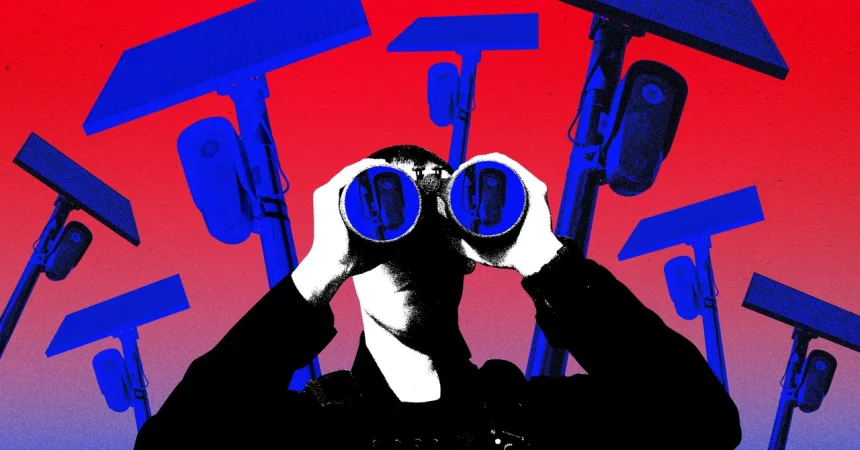
Beyond the individual failures of Dustin Bozzo, this incident shines a stark and unflattering light on the broader ecosystem that enables such misuse: the company itself, Flock Safety. The company has become a ubiquitous presence in American policing, selling its network of solar-powered cameras that capture every license plate that passes by to thousands of communities. Their promise is a smarter, more effective way to fight crime and recover stolen vehicles. But the Alpharetta case reveals a darker, far more personal cost to this blanket surveillance. Bozzo’s actions were not an anomaly; they are part of a disturbing national trend. WIRED has documented at least 45 separate incidents across the country where police officers have been caught misusing Flock’s technology to stalk or track romantic partners, both current and former. This number is likely just the tip of the iceberg, as many cases may go undetected or unreported. Flock Safety markets its product as a “force multiplier” for police, but in the wrong hands, it becomes a “stalking enabler.” The company has touted its internal auditing systems and its ability to flag misuse, but the sheer volume of these incidents raises serious questions about the efficacy of those safeguards. The core issue is one of power: when you hand a tool that provides real-time surveillance of the entire population to an individual, you are creating an enormous potential for abuse, regardless of the intentions of the vast majority of officers. For a woman trying to escape a relationship, the knowledge that her ex is a police officer with access to Flock is not a fear of being pulled over; it is the deep-seated terror of a predator who can find her car at any hour of the day or night, from the comfort of a patrol car. This case is a stark reminder that the technology we accept for our safety can be the very tool that compromises it.
Paragraph 6: This Is Not Okay: A Call for Oversight and a Human Plea
This story, ultimately, is about the human cost of automated surveillance. It takes a news story about technology policy and brings it down to the level of a single person, a woman who simply wanted to move on from a relationship but instead found herself the subject of an obsessive digital investigation by the very person who was supposed to protect her. The former officer, who has now become a civilian employee of the department, was forced to navigate a workplace where her ex-lover could not only be on the same squad, but could, at any moment, call up a map showing her exact location. The psychological toll of this kind of violation is immense. It creates a sense of powerlessness, a feeling that the walls are closing in, and a fundamental breach of trust in the system meant to provide safety. The Alpharetta PD maintains that it acted appropriately, with Chief Trent Lindgren stating that the department holds itself to a “high standard” and took “immediate action.” But this case should serve as an urgent, nation-wide wake-up call. It is no longer enough for police departments to simply have a code of conduct; they must actively and continuously audit the use of surveillance technologies, not just for misuse, but for patterns of behavior that could indicate harassment. They must implement strict protocols that require a compelling law enforcement justification for searching a private individual’s license plate. The fight for our privacy is no longer just about preventing government overreach on a macro level; it is about preventing the individual human beings with access to this digital dragnet from using it as a weapon for their own private vendettas, their own jealousy, and their own inability to let go. This case, with its raw details of a broken relationship playing out against a backdrop of police surveillance, is a testament to the urgent need for accountability, not just for the officers who abuse their power, but for the companies that profit by putting this power into their hands without robust, tamper-proof oversight. When a civil traffic tool becomes an instrument of emotional terrorism, the very foundation of our trust in public safety is shaken, and we are forced to ask ourselves: is this the price we are willing to pay?