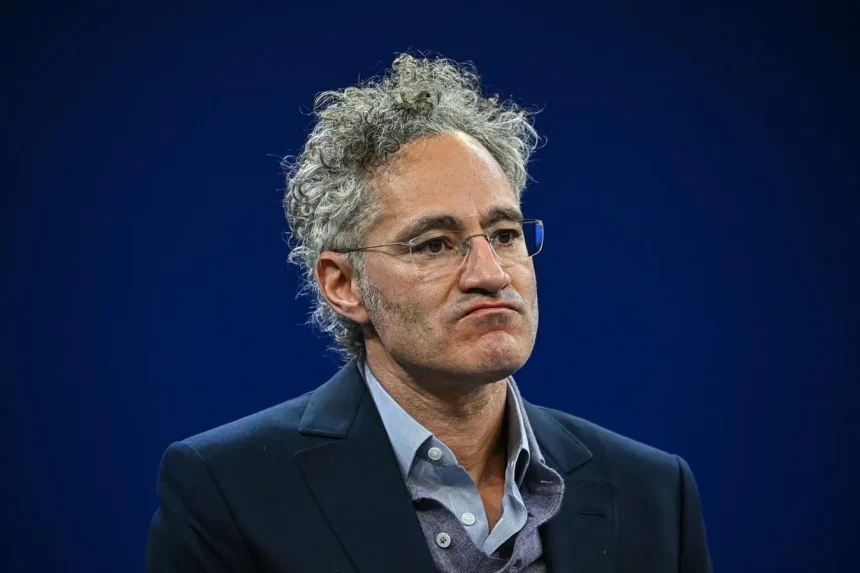
In a candid and explosive appearance on CNBC this past Wednesday, Palantir CEO Alex Karp delivered a scathing critique of the current state of the artificial intelligence industry, labeling the prevailing corporate dynamics as “effing insane.” The interview, which centered on Palantir’s new strategic partnership with Nvidia, quickly evolved into a broader indictment of Silicon Valley’s influence over American national security. Karp suggested that the rapid, unchecked integration of third-party AI into government infrastructure isn’t just a business problem—it’s a profound threat to the sovereignty and safety of the United States. By positioning Palantir as a secure alternative, Karp is attempting to carve out a massive role for his company as the primary gatekeeper for government-sanctioned AI development.
Karp’s frustration appears to be rooted in a deep-seated distrust of how leading AI firms treat their corporate and government clients. During the interview, he pulled back the curtain on conversations he has been having with other high-level executives, describing them as “livid” with the current landscape. According to Karp, these firms are essentially imposing a “wealth tax” on businesses; they charge exorbitant prices for their AI tools while simultaneously harvesting the companies’ proprietary data to train and improve their own internal models. In his view, this is a parasitic business model that exploits the users to build an intellectual monopoly, a dynamic he believes is being force-fed to the U.S. government at the expense of national interests.
The most provocative moment of the discussion occurred when Karp challenged the wisdom of outsourcing the nation’s defense to a handful of Silicon Valley tech giants. He forcefully argued that America cannot be in a position where the “battlefield of this country” is dictated or managed by the “consensus view” of a few private firms. Karp believes that national security is too critical a commodity to be left in the hands of organizations that prioritize commercial growth and experimental tech over operational security. His passion was palpable enough that even the hosts noted his apparent anger, to which Karp retorted that he was merely acting as a megaphone for the broader, unspoken frustrations of the American business community.
This friction exists against a complicated backdrop of regulatory tension and government scrutiny. Recent history shows that the Pentagon is deeply wary of the private AI sector; for instance, they previously labeled Anthropic a “supply chain risk” due to the company’s refusal to align its AI models with certain federal requirements regarding autonomous weaponry and domestic surveillance. These disputes highlight the growing rift between the Department of Defense’s strict security mandates and the rapid, often chaotic, innovation cycles coming out of labs like OpenAI and Anthropic. Adding to the noise, the Trump administration has already moved to establish federal oversight, ensuring that new models undergo rigorous scrutiny before hitting the market.
Despite the intensity of his commentary, the markets reacted with overwhelming optimism. Palantir’s stock surged more than 9% following the interview, signaling that investors are buying into Karp’s vision of Palantir as the “safe” enterprise option in an increasingly volatile AI market. Karp, whose own net worth is estimated at over $12 billion, has spent years building Palantir alongside co-founders Peter Thiel and Stephen Cohen. Their decision to take the company public through a direct listing in 2020—rather than a traditional IPO—set the tone for their unconventional, often contrarian approach to the tech establishment. Today, that defiance is paying off in both media capital and stock performance.
Ultimately, Karp’s tirade serves as a strategic maneuver to define the future of AI procurement. By framing himself and his company as the champions of “American national interest” over “Silicon Valley greed,” he is distancing Palantir from the controversies surrounding its competitors. Whether these grievances are merely a calculated business tactic or a genuine reflection of national anxiety, the result is clear: the bridge between the private tech sector and the federal government is becoming increasingly fractured. As the Commerce Department balances export controls against the need for innovation, Karp has positioned himself as an indispensable middleman, betting that the Pentagon will prefer his calculated, “security-first” approach over the experimental risks of his peers.