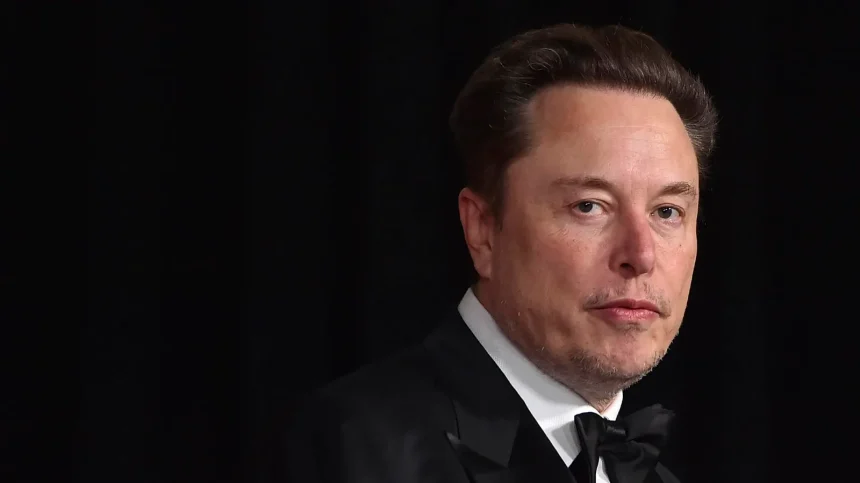
The global financial landscape remains as volatile as the rocket launches Elon Musk has become famous for, with the tech mogul recently experiencing a significant reality check regarding his personal fortune. On Wednesday, the market took a sharp turn, resulting in SpaceX shares tumbling by over 6% and effectively dipping Musk’s net worth back below the much-discussed trillion-dollar threshold. While this loss is objectively massive—totaling roughly $59 billion in a single day—it serves as a poignant reminder that even the world’s wealthiest individuals are subject to the unpredictable whims of investor sentiment and market corrections.
Despite the headlines concerning his “trillionaire status,” it is important to contextualize Musk’s current financial standing. Even with a lower valuation, he remains significantly wealthier than his closest competitors, such as Google co-founders Larry Page and Sergey Brin. His fortune is deeply tethered to the performance of his private and public holdings, particularly the 4.8 billion shares of SpaceX that react instantly to market movements. While the drop feels dramatic, it comes on the heels of a frantic period where SpaceX stock had enjoyed a 12% jump, highlighting that his current net worth is essentially riding a roller coaster of intense speculation and industry excitement.
Interestingly, the negativity surrounding the stock dip arrives at the same time as some of the most optimistic external analysis the company has seen to date. Wedbush Securities analyst Dan Ives, a long-time champion of Musk’s endeavors, recently initiated coverage of SpaceX, labeling it one of the most unique and differentiated assets in the modern tech landscape. By setting a price target of $190, Ives is signaling that he envisions SpaceX evolving far beyond just a rocket company. He portrays Musk’s venture as an emerging “hyperscaler”—a powerhouse that will eventually dominate everything from global connectivity to the complex infrastructure required for artificial intelligence.
While Musk faced temporary headwinds on Wednesday, the tech sector at large saw a massive victory for Meta’s Mark Zuckerberg. Meta shares surged by more than 10%, effectively padding Zuckerberg’s bank account by roughly $19 billion. This wasn’t just a random swing; it was driven by reports that Meta is refining a strategy to sell access to its AI computing power and sophisticated models. The move is a direct challenge to the “Big Three” of cloud infrastructure—Amazon, Google, and Microsoft—and suggests that the arms race for AI dominance is reaching a boiling point where digital real estate is becoming as valuable as traditional capital.
The recent volatility in Musk’s net worth is also tied to the complex scaffolding of his compensation structures, which have drawn significant scrutiny from regulators and financial analysts alike. Only a few weeks ago, his estimated fortune was soaring near $1.45 trillion immediately following SpaceX’s highly publicized IPO. However, a series of market corrections and a major change in how his Tesla compensation is calculated—which led Forbes to remove over $100 billion in restricted stock from his estimated wealth—have created a much more conservative valuation. The transition to a performance-based award that relies on his leadership through 2028 has essentially locked a significant portion of his wealth away, forcing observers to recalibrate what it truly means to be a “trillionaire” in the current era.
Ultimately, this sequence of events serves as a masterclass in the fragility of extreme wealth. Musk’s status is not a static bank balance, but a fluid number dictated by the market’s belief in his future ambitions. Whether it is a $50 billion loss or a $300 billion correction, the numbers are so astronomical that they often lose their tangible meaning. What matters is that, despite the day-to-day fluctuations, Musk remains the face of a technological shift that is redefining space travel, AI, and corporate governance. As the market continues to try and pin a value on these revolutionary technologies, investors should expect Musk’s net worth to remain just as high-stakes and volatile as the rockets he builds.