Stepping into XPeng’s recent showcase in Munich, you are immediately confronted by an oversized wooden Trojan horse—a tongue-in-cheek, slightly edgy statement from a Chinese automaker planting its flag deep in the heart of Germany’s automotive stronghold. At just twelve years old, XPeng is a relative newcomer, yet it has been systematically building its presence abroad since its first foray into Norway in 2020. While the brand might not crack the top ten in raw domestic sales volume compared to domestic giants, it has effectively used its international reputation as a springboard. Now, they are moving from localized experiments to full-scale global domination with a launch strategy covering 60 countries across Europe, Latin America, the Middle East, and the Asia-Pacific.
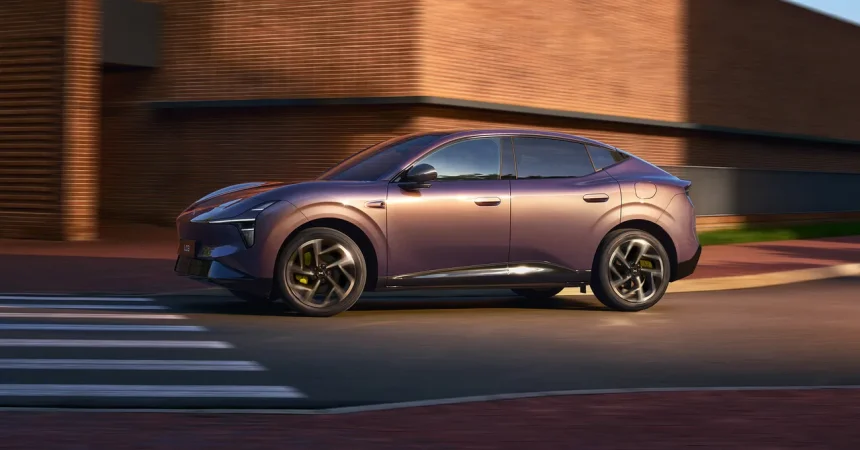
The vehicle at the center of this ambition is the L03, a bold, mass-market effort designed to make electric mobility accessible without sacrificing the premium feel of a luxury ride. Priced aggressively at around €35,600, the L03 is positioned to undercut XPeng’s own G6—a direct rival to the Tesla Model Y—making it the company’s definitive “volume car.” The message XPeng wants to convey is that budget pricing no longer necessitates a “budget” user experience. By targeting the segment occupied by established hitters like the Volkswagen ID.4, XPeng is banking on the idea that they can out-spec the competition while maintaining a price point that makes the average consumer take a second look.
What makes the L03 genuinely striking is the “everything-included” philosophy of its equipment list. Rather than nickel-and-diming customers with endless option packages, XPeng is bundling internal features that typically carry a massive markup. From a panoramic glass roof and heated/cooled massage seats to a 256-color ambient lighting system and a massive 15.6-inch 2.5K central display, the cabin is designed to feel high-end. Even the driving experience is engineered to over-deliver for the price; with a highly aerodynamic 0.228 drag coefficient, an impressive 320-mile WLTP range, and 20-minute fast-charging capabilities, the car checks all the boxes for modern electric vehicle skeptics who are primarily concerned with range anxiety and charging downtime.
Performance enthusiasts won’t be left in the dust, either. While the base model offers a respectable 7.5-second sprint to 60 mph, the top-tier trims shave that time down to a nimble 4.5 seconds. Perhaps more impressive is the technology lurking under the hood. The “Ultra” trim comes equipped with a trio of XPeng’s proprietary Turing 7-nanometer AI chips, which are specifically designed to facilitate advanced point-to-point navigation. While the car starts as a Level 2 autonomous vehicle, XPeng promises an “eyes-on, hands-off” L2++ experience expected to roll out in Europe by 2027. The beauty of this is the delivery method: owners won’t need a new car to get these features, just a simple over-the-air software update to “unlock” the next level of driving intelligence.
Of course, the road to global success isn’t without its speed bumps or branding hurdles. In its home market, this car is known as the “Mona L03,” part of a dedicated budget sub-brand. XPeng is clearly uneasy about this association, stripping away the “Mona” badge for the global release as if to sanitize its reputation for a more quality-conscious international audience. They insist that the version headed to Europe and elsewhere has been significantly tweaked and refined. Whether this is true performance differentiation or just slick marketing, it represents their attempt to shed the “budget” stigma and present the L03 as a sophisticated, standalone piece of technology worthy of international respect.
Finally, it is worth keeping expectations grounded regarding just how “autonomous” this vehicle can truly become. While the Ultra trim feels like a gateway to the future of self-driving, company engineer Xianming Liu has provided a necessary dose of reality: the L03, for all its AI brilliance, lacks the hardware redundancy required for true Level 4 autonomy. It is designed to be a remarkably smart, feature-heavy commuter, not a robotaxi. For the consumer, this is likely a fair trade-off. What the L03 offers is an “above-its-class” experience—a car that manages to balance high-tech innovation with a competitive price, proving that the established giants of the auto industry have a very formidable new player to contend with.