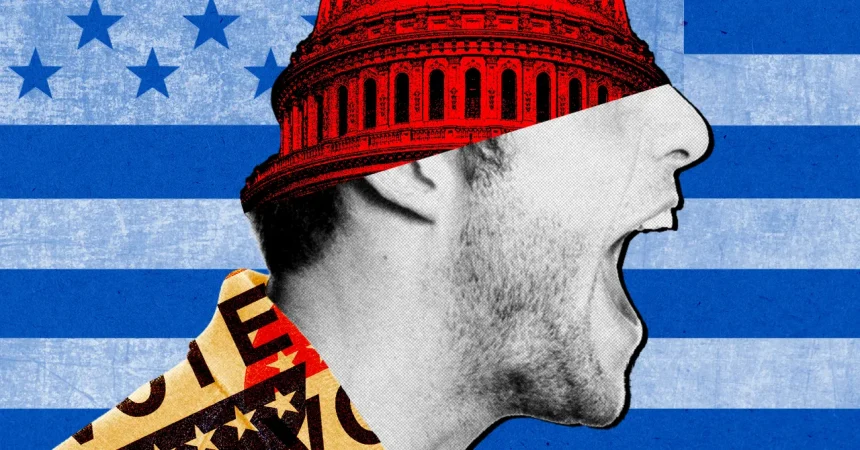
On Election Day last week, something strange and unsettling happened in the digital shadows of American politics. Nick Fuentes, a white nationalist with a small but loud following, looked at the ballot box not as a place where citizens choose their leaders, but as a launching pad for his own movement’s next chapter. He took to X, formerly known as Twitter, and told his supporters to “get out and vote Democrat today.” It was a shocking instruction coming from a man who has spent years attacking the mainstream right as weak, compromised, and too willing to abandon white Christian identity. But Fuentes was not a traitor to his cause. He was playing a longer, more dangerous game. The post itself became a kind of performance, drawing more than 12 million views as it ricocheted across the platform, provoking outrage from conservatives, confusion from liberals, and a kind of knowing glee from the far-right fringe. Then the election results came in, and Democrats swept to victory in key races across the country. To most observers, it looked like a repudiation of Trumpism. To Fuentes and his followers, it looked like an opening. On Telegram, he took credit for the outcome and called it “the Groyper Effect,” a reference to the nickname given to his fervent young supporters. In the days that followed, he insisted that the Democratic wins were not a setback for his movement, but a necessary stage in the collapse of the old order. The suffering that might come under Democratic rule, he argued, would ultimately push ordinary Americans into the arms of the far-right. It was a chilling reminder that for extremists, elections are not about governance. They are about gathering strength from the wreckage.
In a livestream after the results, Fuentes laid out his reasoning in chilling, almost messianic terms. “Let the Democrats rule, see how that goes,” he said, as though he were watching a costly experiment unfold. He predicted that the far left would terrorize ordinary people, that the anger would build, and that the country would eventually ask who was willing to fight back. “Only the far-right,” he answered. And then came the demand: “This is why we have to take over the right wing now.” It was not enough for him to watch from the sidelines. He wanted the machinery of the Republican Party, the institutions, the funding, the media platforms, and the grassroots energy that had made the MAGA movement so powerful. In another livestream, he addressed GOP leaders directly with a warning that sounded like a takeover bid. “It’s our party now,” he said. “You need to cooperate with us… Groypers are open for business. It has [to] be America First—and if it’s not, we’ll do it again for the enemy.” The phrase “we’ll do it again for the enemy” was a sinister reference to what Fuentes and his followers had just done: strategically voting for Democrats in order to damage the Republican establishment and accelerate its unraveling. To the outside observer, the strategy might seem incoherent, even self-defeating. But to Fuentes, the logic was simple. If the Republican Party cannot fully embrace his vision of white, Christian, America First nationalism, then it must be destroyed. If Democrats are in power, they will inevitably overreach, provoke a backlash, and create the conditions for a more radical right to rise. In that world, the political center is not a refuge. It is merely a battleground.
The same mood echoed across the broader far-right ecosystem in the wake of the midterm elections. WIRED reviewed comments from white supremacist, Christian nationalist, and other extremist groups, and found a chorus of voices attacking Trump for failing to prioritize white, Christian American values. Some declared the MAGA movement dead, not because they were mourning it, but because they saw its failure as a vindication of their own longstanding criticisms. For years, they had argued that Trump was too soft, too inconsistent, too dependent on advisors who did not share the movement’s deepest commitments. Now, with the Republican losses, they felt they had proof. The MAGA experiment had been too conventional, too focused on election mechanics, and not enough on cultural warfare. One researcher, Jared Holt, a senior researcher at Open Measures, described the phenomenon with careful but urgent language. “Many prominent figures in racist extremist movements have taken to declaring the MAGA movement dead since midterm elections,” he told WIRED, “claiming that the results validate their previous criticisms of the Trump administration and opens new opportunities for their movements to push disaffected voters toward their ideological beliefs.” The extreme right was not troubled by the Democratic victories. They were energized. They saw the incoming wave of progressive governance as a gift, a chance to say to ordinary people who might be frustrated by inflation, crime, foreign policy, or cultural change, “We told you so.” The goal is not to win elections in the short term. It is to radicalize the people who lose trust in the existing system, and to turn that distrust into open membership in movements that reject democracy itself.
There is a temptation, after reading such statements, to dismiss them as the rantings of a marginal online subculture. But the results on the ground tell a more complicated story. Even as the far-right celebrated the Democratic victory as a strategic opportunity, many of its own candidates were quietly winning races across the country. The Institute for Research and Education on Human Rights tracked 535 candidates running in statewide races who were members of at least one far-right Facebook group. These were not anonymous trolls. They were people running for state office as Republicans, with access to money, volunteers, and party machinery. Of the 476 races that had been called by last Friday, 338 of those candidates were victorious. That is a 71 percent win rate. It is true that the vast majority of these victories were GOP incumbents keeping their seats, which suggests that the phenomenon is less about a wave of new extremists taking over than about a party that has already normalized extremism as a routine part of its coalition. Still, the numbers are frightening. Consider the case of Marshall Rawson, a 34-year-old citrus farmer from Florida who attended the Unite the Right rally in Charlottesville in 2017, the violent gathering where counterprotester Heather Heyer was killed. In the state’s 10th District State House race, Rawson easily defeated his Democratic opponent. He did not need to hide his past. In the new political climate, it was not a disqualifier. He is now a state legislator. This is the deeper reality that the internet-age extremists understand: the loudest voices on social media can be dismissed as losers, but the quieter work of running for school boards, state houses, and local offices is where movements actually gain power. While Fuentes brags about viral posts, people like Rawson are taking their seats at the table, and once they are there, the table itself begins to shift.
To humanize this story is to remember that these are not abstract ideological shifts with no cost. Behind the numbers, there are real people who will be affected by the normalization of white nationalism and Christian nationalism at every level of American life. There is the young family in a suburban district whose new school board member genuinely believes that public schools are a vehicle for anti-white indoctrination. There is the immigrant community in Florida watching a man who marched with white supremacists in Charlottesville hold the power of a state legislator. There is the growing number of ordinary Americans, struggling with economic uncertainty, worried about crime, frustrated by cultural change, who become the target of a propaganda machine that tells them their problems all have one cause: a society that has abandoned white, Christian, masculine authority. The far-right’s strategy is fundamentally about human pain and human fear. It does not meet people with a better argument. It meets them with a story that gives them someone to blame, and that story can be very seductive. It offers belonging to the angry, purpose to the confused, and a promise of restoration to those who feel they have lost something precious. That is why experts like Holt and the researchers at IREHR are so concerned. The movement is not simply trying to win elections. It is trying to build a parallel political culture, one that will survive even when its candidates lose. And when they do win, as they have in hundreds of races, they are not just another politician. They are part of a network that shares language, symbols, and goals, a network that dreams of a country very different from the one we live in now.
The midterm elections will be remembered as a setback for the extreme edge of the Republican Party, but that memory may be dangerously incomplete. Yes, some of the most openly extremist candidates lost their races. The voters in many places rejected the loudest voices. But the movement is not defined by defeat. It is defined by its ability to turn defeat into fresh energy, to reinterpret loss as a necessary cleansing, and to prepare for the next round. Fuentes and his allies understand something that many moderates refuse to accept: the arena has changed. They no longer care about being respectable. They no longer care about the old rules of political party loyalty. They are willing to vote for their enemies if it helps them later destroy their friends. They are willing to spend years in the wilderness if it means emerging with a more radicalized following. That is why the response to this moment cannot simply be celebration or relief. It has to be sober attention to the local officials, the school boards, the state houses, and the online spaces where ordinary people are being pulled into increasingly extreme worldviews. The story of the 2022 midterms is not just a story of blue victories and red defeats. It is a story of a far-right movement developing a new strategy, one that treats the democratic system itself as a tool, not a commitment. The people who care about a multiracial, pluralistic, democratic future need to pay close attention. Because while the rest of us were looking at the national results with a sense of normalcy, the extremists were looking at the wreckage and calling it opportunity. And in the quiet corners of the internet, the Groypers and their allies are already planning for what comes next.