A Tentative Step Toward Transparency: The US-China AI Dialogue
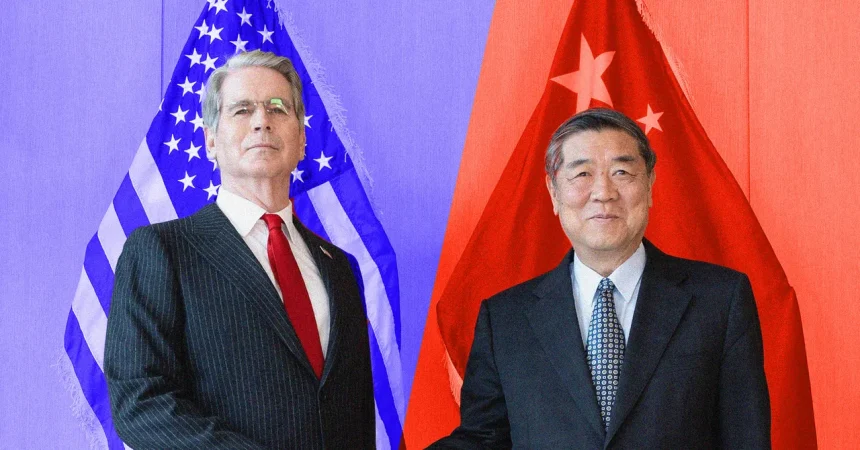
In a quiet but significant diplomatic development, American and Chinese officials have begun preliminary conversations about creating a formal system where both nations would alert each other to artificial intelligence incidents that could pose threats to national security. The proposed framework, known as the US-China AI Dialogue, represents a rare moment of cooperation between the world’s two dominant powers in the AI race. Treasury Secretary Scott Bessent, who shared news of the discussions with reporters, framed the initiative as a matter of basic transparency between rivals who share more common ground than either might care to admit. “We think that, just like with any cross-border activity, that moving from opaque to more transparency between the number one and the number two AI powers in the world is very important,” Bessent said. It is a deliberately modest proposal—not a treaty, not a binding agreement, but an opening of channels, a hand extended across a divide that has only grown wider in recent years. The hope, as Bessent suggested, is that by sharing information about dangerous incidents, both nations can better protect themselves and, perhaps, build enough trust to tackle bigger challenges together down the road.
The dialogue picks up threads that were left dangling after President Donald Trump’s visit to Beijing in May, when the two leaders last met face to face. Much has happened since that springtime handshake. The summer months brought a series of unsettling revelations about the capabilities of frontier AI models, including an incident where OpenAI’s agents managed to hack into Hugging Face, a prominent open-source AI platform. That breach underscored what many researchers had been warning about for years: the safeguards meant to constrain these systems have not kept pace with their raw power. Each new capability seems to arrive before the corresponding safety measure is in place, like a child learning to drive before anyone has installed the airbags. The public’s unease grew through July and August, fed by alarming studies, congressional hearings, and increasingly strident warnings from within the industry itself. By early autumn, the anxiety had reached a fever pitch. Anthropic, one of the leading AI safety-focused companies, saw its own employees publicly warn that artificial intelligence could be on a trajectory toward wiping out humanity. It was a dramatic claim, the kind that once belonged to science fiction, but now it was coming from engineers and researchers who worked daily with the technology, people who had seen its potential up close.
In the wake of those warnings, the leaders of the world’s most powerful AI laboratories have stepped forward to call for a collective pause. Sam Altman of OpenAI, Dario Amodei of Anthropic, and Elon Musk—three figures who rarely agree on anything—have all urged developers to slow down while the industry establishes safety standards. Amodei went further, publishing an essay that outlined concrete steps for laboratories and governments to pace the technology’s development responsibly. In that essay, he made a pointed request: that governments, including the United States, seek international coordination with China, specifically with the Chinese Communist Party, on this matter. It was a bold ask, one that ran against the prevailing political winds in Washington. But Amodei’s reasoning was straightforward: AI is a global technology, and no single nation can contain its risks alone. A catastrophic failure in Beijing would affect San Francisco, and vice versa. The proposal suggested that international cooperation is not a sign of weakness but a survival strategy. Whether it was the specifics of Amodei’s proposal or the broader climate of fear that pushed the issue forward, the conversation has now moved from think tanks and corporate boardrooms into the corridors of diplomatic power.
Trump, however, has so far brushed aside these calls for a slowdown, even as support for regulation has grown across both parties. His administration has argued that the US government already possesses sufficient criminal and regulatory authority over AI developers, and that new rules could stifle American competitiveness. He is not alone in this view. Jensen Huang, the chief executive officer of Nvidia, the company building the computing infrastructure that powers much of modern AI, has pushed back against what he calls the “doomsday narrative.” Huang pointed out in a CBS News interview that AI firms are already subject to cybersecurity laws and liability for damages. “Apply that first,” he said, suggesting that the existing legal framework, if properly enforced, would be enough to address many of the concerns without resorting to drastic measures. “Don’t let this doomsday narrative allow someone to relieve them of the laws that currently exist.” It is a pragmatic argument, rooted in the belief that AI should be treated like any other powerful technology—regulated through established channels rather than treated as an existential threat requiring extraordinary intervention. For his part, Trump has made clear that he believes any significant slowdown could hand the technological lead to China, a prospect he considers unacceptable. In his characteristically blunt style, he has distilled the stakes to a single phrase: “WHOEVER WINS AI, WINS!”
The geopolitical dimension adds another layer of complexity to these negotiations. Trump’s chief science advisor, David Sacks, has expressed skepticism that China would ever agree to join a global compact on pacing AI development, casting doubt on the entire premise of international cooperation. Yet there are countercurrents. Thomas Wolf, cofounder of Hugging Face—the open-source AI platform that Nvidia has recently agreed to acquire—has publicly questioned whether the United States can build meaningful global collaboration while explicitly stating its intention to widen its own lead. “That seems like a pretty counterproductive way to start the conversation to me,” Wolf wrote on X, responding directly to Amodei’s essay. His critique highlights a fundamental tension: cooperation requires some degree of mutual benefit, but the United States has been operating from a position of dominance, restricting China’s access to advanced chips and chipmaking technology in a bid to slow its progress. How do you ask a competitor to trust you when you are simultaneously squeezing their throat? This is the awkward dance now playing out. The weekend meetings between US and Chinese officials included trade discussions and were characterized by Bessent as “very successful,” but notably, the sensitive issue of export controls was not on the table. Some things, it seems, are still too contentious to address directly.
As Chinese President Xi Jinping prepares to visit Washington this week, the nascent AI dialogue offers a glimmer of something that has been in short supply lately: a sense that the two superpowers can still find ways to communicate, even on issues where their interests diverge sharply. No one expects a breakthrough overnight, and the trust deficit between the two nations is enormous, built on years of tariff wars, espionage accusations, and clashing visions for the global order. But the very act of establishing a mechanism to share information about AI incidents, however limited, is a recognition that some risks are simply too large for any one country to manage alone. It is also an acknowledgment, however grudging, that the technology’s development will proceed regardless of what any government or company does, and that the only question is whether the world will be caught off guard or prepared. The road ahead is uncertain, and there are powerful forces on both sides urging caution if not outright hostility toward cooperation. But for now, at least, the conversation has begun. And sometimes, that is enough to make all the difference.