There was a time, not so long ago, when Donald Trump seemed to possess an almost magical television presence. Long before the MAGA rallies, before the impeachments, before the flood of indictments and courtroom appearances, he was the man who walked into a boardroom, gestured to the camera, and made viewers believe that business was a blood sport. Millions of Americans knew him not through bankrupt casinos or tabloid headlines, but as the swaggering host of The Apprentice, a show where aspiring entrepreneurs competed desperately for the chance to work in his real estate empire. The premise was simple, the editing was sharp, and the result was a cultural phenomenon—at least for a season or two. Trump loved to brag that the show was a primetime juggernaut, and while the ratings actually slipped year after year, his claim seemed less important than the image it created. What mattered was that he sounded like a straight-talking CEO, a man of action who could size up a person in seconds and deliver the iconic verdict: “You’re fired.” That catchphrase became a part of the American vocabulary, and when he rode down the escalator in 2015 to announce his run for president, he was selling not a policy platform, but a persona—the successful, unbreakable titan of television. There was, of course, a secret hidden behind that illusion. The Trump we saw on The Apprentice was a carefully edited construction. His rambling, circuitous, often incoherent speech was chopped and rearranged in post-production to make him sound crisp and commanding. His sharpest lines were often crafted by producers, not by Trump himself. But the audience didn’t know that, and perhaps he forgot it too. The man was the show, and the show was the man.
Today, that television firepower is gone. The contrast between President Trump’s old media magic and his current media reality could not be starker. His latest press secretary, Katie Zacharia, lasted just five days on the job before being ousted after a disastrous, on-camera performance at her very first briefing. It was a moment that would have been unthinkable in the Apprentice era. Back then, Trump surrounded himself with communicators who could sell ice to an Eskimo, but now the administration’s public face crumbles in under a week. The press room, once a stage for sharp rhetorical combat, has become a revolving door of misfires and embarrassment. And Trump himself? His own appearances have become increasingly unglued. He falls asleep at events and in meetings, sometimes in the middle of a sentence. He claimed, in one televised forum, that NATO “gave” Greenland to the United States, a bizarre statement that left even his allies struggling to explain what he meant. At a rally, he told his audience about checking out Senator Jon Husted’s backside, a remark that seemed more suited to a locker room than the highest office in the land, and certainly a far cry from the crisp boardroom discipline of his signature show. The contrast is painful. The man who once commanded the screen with a smirk and a one-liner now seems to wander through public appearances like a man who has lost his script, his teleprompter, and his sense of time and place. It is almost as if the editing rooms that once made him look so compelling have vanished, revealing what was always underneath: a tired, impulsive, and increasingly erratic performer who no longer knows how to play the part that made him famous.
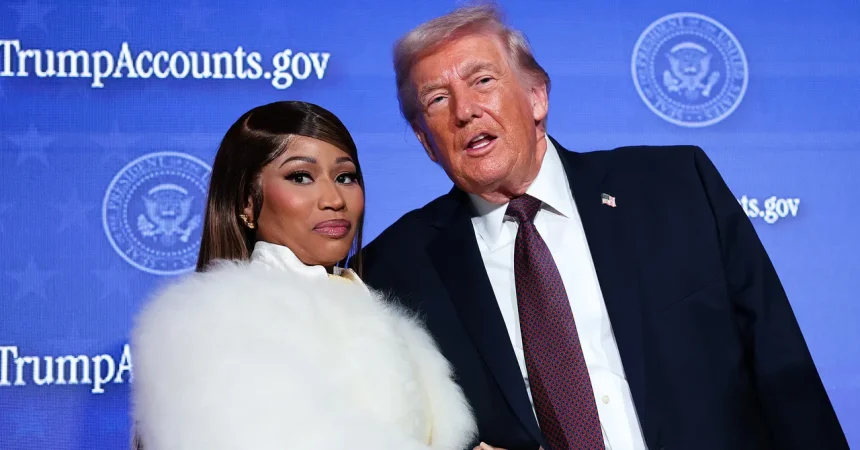
Perhaps that is why, during Trump’s second term, his administration has tried so desperately to manufacture its own television moments. The White House can no longer rely on the major networks, cable news, or even the mainstream media to package its message in flattering ways. So instead, it has attempted to build a parallel broadcast universe, streaming content that resembles familiar TV formats but carries the unmistakable stamp of government propaganda. On Tuesday, the Small Business Administration streamed an hour-long special called the Million Dollar Pitch Competition. The idea, on paper, was a game show. Five business owners would present their companies before three celebrity judges: property investor Grant Cardone, rapper Nicki Minaj, and Airbnb cofounder Joe Gebbia—whose role as a member of Elon Musk’s DOGE operation was conveniently left out of the introductions. The winner would receive a piece of a $1 million cash prize, courtesy of Clover Network, a fintech company that provides point-of-sale systems. Hosted by actor Dean Cain, the show was styled as a hybrid of Shark Tank and American Idol. It had judges behind a desk, nervous entrepreneurs in the spotlight, and a dramatic tone that suggested something important was at stake. But the result was not entertainment. It was a bore. It was a test run of government-produced reality TV, and it did not sit comfortably in any recognizable category. The pacing was slow, the stakes were confusing, and the whole affair felt less like a celebration of American small business than a half-hearted attempt to prove that the Trump administration was bringing factory jobs back to the mainland.
The details made it even stranger. For reasons that no one could quite explain, the show featured a short video in which Dr. Mehmet Oz, the administrator for the Centers for Medicare and Medicaid Services, had a conversation with an animated strand of DNA. “America’s DNA is small business,” he proclaimed, with all the seriousness of a man delivering a keynote speech at a genetic engineering convention. The segment was bizarre, unintentionally comic, and utterly forgettable, yet it somehow captured the clumsy spirit of the entire production. The judges, meanwhile, seemed far more interested in sizzle than substance. They spent less time questioning the financial fundamentals of each business plan than they did evaluating how energetic the presenters were. At one point, Marshall Sasse, the owner and CEO of a pressure valve company in Wyoming, gave a solid but subdued pitch. He knew his numbers, he knew his industry, and he made a reasonable case. But Nicki Minaj was not impressed by his presentation style. She asked whether Sasse had access to any “cowgirls” who could have added “more punch to the pitch.” The question was flippant, perhaps intended to be playful, but it exposed the show’s core problem: the judges were looking for entertainment, not entrepreneurship. They were casting for reality TV personalities, not for actual business acumen. And in doing so, they perfectly mirrored the administration’s broader approach to governance—style over substance, spectacle over competency, with the cameras always rolling but somehow never capturing anything truly compelling.
Trump himself did not appear in the live boardroom portions of the show. Instead, he was presented in short, pre-recorded segments where participants were invited to meet him in the Oval Office. It was a strange kind of cameo, one that underlined how far his television powers had fallen. When the judges asked the president for advice on picking a winner, Trump responded with a memory of his former glory. “You know, it’s interesting,” he said, “because with The Apprentice, I had a very good term that I used: ‘You’re fired.’” The line was meant to be nostalgic, a wink at the audience that remembered when Trump was the king of prime-time. But it landed with a thud. He was not the decisive, threatening boss anymore. He was a visitor in his own building, a man wheeled out for a few seconds to remind viewers of a catchphrase that had lost its lustre years ago. It was almost sad. The Million Dollar Pitch Competition was supposed to prove that the administration could still produce compelling media content, that it could bypass traditional journalism and speak directly to the American people in a language they loved. But the show demonstrated exactly the opposite. It was a hollow imitation of everything The Apprentice had been, without the sharp editing, without the drama, without the star power, and without the coherent storytelling that once made Trump seem larger than life. Nobody was watching, nobody was talking about it, and nobody was moved by it. It simply faded into the endless stream of digital nothingness, another attempt by an administration that has lost the very thing that once made it mesmerizing.
And that, perhaps, is the moral of this strange, sad chapter in modern American politics. The magic that seemed so real in the early days of The Apprentice was always a manufactured illusion. It was a combination of clever editing, supportive producers, and a cultural moment that was ready for a certain kind of tycoon. Trump did not create that persona on his own; he simply stood in front of the camera while others made him look good. But when he entered politics, he stopped being merely a character on a show and became a real person in front of real cameras. There was no editing room to save him. His tweets were raw, his rallies were unfiltered, and his appearances were unscripted in the worst possible way. For a while, that rawness might have seemed authentic, even appealing, but the years have eroded the charm. The press secretary who lasts five days, the president who falls asleep in meetings, the DNA strands lecturing small business owners, the rapper asking about cowgirls—it all creates a picture of an administration desperately trying to regain something it never truly possessed. The firepower was never real. The television glory was a construct. And now, when the administration tries to build its own stage, the result is a ghost of the original, a pale imitation of a show that was itself an imitation of reality. President Trump may still remember the phrase “You’re fired” with nostalgic pride, but the country has seen enough. The man who once commanded the screen now cannot perform even when the entire performance is designed around him. And in the quiet that follows, the only thing left is an awkward silence, where small business owners pitch their dreams to judges who care more about cowgirls, and where the president of the United States, once the master of the television universe, is reduced to a passing memory, a catchphrase in search of a context. The curtain has fallen, the cameras have stopped, and the audience has, at last, stopped clapping.