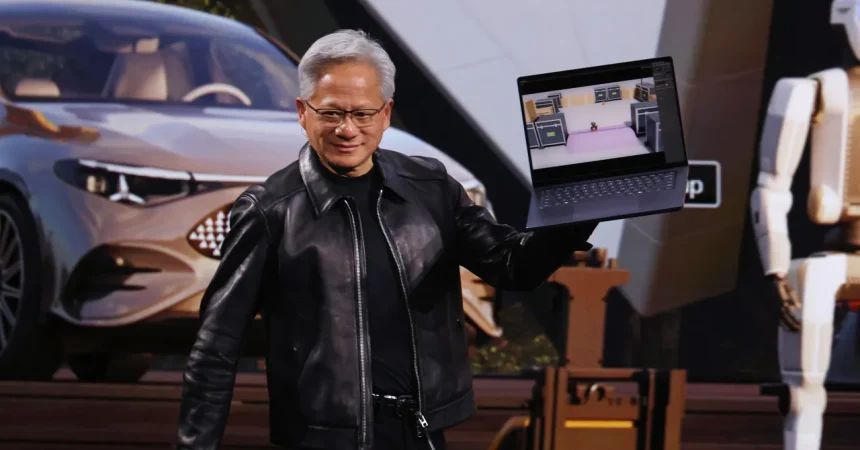
On a gray Wednesday in Berlin, inside the Tempodrom—a venue that feels like a circus tent designed by a gamer with a serious LED budget—Jensen Huang took the stage to deliver a sermon about Europe’s future. It wasn’t the distant, cautious future of think tanks and policy papers. It was a near-term, hands-on future of robots that walk, software that thinks, and data centers that arrive in metal boxes ready to plug in. The Nvidia founder and CEO stood before a crowd of roughly 4,000 engineers, entrepreneurs, and investors, and told them that Europe cannot afford to be a bystander in the artificial intelligence revolution. “To be part of this AI economy, you don’t want to just be consuming the AI. You want to be producing the AI,” he said. “We can do all of that here in Europe.” It was a classic Huang performance: part technologist, part evangelist, part pitchman. He compared the moment to other great industrial shifts, and insisted that the continent’s old manufacturing bones could become its new AI muscle. Seven months after Nvidia’s previous global conference in San Jose, where the focus was on inference and more efficient computing, the message had shifted. The new keywords were power, physical intelligence, and autonomous agents. At the end of his 90-minute pitch, a few adorable Microduck robots—small, duck-shaped machines from Hugging Face, the AI community darling—waddled around the stage, following his commands, as if to prove that the future doesn’t have to be intimidating. It can be cute, too.
Huang’s first major announcement was less about algorithms and more about the physical machinery that makes them run. He introduced the DSX Pod, a modular, plug-and-play AI factory designed to solve one of the industry’s most painful problems: building data centers takes too long. Instead of spending months or years on planning, permits, and construction, the DSX Pod arrives as a fully assembled, oversized metal container, packed with Nvidia’s latest Vera Rubin compute racks. The customer simply connects it to power and networking, and it comes online in 14 days. That is almost unthinkable in Europe, where infrastructure projects often move at the speed of glaciers and red tape. Huang called it “a complete transformation,” and for once the hyperbole seemed justified. Data centers are not just expensive; they are time-hungry. The longer a company waits to get its compute online, the longer it sits on the sidelines of the AI economy. The DSX Pod is designed to shrink that waiting period from years to weeks, and to reduce the wasteful idle time that plagues traditional facilities. For European companies that have watched American and Chinese rivals race ahead, the promise is attractive: you can now order an AI data center the way you order a prefabricated house. It won’t solve the continent’s energy problems or its tangled permitting laws, but it changes the calculus of what is possible. Huang was careful to frame it not as a product launch but as a foundation for everything else he was about to say. Without fast, reliable, scalable compute, none of the robots or agents or models matter. The DSX Pod is the concrete foundation on which Nvidia wants to build Europe’s AI future—one container at a time.
The speech was not all smooth sailing. At one point, two Greenpeace protesters stood up in the crowd and unfurled a banner that read, “Clean up your dirty business.” It was a blunt reminder that Nvidia’s chips, for all their brilliance, carry an environmental cost, and that the AI boom has a carbon footprint that no amount of technological enthusiasm can erase. Huang’s response was telling. Rather than calling for security to remove them harshly, he said, “Go easy,” as they were marched out. It was a small moment, but it humanized a man who often seems to exist somewhere between CEO and science-fiction prophet. He did not pretend the problem didn’t exist, and he did not lash out. Then he simply went back to delivering the rest of his vision. That vision now includes humanoid robotics, which Huang called the “next great industry.” He argued that Europe is uniquely positioned to lead in this field because of its long history in manufacturing, precision engineering, and industrial automation. The continent that built cars, trains, and machines for generations is now being asked to build machines that can walk, learn, and work alongside people. To that end, Huang announced partnerships with European automakers Volkswagen and Mercedes, which will use Nvidia’s platforms to develop autonomous vehicles. It was a deliberate appeal to Europe’s industrial pride: the same hands that shaped the assembly line are now ready to shape the AI economy. Huang’s message was simple: your past is not a burden; it’s a launchpad.
But humanoid robotics is only a piece of a much larger puzzle, and Huang was quick to broaden the picture. Physical AI, as he calls it, goes far beyond human-shaped machines. It is about embedding intelligence into the physical world, from factory floors to cell towers. He noted that even telecom operators are adding Nvidia GPUs to their infrastructure, turning ordinary communication equipment into distributed brains that can process data at the edge. To help developers build these systems, Huang unveiled a full-stack robotics platform designed to standardize the way robots are configured and controlled. He also introduced a preconfigured reference robot called Agile One, which will be available in the first quarter of next year. It is not meant to be a consumer product; it is a starting point, a template that developers can use to build their own physical AI systems. “This is your great opportunity,” Huang told the crowd. The phrase captured the core of his pitch: Nvidia is not merely selling hardware, it is supplying the tools for an entire generation of innovators. Whether you are a university lab in Munich, a startup in Stockholm, or an automotive giant in Stuttgart, you can take these building blocks and create something of your own. Europe, with its dense network of technical universities, deep industrial know-how, and ambitious startups, is exactly the kind of place where such an opportunity could bear fruit. But the window will not stay open forever. Huang’s urgency was not just rhetorical; it was business-minded. The future is being built now, and Nvidia wants Europe to build it with them.
Huang also had a great deal to say about software, and specifically about the way companies will use artificial intelligence in the years ahead. He predicted that every company will eventually rely on a mix of closed, off-the-shelf models and open models that are customized to their own proprietary data. Closed models offer convenience and power; open models offer flexibility and control. The winning strategy, he argued, will not be to choose one, but to use both. Nvidia, unsurprisingly, is positioning itself at the center of this hybrid approach, offering its own open-source models that, once fine-tuned on an organization’s specific data, can match or exceed frontier performance. But Huang was even more excited about agents—software programs that can reason, iterate, and use tools to complete tasks. He predicted that agents will dramatically expand the number of users of software tools, because they make complex software accessible to people who are not programmers. Instead of clicking through menus, you will simply tell an agent what you need, and it will do the rest. This sounds convenient, but it has a hidden consequence: agents consume enormous amounts of tokens, the units of text and code that AI models process. The more agents there are, the more tokens they generate, and the more computing power is required to handle them. In other words, every useful agent is a small machine for increasing demand for Nvidia GPUs. Huang was unfailingly optimistic about this loop. More reasoning, more iteration, more computation—each step makes AI more capable, and each capability creates new demands. It is a self-reinforcing cycle, and Huang is happy to supply the fuel.
By the time Huang reached the end of his speech, the audience had been treated to a whirlwind of announcements, predictions, and visions. Then came the finale: an AI-generated Eurovision song that summarized everything he had just said. It was quirky, self-aware, and a little absurd—a fitting end to a presentation that had oscillated between sweeping prophecy and hardware specs. Huang smiled, the little robots waddled, and the crowd filed out into the Berlin evening, buzzing with a mixture of excitement and exhaustion. The speech, for all its technical density, was surprisingly easy to follow, because at its heart it was not about chips or GPUs or data centers. It was about who will create the future and who will merely consume it. Huang’s answer, unsurprisingly, is that Nvidia will be the foundation—the provider of everything from the physical racks to the software agents to the open-source models. He made a compelling case that Europe can be more than a market for AI; it can be a producer, an inventor, and a leader. But the challenges are real, and the Greenpeace protesters were a reminder that this future has costs that cannot be ignored. Will Europe embrace the tools, build the systems, and write the rules? Huang seems to think so, and he is betting billions on that belief. In the end, his message was less about technology than about identity. The continent is being offered a chance to be not just a place where AI is used, but a place where it is made. Whether that means brilliant robots in factories, intelligent agents in offices, or something no one has yet imagined, Jensen Huang made one thing clear: the future will not wait for Europe, but it is still available to it.