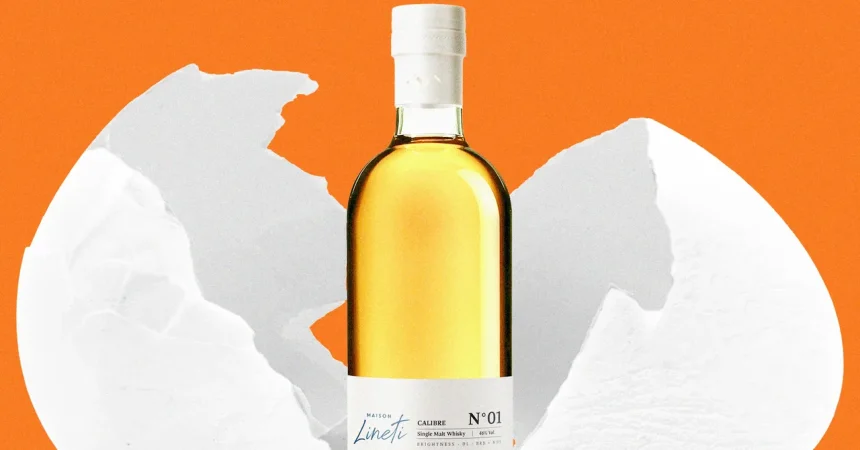
Imagine walking into a dim, cool cellar that smells of damp stone, old oak, and something quietly alive. There are barrels stacked in rows, but they are not the heavy, charred casks you expect from a whisky distillery. They are smaller, older, more delicate—the kind of barrels you might find in a Burgundy wine cave. On a table sits a single glass of pale gold liquid. It could be a Chardonnay. It could be a mature Sauternes. But it is whisky. This is Maison Lineti, and the people who built it are doing something no one has ever done before: making single malt whisky as if it were wine. Not just finishing it in wine barrels, not just borrowing a few wine-making tricks, but treating the entire process—from grain to glass—with the philosophy, patience, and precision of a great winemaker. The result has stunned the whisky world. Critics who have tasted everything from 50-year-old Scotch to rare Japanese single casks are using words like “revolutionary” and “unforgettable.” Collectors are chasing bottles. Rival distillers are paying quiet visits. The spirit world is mighty impressed, and for good reason. This is not a gimmick. It is not a marketing stunt. It is a genuine, radical shift in how a spirit can be made, and it is happening in a small house with a name that most people had never heard of until recently. For years, whisky lovers have argued about what makes a great single malt: the peat, the cask, the age, the water. Maison Lineti has answered a different question. What if the answer is the same as it is for wine? What if it is the land, the year, and the people who refuse to hurry?
To understand why, you need to meet the founders. They are not typical whisky men. They did not grow up in Scotland, surrounded by peat bogs and copper stills. They grew up in a place where wine is not a drink but a language. Their earliest memories are of vineyards, of harvest mornings, of their grandparents tasting grapes and arguing about the weather. They learned that the best wine is not made in a factory—it is grown. It is an expression of a particular hill, a particular summer, a particular moment. But they also loved whisky. They loved its warmth, its depth, its ability to comfort and challenge at the same time. Yet the more they learned about whisky, the more they felt something was missing. Most whisky, they realized, is designed to be the same every year. The goal is consistency. The barley is bought from wherever it is cheapest. The fermentation is controlled. The barrels are chosen to produce a predictable flavor. The founders found this strange. No great wine is consistent. A great wine changes with the vintage. So they asked a simple question: what if we made whisky the way we make wine? What if we treated barley like grapes, the field like a vineyard, and each year like a unique season? The question became an obsession. They left their jobs, sold their houses, and started Maison Lineti. Everyone thought they were crazy. Their friends said it would never work. Their families worried about the money. But they had a vision, and they were willing to fail for it. They spent years experimenting, making mistakes, dumping barrels that smelled like rubber or tasted like old socks. There were nights when they sat in the cellar and wondered if they had made a terrible mistake. But they kept going. They believed that if you treat barley with the same respect as grapes, you can make something extraordinary. And slowly, very slowly, the whisky began to show them that they were right. The first good barrel was a revelation. The second was a confirmation. By the third, they knew they had something that could change the way people think about whisky.
The process they developed is unlike anything in the whisky world. It begins in the field, not the distillery. They work with a handful of small farmers who grow barley the way winegrowers grow grapes. The barley is harvested by hand, at the exact moment of ripeness, after a long growing season that allows the grain to develop complex flavors. Then, instead of using commercial yeast to force a fast, predictable fermentation, Maison Lineti uses wild yeasts—the same kind of yeasts that live on grape skins and in the air of a winery. The fermentation is slow and patient, sometimes lasting weeks. It is a risky, unpredictable process. A normal distillery would see it as a nightmare. But for the founders, it is exactly the point. The wild yeasts bring out the character of the barley and the place where it was grown. After fermentation, the liquid is distilled slowly in small copper stills. The founders take only the heart of the run, the purest and most delicate part, just as a winemaker takes only the best free-run juice. Then comes the part that really sets them apart. The new make spirit is aged in French oak barrels, many of which previously held fine wine. But the whisky is not drained off the dead yeast cells, or lees, as most whiskies are. Instead, it is left to sit on those lees for years, exactly as a great white wine might be. This gives the whisky a creamy texture, a savory depth, and a subtle complexity that is almost impossible to achieve any other way. There is no chill-filtering, no caramel coloring, no added anything. Every bottle is unfiltered, unapologetic, and alive. It is a process that requires patience, nerve, and a willingness to let nature take the lead. It is also, for a whisky maker, a kind of madness. But it is a beautiful madness, and it is what makes Maison Lineti so special. The founders do not hurry. They do not chase trends. They simply wait, watch, and taste. They know that a whisky, like a wine, cannot be rushed. It can only be guided.
The result is not what most people expect from single malt whisky. Pour a glass of Maison Lineti and hold it up to the light. It is pale gold, like a young white wine, not the dark amber of a sherried Scotch. Swirl it, and the legs are slow and elegant. Put your nose in the glass and you will not find the usual heavy vanilla, toffee, or smoke. Instead, there are white flowers, green apple, pear, lemon zest, and a strange, beautiful minerality—like wet stones after rain. There is also a faint, almost salty note, as if the barley had been kissed by sea air. On the palate, the whisky is silky, almost oily. It coats the tongue. Flavors unfold slowly: honey, chamomile, toasted hazelnut, a little white pepper, then a gentle bitterness like grapefruit pith. The oak is there, but it is not a loud, aggressive oak. It is a quiet, supportive presence. The finish is long and clean, with a lingering hint of something floral and slightly sweet. This is a whisky that does not shout. It whispers. It changes in the glass, opening up like a great wine. Some people have called it the Burgundy of single malts. Others say it is more like a mature dry sherry, but lighter and more delicate. The founders simply say it is honest. It is a whisky that tastes like the year it was made, the place it came from, and the people who made it. It is not a whisky for someone who wants a big, familiar hit of caramel and smoke. It is a whisky for someone who wants to sit quietly, pay attention, and let the spirit tell its story. It rewards patience, curiosity, and a willingness to be surprised. And in a world of instant gratification, that is a rare and precious thing.
When the first bottles were released, the whisky world did not know what to make of it. Some dismissed it as a novelty. “This is not whisky,” they said. “It is a wine pretending to be a spirit.” But then the tastings happened. Whisky writers, who had spent decades praising peaty Islay monsters and rich sherry bombs, were suddenly quiet. They tasted again. They wrote long, thoughtful reviews. Words like “revelation” and “paradigm shift” began to appear. At industry events, people gathered around the Lineti table with the same reverence they would give a rare vintage of Domaine de la Romanée-Conti. Master distillers from Scotland, Japan, and the United States flew to the tiny distillery to taste the spirit and ask questions. Some admitted they were “mighty impressed.” The bottles sold out within days. Auctions followed. Collectors began to treat Maison Lineti like fine wine, storing bottles horizontally, checking the fill level, talking about “good vintages” and “difficult years.” The spirit world—a term that includes everyone from bartenders to billionaires—has become obsessed. Not because the whisky is expensive, although it is not cheap. Not because it is rare, although it is. But because it makes you think. It challenges the idea that whisky must be big, bold, and consistent. It proves that a spirit can be delicate, variable, and alive. It also raises a question: if this is possible, what else is possible? The answer, it seems, is that the boundaries of whisky are wider than anyone imagined. Even the most traditional distilleries are now watching Maison Lineti with curiosity. Some are quietly experimenting with their own wine-inspired techniques. The revolution, it seems, has only just begun.
What does the future hold for Maison Lineti? The founders are deliberately small. They have no plans to build a giant distillery or sell to a multinational. They want to keep making small batches, each one unique, each one tied to a particular harvest. They believe that the future of whisky is not in factories but in farms, in soil, in climate, in the hands of people who care. They are also aware of the risks. Climate change means that some years will be difficult. A drought, a late frost, a rainy harvest—all of these will change the flavor of the whisky. But that, they say, is the whole point. A great wine is not the same every year. Why should a great whisky be? The founders hope their experiment will inspire others. They want the whisky world to be more like the wine world: more honest, more diverse, more connected to the land. They want drinkers to slow down, to pay attention, to ask where their whisky comes from and how it was made. They want people to understand that a bottle of whisky is not just a product. It is a memory of a season, a conversation between a farmer and the sky, a small piece of the earth captured in liquid. In the end, Maison Lineti is not just a distillery. It is a reminder that the best things in life are made slowly, with care, and with love. It is a whisper in a world of shouts. And that is something the spirit world will not soon forget. The founders themselves are not interested in fame or fortune. They are interested in the next harvest, the next barrel, the next glass. They are interested in the quiet, patient work of turning grain into something that can make a stranger stop, close their eyes, and smile. And perhaps that is the most impressive thing of all.