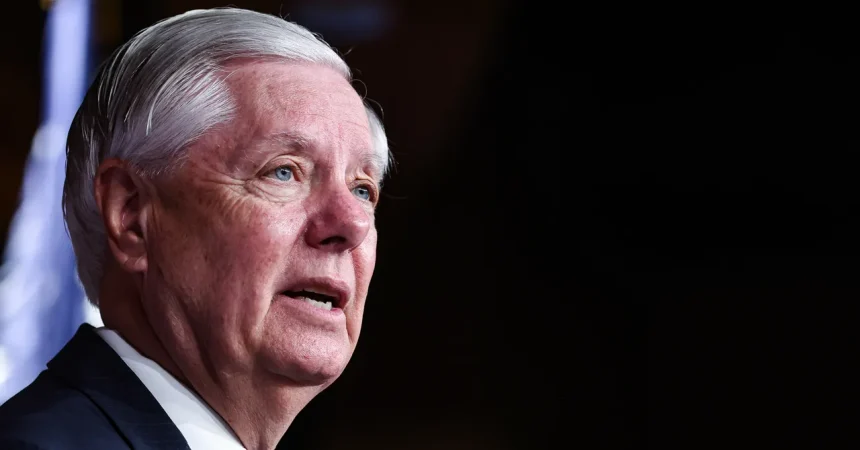
The sudden passing of South Carolina Senator Lindsey Graham, at the age of 71, has sent shockwaves through the American political landscape, but perhaps more unsettling is the immediate, chaotic reaction that followed. Only hours after the news broke that the longtime legislator had been found dead at his Capitol Hill residence, the digital sphere became a hotbed for fringe speculation. While officials from the D.C. medical examiner’s office pointed toward a preliminary finding of a natural aortic dissection—a tragic but biological event—the speed with which the public discourse devolved into dark, unproven theory highlights just how fragile the collective trust in established truth has become in our modern age.
For many, the tragedy was not a matter of health, but a high-stakes geopolitical murder. The senator, who had only recently returned from a high-profile trip to Ukraine to advocate for aggressive sanctions against Russian oil purchasers, was a polarizing figure who spent decades shaping American foreign policy. That very intensity made him a lightning rod for those who view every political death through the lens of shadow games. Within a day, social media platforms were flooded with baseless accusations pointing fingers at foreign actors, from the intelligence services of Russia to the Revolutionary Guard of Iran. It is a grim reflection of our current climate that even a quiet, private death is no longer allowed to be simply a tragedy; it must instead be framed as a global conspiracy.
The role of influencers in accelerating these rumors cannot be overstated. Figures like Laura Loomer, acting as high-volume hubs for conspiratorial thought, immediately weaponized the timing of Graham’s death to serve a pro-Trump narrative. By linking his sudden passing to recent, inflammatory rhetoric from Iran, they successfully bypassed the need for empirical evidence, opting instead for a pattern-recognition trap that keeps their followers in a constant state of alarm. When these influencers cite AI-generated propaganda videos or the routine involvement of the FBI as “proof” of an orchestrated cover-up, they exploit the public’s innate curiosity and fear to undermine institutional authority, effectively creating a feedback loop where lack of information is spun as intentional deception.
This skepticism trickles down from the fringes of the internet to individuals who present themselves as authorities—former intelligence contractors and professional commentators—who use their perceived expertise to lend a veneer of plausibility to the impossible. When commentators suggest that a medical diagnosis like an aortic dissection is merely a “perfect cover” for a chemical assassination, they do more than just spread misinformation; they deeply erode the public’s ability to accept a mundane, albeit devastating, reality. This creates a cultural environment where “natural causes” are effectively treated as a corporate or state-sponsored lie, making it increasingly difficult for anyone, let alone government officials, to provide a narrative that the public will actually believe.
The involvement of figures like commentator Marc Thiessen and financier Bill Browder further complicates the situation, as they lend a more mainstream, credible voice to the suspicion surrounding Russian involvement. By pointing to Vladimir Putin’s established history of political retaliation, they tap into real-world anxieties about international malice. However, in doing so, they blur the lines between legitimate political analysis and reckless speculation. While call-to-actions for thorough toxicological testing are scientifically sound, when they are broadcast to millions under the banner of potential assassination, they strip away the dignity of the deceased and transform a human loss into a geopolitical chess piece, leaving the public to feel as though they are being lied to by their very own government.
Ultimately, the firestorm surrounding Senator Graham’s death serves as a chilling case study for our times: we have reached an inflection point where death is no longer a private, solemn affair, but a weaponized narrative tool. As authorities work diligently to finalize their testing and toxicology reports, it is clear that for many, no amount of scientific evidence will suffice. The damage is already done, and the precedent is set—the truth now struggles to find oxygen in a room filled with the smoke of perpetual distrust. We are left with a society that is not only grieving a public figure but simultaneously wrestling with an erosion of reality, where the simple, tragic closing of a life can no longer stand on its own without being forced into an elaborate, conspiratorial frame.