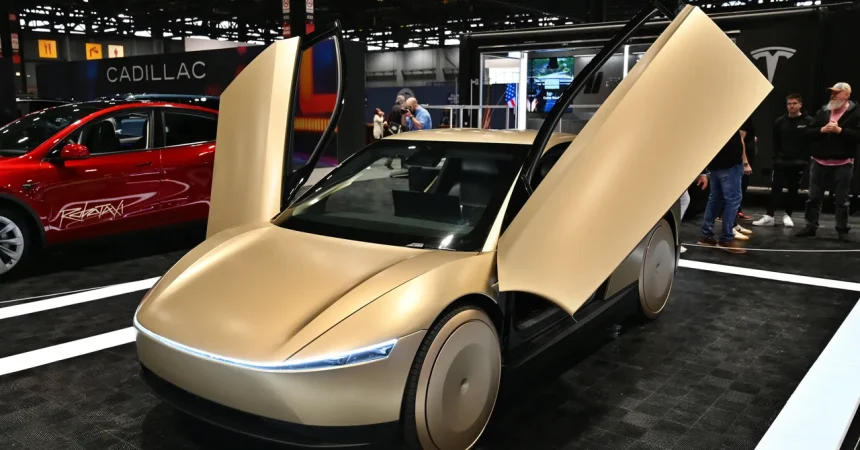
The dream of a truly inclusive autonomous future took a significant, if still distant, step forward this week. During a policy hearing before the Washington, D.C. City Council, Tesla senior policy advisor India Herdman confirmed that the company is actively developing a purpose-built, wheelchair-accessible autonomous vehicle. For the millions of people who live with mobility challenges, the current landscape of autonomous ride-hailing is often exclusionary; robotaxis, as they exist today, are largely limited to standard sedans or SUVs that assume a high level of physical dexterity. Herdman’s announcement, which noted that development is currently underway at Tesla’s Texas facilities, marks a conscious pivot toward addressing the “pain points” of existing paratransit systems, which are frequently unreliable, slow, and stigmatizing.
While the news is undeniably exciting, it is important to balance this optimism with the reality of the automotive development cycle. Tesla is famous for its lofty ambitions and its equally famous tendency to take several years to move from a concept to a production-ready vehicle. Currently, Tesla’s autonomous testing efforts in cities like Austin, Dallas, Houston, and Miami rely strictly on the Model Y, a vehicle that offers zero accommodation for those who use wheelchairs. Additionally, the highly anticipated “Cybercab”—Tesla’s vision of a steering-wheel-free future—was recently unveiled as a non-accessible platform. While Tesla has teased accessibility features like Braille controls and lowered seat heights, these are mere workarounds for the true necessity of ramp-enabled, open-floor-plan transport.
The struggle to solve this problem is universal across the tech sector, proving that the hurdle is as much physical as it is digital. Even Waymo, the current industry leader in autonomous ride-hailing, has openly admitted to the difficulties of retrofitting existing vehicle platforms to accommodate both complex sensor suites and space-consuming wheelchair ramps. Their spokesperson, Matt Walsh, was candid with the D.C. Council, noting that the industry has yet to identify a hardware platform that can safely marry autonomous technology with full, seamless accessibility. While small players like Michigan-based May Mobility have made more progress by keeping human operators on board to manage ramps, the fully autonomous, push-button-access vehicle remains the industry’s “Holy Grail.”
This technological pursuit is underscored by a profound legal and moral imperative. Under the Americans with Disabilities Act (ADA), equal access to transportation is not a luxury; it is a federal requirement. Despite this, the ride-hailing industry has historically lagged, often relying on outsourced partnerships with specialized fleets to meet accessibility needs rather than building it into their own core products. The Department of Justice’s recent litigation against Uber for failing to provide adequate, non-discriminatory service speaks to the systemic frustration felt by the disabled community. When a tech giant like Tesla promises to build from the ground up rather than relying on a patchwork of partnerships, it signals a potential shift in how accessibility is prioritized in the Silicon Valley boardroom.
History, however, warns against unbridled optimism, as seen in the rocky path taken by others. General Motors’ Cruise, for instance, once seemed poised to reshape the industry with a prototype of a wheelchair-accessible driverless taxi unveiled in 2023. At the time, it felt like a triumph for inclusivity. Yet, after a series of safety-related setbacks and public scrutiny that led to a national halt of their services, that vision essentially dissolved alongside GM’s funding for the project. The lesson is clear: in the race to be first, it is far too easy for accessibility to be sidelined when a company faces existential business challenges. For Tesla’s commitment to be meaningful, it must survive the grueling, multi-year process of testing, regulatory approval, and mass-market manufacturing.
Ultimately, the promise made in Washington this week is a beacon of hope, but one that must be anchored by execution. It is heartening that Elon Musk has signaled support for these efforts, and that a formal announcement has been made in a legislative setting. Still, until these vehicles are actually on the pavement, helping passengers navigate their daily lives with independence and dignity, the promise remains a piece of software in the making. The real test will be whether the industry can prioritize the needs of a marginalized user base as aggressively as they prioritize the efficiency of the software itself. Until a wheelchair-accessible robotaxi reaches the curb, the vision of a “transportation for all” remains a goal still in the driveway, waiting for the green light.