Just a short two-hour train ride westward from the bustling heart of Beijing, the landscape transforms into an entirely different world. The towering skyscrapers and dense concrete of the capital give way to the sweeping, golden expanses of the Inner Mongolian Plateau. This is a land of stark beauty, where rolling grasslands meet the sky and ancient, dormant volcanic cones—cinder cones—break the flat horizon like silent monuments to a fiery past. For generations, this vast and arid region has been known for two very earthly things: the shepherding of sheep and the deep, dark extraction of coal. It was a place defined by pastoral traditions and heavy industry, a resource-rich frontier that powered China’s economy in the most tangible, physical ways. However, a profound and largely invisible transformation has taken root here over the last few years. The winds that once only carried the scent of grass and dust now carry the hum of a digital revolution. Ulanqab, a city of roughly 1.5 million people nestled in this expanse, has rapidly shed its sleepy, old-world identity to become the single hottest destination in China for building artificial intelligence data centers—a metallic and silicon-fueled gold rush that is rewriting the economic and environmental fate of this otherwise tranquil outpost.
The sheer scale of this digital construction boom is almost impossible to grasp without context. Since 2016, nearly one hundred data centers have either opened their doors or broken ground in Ulanqab. But the true measure of its newfound importance lies in the colossal amount of computing power being planned. According to a recent research note from Goldman Sachs, Chinese companies have pledged to build projects with a combined estimated capacity of a staggering 12.5 gigawatts in the city. To put that astronomical figure into perspective, the celebrated $500 billion Stargate Project in the United States—OpenAI’s flagship joint venture—is slated to reach a total capacity of only 10 gigawatts when fully complete. This means Ulanqab is not just participating in the AI race; it is building the physical engine room at breakneck speed. What makes this even more astounding is the velocity of the recent commitments. Over seventy percent of that total pledged capacity has been announced in just the last twelve months, accelerating the city’s trajectory into one of the fastest-growing compute clusters on the entire Asian continent. It is a frantic, carbon-fiber-and-steel sprint to house the brains of the next generation of artificial intelligence, and Ulanqab has found itself thrust into the very center of the storm.
What exactly makes this remote plateau so extraordinarily attractive to tech giants, cloud providers, and ambitious AI startups alike? It is a confluence of geography, climate, and economics that creates an almost perfect formula for the data center industry. First and foremost, the city’s physical location is ideal. Sitting at a high elevation on the Inner Mongolian Plateau, Ulanqab is blessed with long, bitterly cold winters and a generally cool, dry climate. This isn’t just a comfort issue; it is a financial life-saver. Data centers generate immense amounts of heat, and keeping the vast server racks cool traditionally consumes enormous amounts of electricity—often accounting for a massive chunk of an operation’s total energy bill. In Ulanqab, the naturally frigid air acts as a free, natural coolant for most of the year, dramatically slashing the energy required for mechanical cooling systems. Proximity to the capital is the second crucial piece of the puzzle. Ulanqab is geographically close enough to Beijing and other major metropolitan hubs to allow for high-speed data transmission with minimal latency, ensuring that the digital services supported by these centers can reach the vast majority of Chinese users without frustrating delays. But the most alluring factor of all is the cost. Electricity in Inner Mongolia is among the cheapest in all of China, a direct result of the region’s dual energy heritage: it boasts a massive, abundant supply of cheap coal, while simultaneously experiencing explosive growth in wind and solar power generation. This perfect storm of low temperatures, usable proximity, and rock-bottom energy prices has turned Ulanqab into a veritable promised land for the infrastructure-hungry AI industry.
Perhaps the most fascinating shift happening within these dusty construction sites is not just the volume of cement and copper being poured, but who is pouring it. For the first time in China’s tech history, the nation’s pioneering AI companies are making massive, direct investments in their own physical infrastructure rather than relying on renting computing power from established cloud vendors like Alibaba Cloud or Tencent Cloud. Reports indicate that DeepSeek, the rising star of Chinese AI, is constructing a massive data center here, alongside major internet titans like ByteDance, Alibaba, and the social media powerhouse Xiaohongshu. This marks a definitive end to an era where Chinese artificial intelligence was, figuratively, a tenant. For years, Chinese AI firms spent dramatically less on building the physical hardware backbone of their operations compared to their American counterparts, even while developing extremely popular and capable models. They optimized for algorithmic efficiency, squeezing remarkable performance out of constrained resources. But this boom in Ulanqab signals a monumental strategic pivot. They are now finally pivoting to the expensive, gritty, tangible phase of the AI race, deciding that to compete at the highest levels, they must own the land, the power substations, and the server racks themselves. It is a signal that the Chinese AI ecosystem is transitioning from a phase of clever ingenuity to one of massive, capital-intensive scale, determined to match the infrastructural might of the West.
However, in the midst of this exhilarating digital construction boom, a quiet but critical problem has begun to rear its head: water. Ulanqab is profoundly arid, receiving only about 14 inches of rain each year—comparable to the climate of Denver, Colorado. The local government is already grappling with intense pressure to supply enough water to meet the basic residential needs of the people, even before the vast majority of these new data centers come online. The strain has become so acute that just last month, the local water utility was forced to implement a drastic measure: turning off several waterworks for seven hours every single night to mitigate peak demand and prevent the system from collapsing. The irony is stark. While these data centers are built specifically to capitalize on the cold, dry winters, requiring minimal additional water for cooling during those months—government weather data suggests extra cooling water is only needed for about two months of the year—the sheer, overwhelming concentration of new infrastructure still presents a monumental environmental challenge. During the late summer months, when ambient temperatures rise, the demand for evaporative cooling will spike, potentially placing a catastrophic burden on the region’s already depleting aquifers. The very thing that makes Ulanqab cheap and efficient—its harsh aridity—also makes it vulnerable. The city is being asked to fuel the digital future of a nation while simultaneously rationing its most precious natural resource for its own citizens, a tension that threatens to destabilize the long-term viability of these ambitious projects.
To understand how we got here, we have to look back at Ulanqab’s history, which spans far beyond the current AI craze. This region has been a data center hotspot for over a decade, quietly serving as a digital warehouse for China’s internet. Huawei built its first facility here in 2016, and technology giant Apple followed suit three years later in 2019. In 2021, the area was officially designated as a primary hub within a massive national government initiative known as “Eastern Data, Western Compute”—a grand plan to shift heavy data processing into the western hinterlands of the country, leaving the more crowded east to focus on user-facing applications. For a long time, however, these remote centers had a crippling flaw: they were simply too far from the populous eastern coast, resulting in high latency (or lag) when transferring data to end-users. Consequently, they were largely relegated to mundane tasks like backup storage, sitting relatively idle as digital vaults. That all changed with the meteoric rise of generative AI in 2022. As experts like Andrew Stokols, a professor at Singapore Management University studying China’s compute infrastructure, point out, the industry realized these remote locations were perfect for AI model training. Training a large language model takes months of continuous, massive computation and does not require real-time interactivity—a few milliseconds of lag are utterly irrelevant to a batch processing job. This gave the remote centers a critical, high-value purpose. Moreover, Ulanqab’s relative proximity to Beijing, enhanced by two dedicated fiber optic cables built in 2017 and 2019, has slashed average latency to under five milliseconds. This modern physical link means that Ulanqab can now seamlessly handle not just the slow, grinding work of training, but also the immediate, real-time demands of AI inference—the process of generating answers for users in real-time.
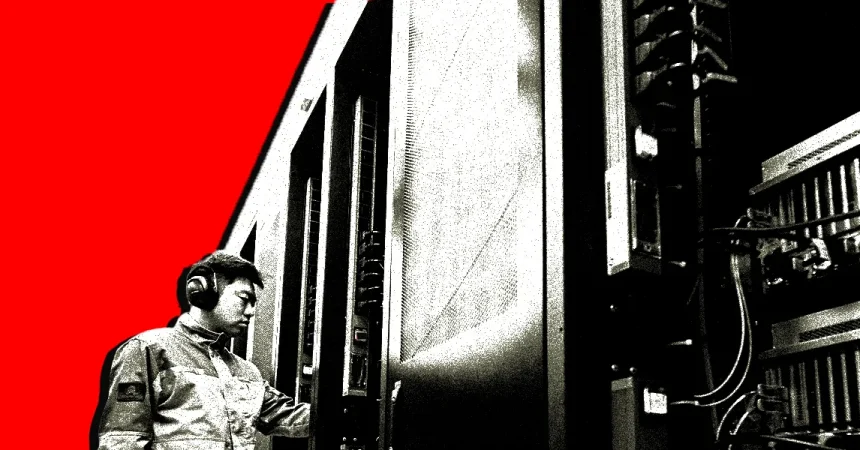
As the sun sets over the volcanic plains of Ulanqab, the silhouette of the mountains is now broken by the straight, geometric lines of colossal, windowless data centers, their exterior walls humming with the sound of cooling fans and massive electrical substations. This is the new frontier of the Chinese digital economy, a frontier built not on horseback but on 5G networks and gigawatts. The city stands as a powerful testament to the relentless surge of artificial intelligence, embodying the dramatic shift from software innovation to hardware dominance. Yet, it also serves as a cautionary tale. The digital gold rush underway here is a microcosm of a global struggle, where the hunger for compute is colliding with the fragile natural resources required to sustain it. Ulanqab is a place where enormous national ambition meets the simple, daily necessity of turning on a faucet. The arrival of these AI juggernauts has brought investment, high-tech jobs, and a global spotlight, painting a picture of a true boomtown. But the shadow of that boom hangs over the local residents, who are already feeling the pinch of severe water rationing. The race to build the AI future is not a race of pure logic and codes; it is a race of concrete, steel, water, and electricity. In the windswept grasslands of Inner Mongolia, China is learning the harshest lesson of the digital age: that silicon brains require not just data, but the very earth itself, and there is a finite supply to go around.