The penultimate Round of 16 clash at the 2026 World Cup between Argentina and Egypt wasn’t just a showcase of elite football; it became the epicenter of a worldwide firestorm regarding the integrity of the Video Assistant Referee (VAR). While fans were treated to a dramatic display of skill and grit, the narrative quickly shifted away from the goals scored and the saves made, centering instead on a series of officiating calls that many felt altered the very destiny of the tournament. The match ended in a devastating 3-2 comeback victory for Argentina, but for the Egyptian team, who had confidently stormed ahead with a two-goal lead, the bitter taste of defeat was compounded by a sense of profound injustice. The Egyptian Football Association (EFA) did not hold back, publicly questioning whether the technology intended to ensure fairness had instead become a barrier to it, ultimately filing a formal protest with FIFA to demand a full investigation into the officiating inconsistencies that silenced their dream.
For the Egyptian federation, staying silent was never an option. In a statement that resonated across the global football community, they argued that the integrity of the 2026 World Cup—a competition that belongs to the world and should be the gold standard of sportsmanship—was compromised by questionable VAR interventions. Local and international pundits alike have since analyzed the pivotal moments of the match, highlighting specific calls that shifted momentum away from Egypt at crucial junctures. This controversy has ignited a broader, more existential debate about the nature of the sport itself. Can we truly claim to have a transparent and fair game when the very tools designed to eliminate human error seem to be at the center of the controversy? The EFA’s demand for transparency serves as a rallying cry for fans who are tired of seeing games decided by behind-the-scenes reviews rather than the pure, unscripted drama of the pitch.
This incident is far from an isolated event; it represents the boiling point of a lingering tension that has plagued the 2026 tournament. Throughout the competition, critics have watched with growing frustration as goals are wiped off the board due to razor-thin, and often contentious, offside calls that seem to defy the spirit of the game. A troubling narrative has taken hold: the suspicion that VAR is not merely a tool for accuracy, but a mechanism that can be selectively utilized to tip the scales in favor of favored teams. Whether this suspicion is born of genuine bias or merely the inherent limitations of the human beings operating the machines, it has undeniably disrupted the flow of play. The spectacle of players standing around, waiting for a silent room of officials to confirm their fate, has left many longing for the days when the referee’s whistle was the final, albeit sometimes flawed, authority on the field.
These controversies invite us to peel back the layers of our reliance on technology in high-stakes sports. If VAR is intended to provide clarity, why does it so often yield more confusion? The central question persists: are these failures a result of the system’s technological limitations, or are they a failure of the people sitting behind the monitors? There is also the significant issue of training—are all officiating teams globally truly leveled in their proficiency with such a complex assistive tool? As we witness the growth of these systems, we must ask if the pursuit of “perfect” refereeing is actually killing the natural rhythm of football. The transition from a game decided by human perception to one dissected by frame-by-frame scrutiny has been anything but smooth, sparking a debate about how much technology we are willing to permit before the game loses its soul.
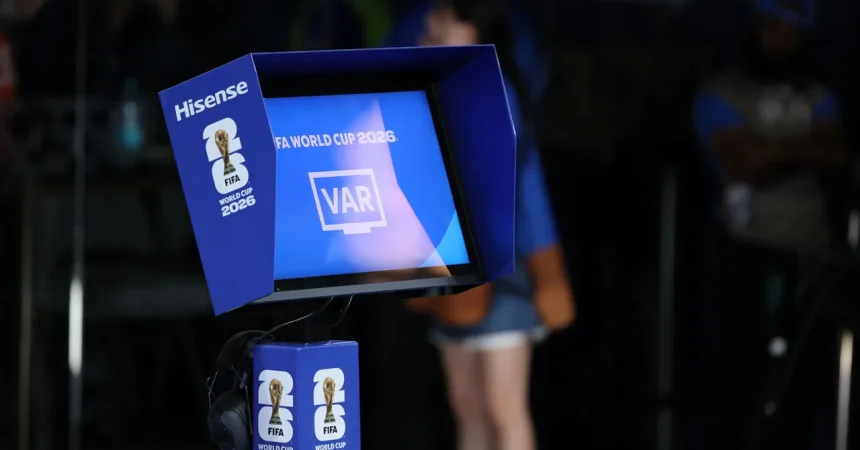
To understand the complexity of the problem, we must look at the immense machinery driving these decisions. Since its introduction in 2018, the VAR system has ballooned into a sophisticated network involving 42 broadcast cameras, including super-slow and ultra-slow-motion feeds, alongside semi-automated offside sensors. A specialized team of four—the main VAR and three assistants—meticulously pieces together these angles to advise the on-field referee, who ultimately bears the weight of the final decision. While the intent is to have another set of watchful eyes, the sheer volume of data can often lead to “analysis paralysis.” The process is designed to catch direct red cards, penalty shouts, and identity errors, but the reality is that the more power we give the system, the more the public expects absolute infallibility—a standard that is nearly impossible to meet, especially when subjective judgment is still required from the observers.
Looking ahead, FIFA continues to expand the scope of VAR, adding new triggers for intervention in the 2026 edition to address blocking, improper fouls in the buildup to set pieces, and even new behavioral rules—such as the “Prestianni-Vinícius Rule” regarding covering one’s mouth during confrontations. Former referee Armando Archundia notes that these layers are constantly evolving to keep up with the game’s complexities, yet every new rule adds another layer of interpretation. As the technology grows more pervasive, the challenge for FIFA is not just to improve the cameras or the algorithms, but to restore the trust of the players and the fans. If football is to remain the world’s most beloved game, technology must stop being the protagonist. Instead, it must return to its original purpose: a silent, secondary helper that ensures the game is won through talent and tenacity, rather than the cold, unpredictable outcomes of the monitor.