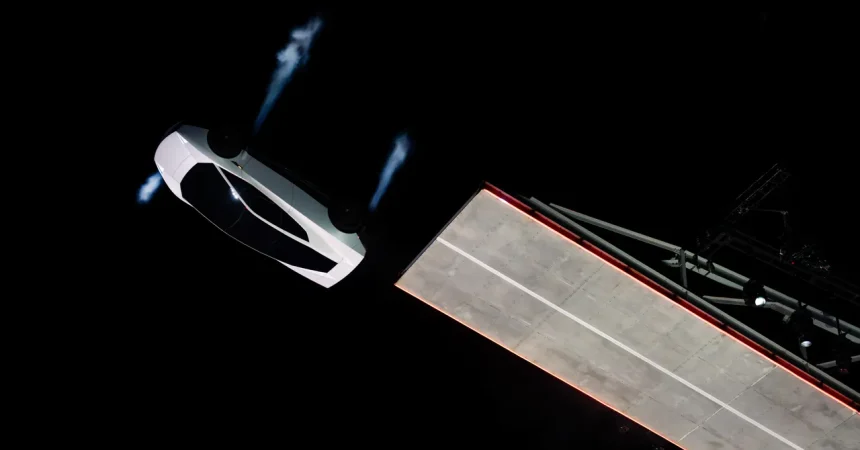
Let’s be honest: when Tesla showed the Roadster 2 driving upside down on a ceiling, the first reaction was not “look at the tire contact patch” — it was “wait, what?” It looked like a magic trick, a special effect, or a parody of showmanship. But the more interesting physics is what happens when the car comes back down and drives on normal roads. The suction system isn’t just for theatrics. It is a way of shoving the car into the pavement, and that changes everything. Cars accelerate, brake, and steer through friction between tires and road. Friction is the contact force that resists sliding; when the tire pushes backward on the asphalt, the asphalt pushes forward on the tire. The amount of friction available depends partly on how hard the surfaces are pressed together. If you press the car down with suction, you increase the normal force, and with it the maximum frictional force. That means more grip for launching, more grip for stopping, and more grip for turning. Race teams have spent decades chasing exactly this with aerodynamic wings, splitters, and sticky tire compounds. They add wings to push the car down at high speed, and they make tires wider and softer. The Roadster 2’s suction system is another way to produce downforce, and because it doesn’t rely on forward speed, it can work even at a standstill. So before you roll your eyes at the ceiling stunt, think of it as a demonstration that downforce isn’t just for race tracks; it’s a way to cheat the limits of ordinary tires. The car is essentially using the ceiling as a prop to show off something that matters on every single road: the harder you push a tire into the ground, the harder the ground can push back.
Then there is the acceleration claim. The Roadster 2 is supposed to hit 60 mph in under one second. For a conventional car, that’s basically impossible. Why? A normal car accelerates because its tires grip the road. The maximum acceleration is limited by how much friction the tires can generate. A typical coefficient of friction between rubber and asphalt might be around 0.6, though good sticky tires can do better. With a coefficient of friction of 0.6, the maximum acceleration is 0.6 g, or about 5.9 meters per second squared. To reach 60 mph, which is about 27 meters per second, you would need at least 4.5 seconds. That’s not even close to one second. Better tires and aerodynamic downforce can shave time, but they don’t change the basic rule: if all your force has to come from the contact patch, you can’t just make rubber generate arbitrary amounts of grip. You could make the car very light, but then at launch the tires might not have enough weight on them to grip. You could put a fan on the car to push down, but then you’re back to adding an extra downward force. The Roadster 2’s solution is to stop relying on friction for acceleration. It uses a different kind of force altogether: thrust. Compressed air is stored in a tank and then shot out the back at high speed. That is exactly how rockets work. It doesn’t need a road to push against; it uses the reaction force from throwing mass out the back. That lets the car blast forward at rates that would make the tires spin uselessly if they had to do all the work. The one-second 0–60 claim is plausible in a way it couldn’t be for a purely tire-driven machine.
To understand how compressed air can move a car, forget the high-tech bodywork for a second and think about a balloon. If you inflate a balloon, attach it to a toy car, and let it go, the balloon shrinks and pushes air out through the neck. That air has mass, so accelerating it from rest to the exhaust velocity takes a force. The balloon’s rubber exerts a force on the air; by Newton’s third law, the air exerts an equal and opposite force on the balloon. That reaction force is what makes the toy car lurch forward. It’s not the air pushing against the outside world; it’s the push-and-pull between the balloon and the air leaving it. The Roadster 2 is the same idea, except instead of a balloon running out of breath in a few seconds, it has a high-pressure tank that can release air in a controlled, extremely powerful burst. When that air is directed backward, the car surges forward. When it’s directed downward, the car can lift off the ground — or at least hop over an obstacle. It’s a beautiful way to sidestep the tyranny of friction. The tires still matter for steering and normal driving, but for the headline acceleration, the car is briefly a rocket on wheels. There’s something almost childish about that, and I mean it as a compliment. The same wonder you feel watching a balloon skitter across a kitchen floor is the wonder Tesla is trying to bottle and sell at a very high price. The Roadster 2 is, in a sense, a giant toy car with a very expensive balloon inside.
Now for the “flying car” part of the story, and the reality check. The same compressed-air system that produces forward thrust can also push up on the car. That is how the Roadster 2 is able to leap over a Tesla Semi in the demonstration. But is that flying? Sort of, in the way a jumping frog is flying. The thrust only lasts as long as the tank has pressure. The moment the high-pressure air is exhausted, the pressure drops, the exhaust velocity drops, and the upward thrust fades. A car that can hop for a few seconds is a wonderful trick, but it is not a flying car in the sense most of us would want. I would expect a flying car to stay airborne for at least ten minutes, maybe longer. With a tank of compressed air, you would need an enormous tank and a very light car to get that kind of endurance, and even then, each hop would consume so much air that it would be hard to make a practical vehicle. There’s also the question of control in the air. Once the wheels leave the ground, the car doesn’t have its usual friction to steer with, and the compressed-air thrust has to be aimed carefully just to keep the car stable. The concept is exciting; the engineering reality is much messier. It’s one thing to make a car leap over a truck in a carefully orchestrated demonstration. It’s another thing to make a car that can safely navigate city traffic while occasionally flying, because the moment you leave the ground, you have to think about landing, stability, and what happens when you run out of air at the worst possible moment. The Roadster 2 is not so much a flying car as a hopping car, and there’s a big difference between the two.
The bigger problem with rocket-assisted jumping is what it does to the people inside. To leap over a truck, the car has to change its vertical velocity in a very short time. That requires a large upward acceleration. If you look at the video frame by frame, you can track the position of the car and figure out what that acceleration is. Using a free tool like Tracker Video Analysis, you can mark where the car appears in each frame. Since the Tesla Semi truck in the demonstration is about four meters tall, it gives you a reference length. You can then plot the car’s vertical position as a function of time. The shape of that plot — how sharply it curves upward — tells you the acceleration. The results are not the sort of thing most of us experience in everyday life. A few seconds of high g-force can be uncomfortable at best and dangerous at worst. Trained pilots can handle high acceleration in the right direction, but only if they are wearing specialized suits and bracing themselves. An ordinary driver, even one with a lead foot, would be pressed into the seat, blood rushing away from the brain. It is one thing for a car to be engineered to survive a violent jump; it is another thing for a human body to come along for the ride. This is the fundamental tension in any high-performance vehicle: the machine can often handle far more than the driver can. So the Roadster 2’s “flying car” stunt is not just a matter of building stronger tanks and valves; it’s also a matter of not turning every passenger into a crash-test dummy. You can have the most powerful thrusters in the world, but if the driver passes out halfway through the jump, the spectacular demo becomes a very expensive accident.
In the end, the upside-down Roadster 2 is more than a publicity stunt, but it’s also not quite the future of personal flight. It is a rolling physics lesson. Its suction system shows how downforce can multiply friction and improve cornering, braking, and acceleration. Its compressed-air thrusters show how Newton’s third law can produce acceleration that doesn’t depend on tires. Its jump over a semi-truck shows how hard it is to turn a car into a flying machine without also turning it into a rocket sled. The same forces that allow a balloon to skitter across a floor are doing the heavy lifting, just scaled up and put into a beautiful package. That is genuinely exciting. It’s the kind of idea that makes engineers smile and drivers dream. But it’s also a reminder that every force in the universe is an interaction between two things: the car and the road, the car and the air, the car and the ground. You can’t beat physics, but you can use it cleverly. Maybe the Roadster 2’s real contribution isn’t that it will ever be a practical flying car; it’s that it expands our sense of what a car can briefly do. It grips like a race car, launches like a rocket, jumps like a toy balloon, and then — like all good demonstrations — leaves you with more questions than answers. And that’s exactly what a great piece of automotive theater should do.