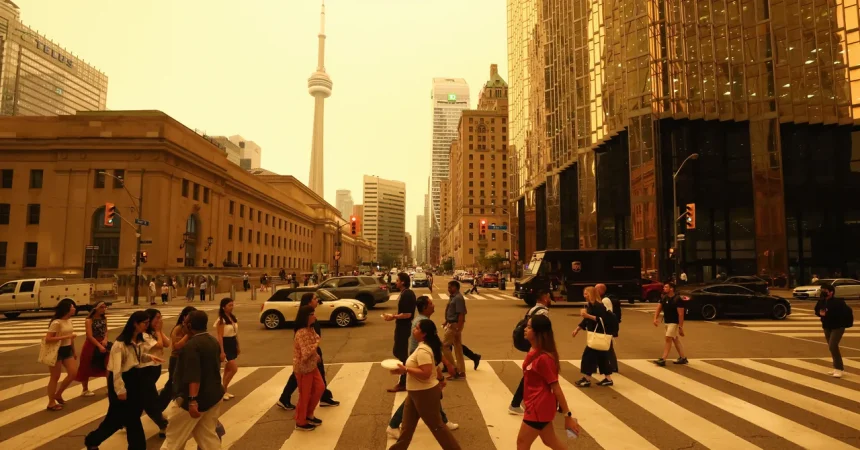
Across the Midwest and Northeast, millions of people are waking up to a surreal, filtered reality. The sky has taken on an eerie, apocalyptic orange hue, acting as a visible messenger for the massive wildfires currently raging across Canada. With over 100 fires burning out of control, the smoke has drifted hundreds of miles south, settling over major cities like Toronto, New York, and Minneapolis. This isn’t just a seasonal inconvenience; it’s a profound shift in our environment. When air quality indices reach “hazardous” levels—as they did in some towns, hitting a staggering 500—the very act of stepping outside to grab the mail or commute to work becomes a health risk, reminding us that nature’s fury recognizes no borders.
The invisible culprit behind this hazy skyline is a substance called PM2.5. These microscopic particles are roughly 30 times smaller than a human hair, allowing them to bypass our body’s natural defenses and travel deep into our lungs and bloodstream. For those of us who feel “healthy,” it is easy to dismiss the warnings, but medical experts like Dr. Nicholas Nassikas from Harvard Medical School urge caution. Children, whose respiratory systems are still developing and who breathe at a faster rate, are particularly susceptible. So too are our elderly neighbors and those with pre-existing conditions like asthma. The message is clear: even fit, able-bodied adults shouldn’t feel invincible against the invisible irritants currently saturating the air.
Taking personal precautions has gone from being a niche health tip to a necessary part of daily planning. Experts like Jennifer Stowell, an assistant professor at the University of Maryland, suggest that if the Air Quality Index (AQI) climbs above 100, we need to adapt. This means keeping windows sealed, running air filters, and, if you absolutely must be outside, donning an N95 mask to act as a barrier against the fine particulate matter. Even those who study climate physics, like Columbia University’s Dan Westervelt, are changing their routines—choosing to keep children indoors and skipping outdoor exercise. It is a sobering reflection on the new baseline of our daily lives, where checking an air quality app has become as routine as checking the weather forecast before leaving the house.
The root of this crisis—a warming planet—is no longer a theoretical debate for the future; it is a present-day reality. Climate change is fueling a cycle of hotter, drier conditions that transform forests into tinderboxes, resulting in longer and more explosive wildfire seasons. We are seeing a feedback loop where the changing climate creates the very conditions that devastate our air quality, impacting the lungs of millions of people who live thousands of miles away from the fire lines. The smoke of 2023 was a wake-up call, but the recurring nature of these events suggests that hazy, orange skies might become the new signature of our summers if global trends remain unchecked.
The long-term implications for our health are perhaps the most concerning part of this story. While we often focus on the immediate discomfort of a scratchy throat or stinging eyes, researchers are looking at the compounding impact of chronic exposure. Estimates suggest that wildfire smoke is already contributing to tens of thousands of deaths annually in the U.S., a figure that could potentially double by 2050 if the current warming trajectory continues. Dr. Westervelt notes that sustained exposure to high levels of pollution acts like a slow, silent thief, chipping away at life expectancy. We are essentially learning in real-time how a changing planet impacts the long-term vitality of human populations, and the data is deeply concerning.
Ultimately, these smoky days serve as a stark lens through which we view our collective responsibility to the environment. It is easy to feel powerless when faced with massive, unchecked wildfires, but informed action remains our best defense. By staying indoors, monitoring air quality, and protecting the most vulnerable among us, we can mitigate the immediate dangers. However, the larger challenge remains the climate itself. We are currently living through the consequences of a world where environmental health and human health are inextricably linked. As we navigate these hazy days, it serves as a reminder that the air we breathe—and the protection of the atmosphere—is the most fundamental public health issue of our time.