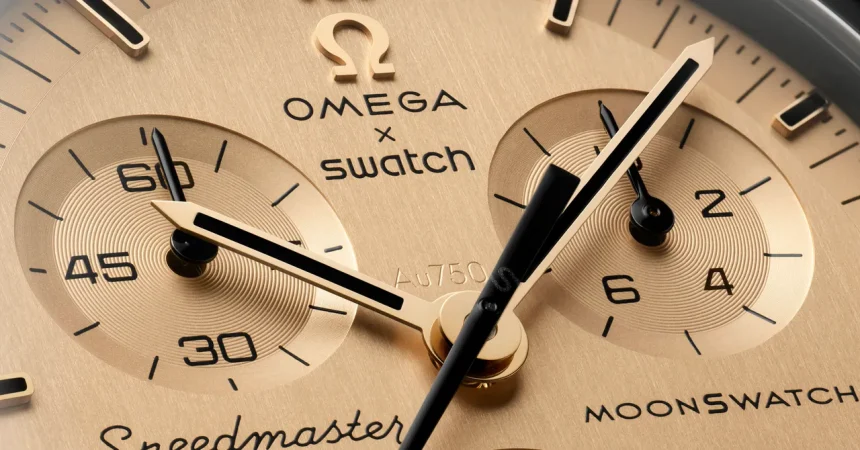
The collaboration between Omega and Swatch has been one of the most fascinating experiments in the world of high-end horology, effectively bridging the gap between affordable accessibility and luxury prestige. Their latest venture, the “Mission to the Moon 1969,” leans heavily into Omega’s space-faring heritage while celebrating a milestone that defines human ambition. By utilizing Omega’s proprietary 18K Moonshine Gold alloy, this iteration isn’t just another playful entry in the series; it is a serious nod to mid-century engineering. Unlike previous versions where the gold was merely a thin veneer or a subtle accent, this watch commits entirely to the material, featuring an 18K Moonshine Gold dial, crown, pushers, and hands. It is an unapologetic statement piece, carrying a total of 11 grams of precious gold that gives the typically lightweight Swatch silhouette an unexpected, premium heft.
The inspiration behind this release is the Apollo 11 lunar mission, a pivotal moment in history that occurred on July 21, 1969. To honor this date, Swatch has limited the production to exactly 1,969 numbered pieces, ensuring that each watch serves as a tangible artifact of that era. Visually, the watch is striking, opting for a sleek black-and-gold color scheme that manages to feel both retro and contemporary. Complementing the sophisticated aesthetic is an upgraded rubber strap, which offers a more durable and modern feel than the standard Bioceramic straps we’ve seen in the past. It is a design choice that acknowledges the “space-watch” DNA of the original Speedmaster while updating the experience for a modern collector who values comfort as much as craftsmanship.
One of the most human elements of this release is the thoughtful approach Swatch has taken toward its “sourcing.” The gold used in these pieces carries a beautiful narrative: it was reclaimed from actual Omega spare parts dating back to 1969, melted down within the company’s internal foundry to be reborn in this new form. There is a profound sense of continuity in knowing that material from the year of the moon landing is literally woven into the fabric of these watches. It transforms the object from a mere mass-produced accessory into a vessel for history. The company has further emphasized this connection by grounding the pricing in that same historical context; rather than charging the inflated market rates for gold in 2024, they calculated the cost of 11 grams of gold based on the market price as it stood on July 21, 1969.
This historical pricing strategy results in a retail price of approximately $620, a figure that is intentionally accessible in an industry often defined by exclusionary price points. It’s a whimsical, somewhat romantic gesture that highlights a rare sense of playfulness from a major watchmaker. In an age where limited-edition luxury items are frequently treated as speculative assets or investment vehicles, Swatch is trying to preserve the joy of watch collecting. By keeping the price pegged to 1969 standards—roughly $11 for the gold content—they are inviting fans to engage with the story of the watch rather than just obsessing over its potential resale value. It is this storytelling, rather than the raw material, that makes the “Mission to the Moon 1969” stand out.
The logistics of purchasing such a high-demand item are where the reality of the modern market sets in. Having previously witnessed the absolute chaos at retail locations—scenes of pushing, shoving, and global supply shortages during former MoonSwatch launches—Swatch is taking a more controlled, digital-first approach. To mitigate the risk of store-floor overcrowding and the frustration of unsuccessful store visits, they are funneling the release through an online application process known as an “Electronic Swatch Timepiece Application” (or ESTA). It is a clever, if slightly bureaucratic, way of attempting to keep the buying experience orderly and fair, ensuring that the privilege of owning such a piece is awarded through a system rather than a survival-of-the-fittest scramble.
Ultimately, the Mission to the Moon 1969 captures the spirit of exploration and the nostalgia of the golden age of space travel. It sits at a unique intersection: it is a piece of wearable history for the enthusiast, a collector’s trophy for the brand loyalist, and a technical achievement for the watchmaker. In choosing to melt down the past to create the present, Omega and Swatch have managed to do something quite rare—they have kept the romance of the Apollo missions alive while making it accessible to those who weren’t there to see the original landing. Whether you manage to secure one through the ESTA process or admire it from afar, the watch stands as a testament to the idea that, even in the modern era of high-tech manufacturing, there is still infinite value in a well-told story.