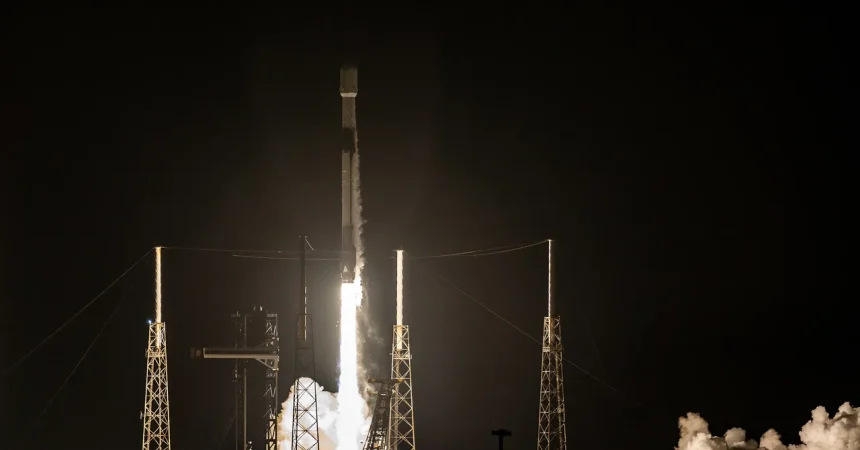
On Wednesday, humanity is set to witness a unique intersection of space debris and lunar exploration, as a spent SpaceX Falcon 9 rocket stage hurtles toward the Moon’s surface. This event, scheduled for approximately 6:34 am UTC, marks a historic milestone in space observation. For the first time, scientists are forecasting a high-speed collision on the sunlit face of the Moon, near the Einstein crater. Traveling at an astonishing 5,400 mph, this impact is expected to kick up a massive plume of lunar dust, creating a spectacle that, under the right conditions and with the proper equipment, could be caught by amateur astronomers and professional researchers alike.
The science behind this predicted impact is as fascinating as the event itself. A team led by William Jo, a doctoral candidate at the University of Texas at Austin, utilized complex high-resolution physics simulations to forecast the mechanics of the collision. Unlike a solid meteorite, which acts like a dense cannonball, the Falcon 9 stage is essentially a hollow, metal “eggshell” with a weighted engine at one end. According to professor David Goldstein, who supervised the study, this unique structure means the rocket will likely collapse inward upon impact rather than simply burrowing into the lunar soil. The simulation suggests the crash will displace over 12,000 kilograms of debris, sending a vast, low curtain of lunar dust spreading across the surface.
While the simulation provides a compelling visual of how this “splash” might manifest, the research team is careful to manage expectations. The current model assumes a vertical, “pin-drop” style impact; however, in reality, the rocket is likely to strike at an angle. A glancing blow would inevitably result in a smaller, dimmer plume, making it more difficult to resolve from Earth. Goldstein notes that their study represents the “best-case” scenario for debris generation. Whether this man-made meteor will create a display visible to Earth-based telescopes remains a tantalizing question that will only be answered in the seconds following the collision.
The challenge of viewing the plume lies in the delicate balance of optics and contrast. Astronomer Laurence Trafton explains that while the plume could technically reach a size easily resolved by a modest telescope—spanning about one-sixtieth of the Moon’s apparent width—it will be significantly fainter than the bright, sunlit lunar surface nearby. The scattered moonlight acts as a “washout” factor, demanding extreme precision and a very steady mount for any telescope aimed at the crater. It is a game of visual hide-and-seek, where the observer must discern a faint, dusty veil against the brilliant, crater-pocked backdrop of the Moon’s limb.
Timing and geography will ultimately dictate who gets to witness this fleeting moment of history. The plume is expected to peak about 90 seconds after the impact, providing a brief window for observers to document the debris cloud. However, the Moon’s position in the sky will be a major hurdle for many in the Northern Hemisphere. For those located north of a line stretching from Massachusetts to Texas, the Moon will appear low on the horizon. Looking through the thicker, more turbulent layers of the Earth’s atmosphere at that angle will likely distort the view, potentially masking the faint plume behind a haze of atmospheric interference.
Ultimately, this event serves as a poignant reminder of our growing presence in the cosmos and the unintended consequences of our reach. As we continue to launch missions to the Moon, the remnants of our technology occasionally find their way back to the lunar surface in dramatic fashion. Whether or not observers succeed in capturing the plume on Wednesday, the attempt highlights the remarkable capability of modern physics to model the unknown and the enduring human drive to watch the skies. It is a rare opportunity to observe the final chapter of a piece of aerospace engineering, turning a routine piece of space junk into a catalyst for planetary science.