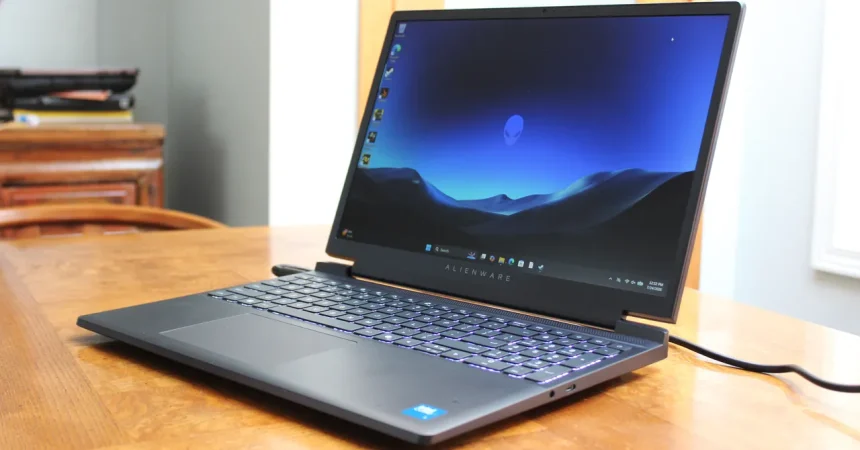
The Alienware 15 serves as an interesting case study in the current landscape of gaming hardware, balancing the brand’s signature premium aesthetic with the practical realities of mid-range performance. When putting it through its paces, I found that while it isn’t a powerhouse out of the box, it doesn’t take much to get it running smoothly. By dropping the settings to a “Medium” preset, I was able to hit fluid frame rates without making the visuals look muddy or compromised. In an era where integrated graphics are becoming surprisingly capable, the Alienware 15 manages to justify its physical bulk by providing that extra graphical overhead, ensuring it still feels like a “proper” dedicated gaming machine rather than just another laptop.
When you look at the raw numbers, the RTX 5050 tucked inside this chassis is a noticeable step up from the best integrated solutions, like those found in the latest Dell XPS 14. To be specific, the Alienware 15 offers about a 77 percent performance boost in gaming scenarios. Because of this, you can actually take advantage of that snappy 165-Hz display, especially if you lean on modern tricks like DLSS upscaling and frame generation. It is a capable rig for the casual to mid-level enthusiast, though it does carry the familiar trade-offs associated with older chip architectures, particularly when it comes to power efficiency.
One of the most noticeable drawbacks of the Alienware 15 is its battery life, which sits well below the gold standard of modern mobile computing. Because it relies on slightly older processor technology rather than the newest Intel silicon, you’re looking at a machine that struggles to stay unplugged for long. In my testing, I found that even under a very light workload, the battery rarely pushed past the six-hour mark. If you’re a power user with multiple browser tabs open and background applications running, that window shrinks significantly. It’s a sobering reminder that this is, first and foremost, a desktop replacement that happens to have a battery, rather than a machine designed for the digital nomad.
The real challenge for the Alienware 15, however, isn’t its internal components—it’s the brutal competition in the current market. For most of 2026, I have been pointing people toward the Lenovo LOQ 15 as the undisputed value king. Originally priced well under $1,000, it offered an RTX 5060, which significantly outperforms the Alienware’s 5050. Now that the price for the LOQ has crept up to $1,200—matching the Alienware—the value proposition for the Dell-branded machine becomes much harder to defend. When you compare them side-by-side, the LOQ still boasts a superior screen and higher raw gaming performance, making it the more logical choice for someone purely interested in specs per dollar.
There is a bit of uncertainty in the market right now that might affect your decision, primarily because Lenovo is in the process of transitioning to their “LOQ Essential” line. This new version will likely be priced closer to the Alienware, and as of my current testing, the budget-friendly RTX 5050 configuration for the new model isn’t available yet. This means the current, high-value LOQ 15 is a “get it while it lasts” situation. If you’re browsing the market, you’ll also inevitably run into options like the Acer Nitro V 16 or the MSI Cyborg A15. While these machines lack the polished, high-end design language of the Alienware, they offer effectively the same performance for significantly less money.
Ultimately, the Alienware 15 is a laptop that wins on personality but loses on math. I truly enjoy the build quality and the “Alienware look”—it feels substantial and sophisticated in a way that the budget-tier Acer and MSI offerings simply don’t. However, the price gap is difficult to ignore when the screen quality and the internal GPU don’t necessarily push the boundaries of what’s expected at this price point. If you value brand prestige and chassis design above all else, you’ll be happy here. But if you’re a pragmatic buyer looking for the most frames per dollar, the current competitive landscape suggests you might be better off looking at the alternatives before they disappear from store shelves.