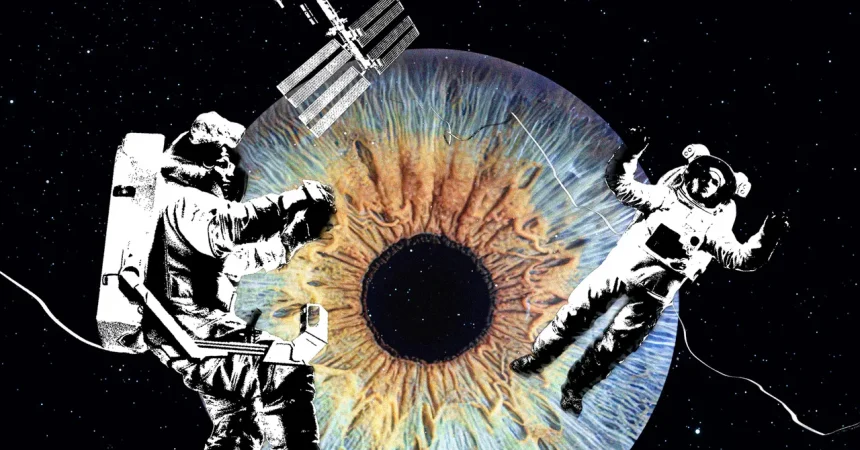
The dream of deep-space exploration—the missions that will take us to the Moon, Mars, and beyond—is currently tethered to a sobering reality: our bodies simply aren’t built for the void. While we often obsess over rocket propulsion and life-support systems, one of the most insidious threats to an astronaut’s mission readiness is happening silently inside their own skulls. As humans spend more time in microgravity, a significant number of them are returning home with permanently altered vision. The European Space Agency (ESA) is now leading a crucial effort to demystify this condition, hoping to turn the tide on a medical mystery that could threaten the viability of long-term cosmic travel.
The culprit behind this phenomenon is known as Spaceflight-associated neuro-ocular syndrome, or SANS. In the absence of gravity, bodily fluids that usually drain downward don’t behave as they should; instead, they shift upward, pooling in the head and creating a localized pressure buildup. For about 70 percent of astronauts on the International Space Station, this pressure manifests as a physical distortion of the eye. It literally squashes the eyeball, swells the optic nerve, and pushes the retina forward. The story of NASA astronaut John Phillips serves as a chilling reminder of these stakes: he arrived in space with perfect 20/20 vision and returned six months later with 20/100, a level of impairment that would make life on Earth—let alone navigating a spacecraft—dangerously difficult.
To tackle this, the ESA has turned to a fascinating intersection of quantum physics and modern medicine. They’ve commissioned Siloton, a British startup founded by physicists, to shrink the kind of sophisticated optical technology found in a local optometrist’s office down to the size of a coin. Using a photonic chip, Siloton is working to miniaturize the complex imaging hardware that typically fills an entire exam room. This isn’t just a feat of engineering; it’s a necessary evolution of medical care. The agency needs diagnostic tools that are robust, portable, and capable of operating without the massive weight and power requirements of traditional terrestrial equipment, ensuring that astronauts can monitor their health as easily as checking a watch.
The transition from a clinical environment to a spacecraft is a massive hurdle, but the core technology is already being stress-tested here on Earth. Siloton is currently collaborating with the UK’s National Health Service to help patients with chronic retinal conditions monitor their eyes from the comfort of their own homes. This Earth-bound application mirrors the needs of the ESA perfectly: both require high-quality, reliable, and user-friendly diagnostics that don’t rely on a specialist standing over the patient’s shoulder. By leveraging this existing research, the agency is effectively turning the challenges of geriatric eye care into the life-saving technology of the next century’s space pioneers.
This portability is not just a luxury; it is a fundamental requirement for the upcoming Artemis missions and beyond. Currently, monitoring eye health in space relies on heavy, bulky machinery that requires direct, real-time guidance from medical experts back on Earth. As we push further into deep space, the communication delay—the time it takes for a signal to travel from a lunar base or a Martian landing site back to Houston or Darmstadt—will make this “remote hand-holding” impossible. The astronauts will need to be their own optometrists, capable of self-scanning with enough precision to detect the subtle, microscopic shifts that precede permanent damage.
Ultimately, the goal is to transform SANS from an inevitable hazard of spaceflight into a manageable, and perhaps even preventable, condition. By gathering more granular, consistent data on how the eye degrades in microgravity, scientists hope to develop early warning systems that can flag issues long before an astronaut experiences a decline in vision. Whether it’s finding new ways to mitigate fluid pressure or developing targeted therapies, the work being done by Siloton and the ESA represents a vital step toward safeguarding the human body. As we prepare to leave our home planet for extended periods, we are finally acknowledging that to reach the stars, we must first master the art of keeping our eyes fixed firmly on the mission ahead.