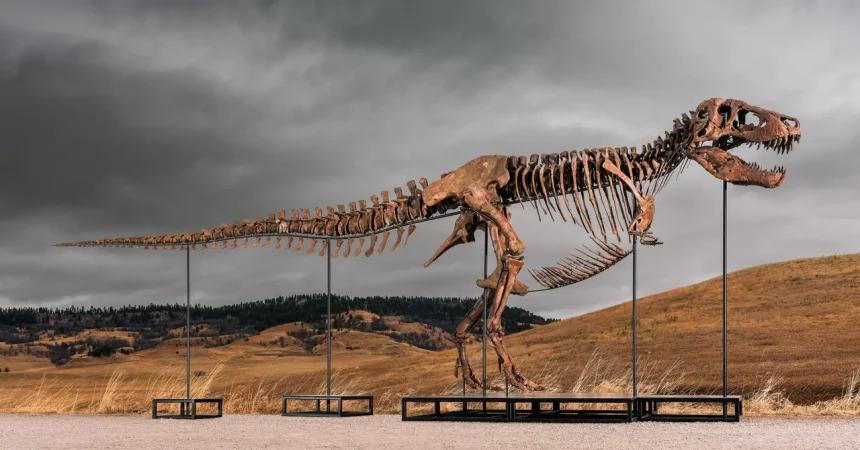
The world of paleontology is currently bracing for what could be described as the auction of the epoch. On July 14, Sotheby’s will open the floor to bids for “Gus,” a rare, 67-million-year-old Tyrannosaurus rex skeleton unearthed from a ranch in South Dakota. Comprising an incredible 183 bone elements, Gus is roughly 61% complete, presented in a dramatic, life-like pose that captures the raw power of a creature that once ruled the earth. While experts like University of Maryland paleontologist Thomas Holtz acknowledge that the specimen is scientifically significant, the price tag associated with this piece of history is staggering. Estimates suggest Gus could fetch up to $30 million, a figure that highlights a growing and controversial shift in how humanity treats the deepest remnants of our planet’s ancient past.
The story of the modern fossil market effectively began in 1997, when Sotheby’s auctioned “Sue,” the most complete T. rex skeleton ever discovered, for $8.4 million. At the time, that sale redefined the worth of natural history. Cassandra Hatton, head of science and natural history at Sotheby’s, points out that while many countries claim state ownership of fossils, U.S. law dictates that whoever owns the land also owns the treasures beneath it. This legal reality paved the way for a booming commercial market. However, there is a fundamental difference between the sale of Sue—which ultimately found a home at the Field Museum in Chicago, where it remains available for public study—and the current trend of fossils being treated as exclusive, high-end luxury assets for the ultra-wealthy.
In recent years, the landscape of fossil acquisition has shifted toward private hands, often at the expense of science and public education. Increasingly, billionaire collectors and hedge fund managers are outbidding major institutions for world-class specimens. For example, in 2024, hedge fund billionaire Ken Griffin secured the record-setting “Apex,” a stegosaurus, for $44.6 million. Similarly, a one-of-a-kind juvenile Ceratosaurus recently disappeared into the hands of an anonymous private buyer for over $30 million. These exorbitant prices create a barrier to entry that most museums simply cannot hurdle, effectively locking away priceless biological history behind the closed doors of private residences.
The concern among the scientific community is profound. When a fossil of the caliber of Gus is purchased as a status symbol rather than a research subject, a vital link to our planet’s evolutionary story is potentially severed. Paleontologists argue that the hype generated by auction houses drives up prices, turning fossils into speculative commodities. A study published in 2025 revealed a startling milestone: there are now more T. rex skeletons held in private collections than there are in public trusts. This privatization of natural history means that the very creatures meant to inspire future generations and provide data on climate change and extinction events are being removed from the reach of the researchers who could best interpret their secrets.
The human element of this dilemma is rooted in the tension between property rights and the preservation of global heritage. While the landowner who found Gus on their property undeniably has a legal right to profit from that discovery, we must ask ourselves what we lose when “science” becomes a luxury good. A dinosaur skeleton is not merely a statue or a piece of interior design; it is a physical record of the dawn of life on Earth. By turning these creatures into trophies, we are effectively saying that the prestige of the few is more valuable than the educational inheritance of the many. When a rare specimen is sold to a private collector, it vanishes from the scientific record, silenced in a private study rather than speaking to the public at large.
Ultimately, the sale of Gus serves as a high-stakes mirror held up to our society. It forces us to confront the fact that in our current economic climate, even the extinction of the dinosaurs can be auctioned off to the highest bidder. If we continue to treat our natural history as a commodity rather than a communal treasure, we risk a future where the most iconic chapters of Earth’s history are no longer owned by humanity, but by a select handful of people. As the hammer falls on July 14, it will signal more than just the change of ownership for a jumble of ancient bones—it will represent a deepening divide between the public interest and the insatiable appetite of the private market, leaving behind a legacy where the study of the past is dictated by the wealth of the present.