Waking early, the house still dark, I moved with the quiet purpose of someone about to do a small thing that feels important. I went to the refrigerator, opened the door, and let the cold air wash over my face. On the middle shelf sat a jar of my own sauerkraut, pale ribbons of cabbage suspended in a faintly cloudy brine, alive in a way most food never is. I screwed the lid tight, wrapped it in a kitchen towel, and slipped it into my messenger bag. Then I pulled on my coat, walked my bicycle out into the soft gray Seattle morning, and rode down to King Street Station. The sounds were familiar: the clatter of the chain, the hiss of wet tires on asphalt, the gentle grumble of a city not yet fully awake. I locked my bike, bought a coffee, and boarded the train heading south. The destination was the Portland Fermentation Festival, the yearly gathering affectionately known as Stinkfest. For anyone who loves the funk, the fizz, the tang, and the sourness that comes from microbes doing their slow, patient work, it is a kind of pilgrimage. And as the train slid through the rain-streaked landscape of Washington and into Oregon, I thought about everything the festival had come to mean since it started more than a decade ago: community, craft, health, politics, and the simple pleasure of putting cabbage and salt together in a jar and watching time do the rest.
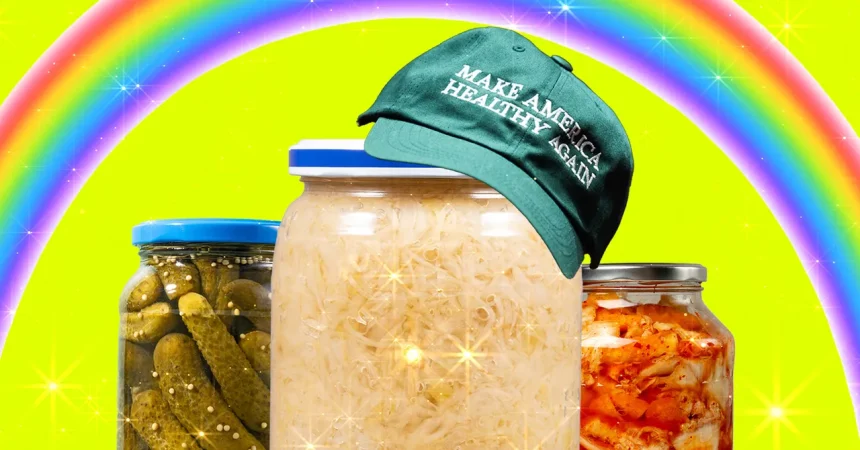
Usually, the fact that a festival like this exists is enough to get a certain kind of person revved up. Fermentation nerds, home picklers, health nuts, chefs, gardeners, curious eaters, and anyone who has ever been seduced by the smell of sour rye or miso all find their way to the exhibition hall, eager to swap stories, trade samples, and celebrate the ancient art of preserving food through the action of bacteria and yeast. But this year, something strange and interesting was happening in the air. Fermented foods were enjoying a popularity boost from a completely different crowd. The MAHA movement, and particularly the Trump cabinet, had become enthusiastic about fermented food, eating meat—usually steak—with fermented sides like kimchi or sauerkraut at every meal. It was an unlikely pairing: the world of crunchy, left-leaning urban fermenters and the world of steak-eating, red-meat-comeback politics. I came to Portland wondering if there was going to be any overlap in the Venn diagram between festival attendees and the MAHA steak-and-ferment crowd. I mentioned this to my cousin-in-law Erick, who has been part of the Portland food scene for years. He laughed out loud. “It’ll be more like a Venn dumbbell,” he said, making a pair of thumb-and-forefinger circles and tracing a line in the air between them. “No overlap, but food will be the bridge.” That image stayed with me. So I arrived carrying my jar of sauerkraut in my bag and that question in my head: could fermented food really bring people together, even when so much else seemed to pull them apart?
The festival turned out to be almost exactly what the fermentation-friendly might hope to find. Right inside the main door, next to the check-in desk, was a bacterial petting zoo—a common and comforting thing at this sort of event—where people could look at cultures under a microscope and marvel at the invisible life-forms doing all the work. Nearby, there was a table where attendees could drop off their own ferments to share with the community. Further on, lining every wall of the main room, were exhibitors who had paid a grand total of twenty-five dollars for a table, handing out free samples of their favorite ferments. The room smelled alive: vinegar, mustard seed, ginger, garlic, dill, something deeply sour and strangely wonderful. The space quickly filled up, with several hundred people flowing through over the course of the evening. There was a line in front of each exhibitor, but also a more organic, continuous line, people moving clockwise from one table to the next, little cups and spoons in hand, tasting things they had never tried before. People were notably excited and happy. There was a kid walking around with a tray of handmade pickle pins, giving them to everyone who wanted one, and a collective gasp rippled through the crowd when, twenty or thirty minutes in, Dillon T. Pickle—the mascot of the Portland Pickles West Coast League baseball team—walked into the room. At one point, a big baby crawled across most of the main floor, unhindered and happy, while adults stepped carefully around it, smiling. It was the kind of event that made you feel as though the world might be a little simpler and kinder than it usually seems.
In the middle of it all was festival co-organizer, journalist, and cookbook author Liz Crain. She moved through the room with the ease of someone who has done this many times before, greeting old friends, checking on exhibitors, and pausing to answer questions from first-timers. I eventually caught up with her near the back of the room, and she explained that the festival, now in its fourteenth installment, had been started in 2009 by friends who simply loved to ferment. There were members of a little company called Pickleopolis and a club called The Kraut Collective, and, with some help from author and fermentation rockstar Sandor Katz, they launched a Portland tradition. What struck me was how humble the origins were. It wasn’t a corporate event or a political rally. It was a group of people who believed that fermentation was worth celebrating, worth sharing, and worth keeping accessible. The price for an exhibitor table was still just twenty-five dollars. The atmosphere was low-key and generous. There were no high production values, no fancy stage, no VIP section—just a room full of people who cared about living food and were happy to talk about it far into the evening. Liz’s presence tied it all together; she was not just a producer but a community member, someone who understood that the festival was ultimately about connection. She told me that the goal had always been to keep the event joyful and welcoming, a place where anyone could walk in and feel a little less alone in their love for sour, fizzing, bubbling things. That felt especially important in a year when fermentation had become a talking point in the wider culture, sometimes in ways that seemed strange and politically charged.
As the evening went on, I began to see what Erick had meant about the dumbbell. At one table, an older woman who had been fermenting vegetables since the 1960s was explaining to a younger man the difference between wild fermentation and inoculation with a starter culture. He listened carefully, chewing a piece of spicy kimchi spread on a cracker. He told her that he had come to the festival because he had heard that fermented foods were good for gut health, a theme in the MAHA movement, and that he had recently started eating sauerkraut with his steak every night. She nodded and said she was just glad he was eating it. They did not talk about politics. They talked about cabbage, salt, temperature, time, and the strange magic of how flavor develops. Nearby, I fell into conversation with a man who had driven down from Tacoma because his doctor recommended fermented vegetables to help with his digestion. He was a big, friendly guy in a cap, and he admitted that a year ago he had never heard of kimchi. Now he was comparing different brands and arguing about whether store-bought sauerkraut was as good as the handmade kind. A woman with a tattoo of a lactobacillus on her wrist handed him a sample of beet kvass. He made a face, then smiled. “That’s terrible,” he said. “I love it.” They laughed, and she explained how to make it at home. There were dozens of small moments like that throughout the evening, moments where people from different backgrounds, different political leanings, different ways of eating, found common ground over a shared table of samples. It wasn’t that anyone changed their mind or that the divide disappeared. It was that food, and specifically the ancient, humbling process of fermentation, created a bridge. In a culture that often feels like a collection of locked rooms, here was a door left open.
By the time I emerged from the festival, my jar was empty. I had shared my sauerkraut with a stranger—a young mother who had come with her pickled-vegetable-loving toddler and who admitted she had never tried making kraut before. I told her how easy it was: just cabbage and salt, a clean jar, a little patience. She took a bite, her eyes widened, and she asked if I had written down the recipe. I hadn’t, but I described it as best I could while someone else handed her a spoonful of something mysterious and green. The rain had stopped by the time I walked back to the train station. The streets of Portland glittered under the streetlights, and I thought about Erick’s dumbbell: two circles, far apart, connected by a bridge. He was right. There was no overlap between the festival crowd and the MAHA steak-and-ferment crowd, but food was the bridge. Fermentation, after all, asks for patience, attention, and a willingness to let the world change on its own schedule. It does not care who you voted for. It cares whether you wash your hands, pack the cabbage tightly, and wait long enough for the transformation to happen. The festival was not a political event. It was a human one. Maybe the different crowds will never agree on much else, but for one evening, they were in the same room, tasting, asking questions, and discovering that the ancient process of turning simple ingredients into something alive and nourishing could still connect them. That counts for something. On the train ride back to Seattle, I thought about the baby crawling across the floor, the kid with the pickle pins, the grandmother and the guy in the cap, the shared jars, the happy noise of a room full of people who had momentarily forgotten their differences. I made a mental note to start a new batch of sauerkraut when I got home, and to leave a jar on the counter, waiting for anyone who needed a taste of something that took time, care, and a little bit of trust.