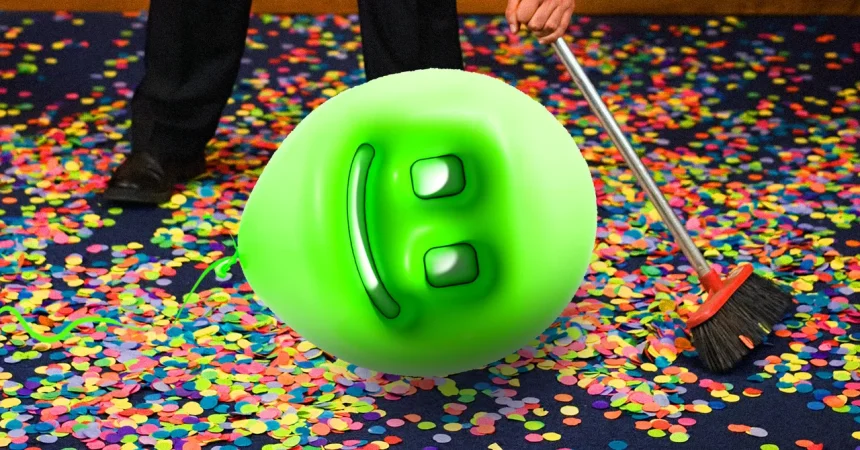
On a gray January morning in 2024, employees arriving at the Lower Manhattan headquarters of Macmillan Publishers found themselves walking into what looked like a strange, unexplained celebration. Flyers had been taped to the walls, welcoming a new member of the team named “NOA.” The cafeteria was decorated with purple balloons and banners, and above it all, a glowing marquee spelled out the name in light-up letters. A plate of doughnuts had been arranged to spell “NOA IS HERE.” For a few confused moments, people assumed this was some kind of office prank or perhaps a farewell party for a beloved colleague with an unusual nickname. But no one named NOA existed. As employees soon learned, NOA was an acronym for “No Ordinary Assistant,” and it was not a person at all. It was an artificial intelligence chatbot developed by Chaptr, a German software company backed by Holtzbrinck, Macmillan’s parent company. The spectacle felt less like a welcome and more like a corporate announcement: the future had arrived, and the future was a machine. For the human assistants in the building—the people who answer emails, schedule meetings, read submissions, and quietly keep the publishing machine running—the name was immediately offensive. The implication was impossible to miss. They were being told, in balloons and doughnuts, that they were merely ordinary, and that their replacement had arrived.
The official introduction came in an email that tried to frame NOA as a friendly, safe, and indispensable tool. It promised employees that NOA was “a safe environment where you can input proprietary information without the risk of sharing that data with any third party.” This was meant to reassure editors and assistants that they could feed unpublished manuscripts, author letters, and internal notes into the system without fear of leaking sensitive material to the wider internet. Ostensibly, NOA was a closed-loop enterprise tool that did not retain or share data for model training. In training sessions, however, employees were warned that NOA could hallucinate—confidently invent facts, names, or passages—and that everything it produced would need to be fact-checked by a human. Still, the message from leadership was clear: use NOA. Use it to compose emails. Use it to draft marketing copy. Use it to do research. Use it to generate ideas. Use it to make your work faster and smarter. There were even instructions about manuscripts, with staffers told to paste only a “percentage” of an author’s text into the chatbot, an oddly specific and vaguely unsettling directive. To make the tool feel more approachable, employees could adjust NOA’s speaking tone. The options included “lighthearted,” “spartan,” “pessimistic,” “sarcastic,” and, bizarrely, “regretful.” The absurdity of choosing a “regretful” tone for an artificial intelligence in a publishing house was not lost on the people who had to use it. One employee remembered a representative from Chaptr trying to reassure workers during an early in-person training session. The representative said the company understood that publishers were dealing with something very important—content. The employee paused at the word. “And here I thought we were publishing literature,” they said.
As 2024 wore on, the pressure to embrace NOA only intensified. At one point, employees were encouraged to use the chatbot to generate their goals for their upcoming performance reviews. An email cheerfully explained, “We built a specialized prompt to have NOA write goals for you!” For many, this was a step too far. The idea of asking an artificial intelligence to articulate your own professional ambitions felt like a surrender of the self, a strange corporate abdication of judgment and desire. It was also, practically speaking, absurd. Several Macmillan employees later told WIRED that NOA was unhelpful and unreliable. “It was terrible, and no one used it,” one said flatly. The tool was supposed to save time, but it often produced generic, off-base text that required more effort to correct than it would have taken to write from scratch. A chatbot cannot know which author is having a difficult year, which book has been struggling to find its audience, or which sentence in a manuscript needs to be preserved at all costs. It cannot know the history of a house, the taste of an editor, or the quiet trust between an agent and a publisher. The performance review goals it generated were vague, soulless, and disconnected from reality. Some employees used them as a starting point and then rewrote them completely. Others ignored the prompt entirely and wrote their own goals, quietly defying the new corporate orthodoxy. There was no dramatic rebellion, no memo of protest. There was just a slow, stubborn refusal to treat a chatbot as a colleague.
The rollout of NOA was part of a broader push to make publishing more efficient by injecting artificial intelligence into every stage of the process. Publishing has always been a human business, built on relationships, taste, and trust. Agents send manuscripts to editors they know. Editors champion books they love. Assistants read slush piles and discover voices that no algorithm could predict. This is not easily automated, yet leadership kept trying. In October 2025, Macmillan staff learned through a company-wide email that Chaptr would be sunsetting NOA. The experiment was ending, quietly and without fanfare. But the impulse behind it did not end. Since then, workers say, leadership has been attempting to integrate Google Gemini into the publishing process. Some staffers experimented with using Gemini to evaluate submission letters from literary agents, hoping it might at least triage the enormous volume of incoming queries. The result, according to one editor, was “useless.” Gemini might have summarized a letter, but it could not understand voice, marketability, or the subtle signals that make a submission worth reading. It could not tell whether an author was a good fit for a particular list. It could not feel excitement or hesitation. It could not, in any meaningful sense, read. The experiment failed, but it revealed a pattern: tools were chosen not because they worked, but because they were new. Employees were expected to adapt to the technology, not the other way around.
The human dimension of this story is perhaps the most important part. The people who spoke to WIRED, including employees and authors, did so only on condition of anonymity because they were concerned about professional repercussions. That fear is not irrational. Publishing is a tight-knit industry, and speaking critically about your employer’s shiny new artificial intelligence project can be a quiet career death sentence. The employees who were most offended by NOA were not Luddites. They were the people who had spent years learning how to read, edit, and care for literature. They knew that a book is not “content” and an author is not a “user.” They knew that an assistant is not an ordinary worker but a human being with taste, judgment, and institutional memory. The name “No Ordinary Assistant” was a cruel joke, because the machine it celebrated was, in fact, the most ordinary thing about the office—a generic language model dressed up in purple balloons and marquee letters. The doughnuts spelled out “NOA IS HERE,” but in reality, NOA was never fully there. It was a hollow presence, a corporate placeholder, a way for leadership to say “we are innovating” without actually improving anyone’s life. It did not make books better. It did not make work lighter. It did not make anyone feel more creative. It simply made the people who cared most about their work feel that their values were being quietly, politely dismissed.
By the time NOA was finally sunset, many employees had already moved on. They had learned to work around it, to use it as little as possible, to treat it as a strange corporate ritual that had to be endured. The purple balloons came down, the flyers disappeared, and the chat window was eventually closed. But the memory lingered. The arrival of Google Gemini suggested that leadership had not learned the lesson. The technology changes, the names change, but the impulse remains the same: to find a machine that can do the work of human taste. What the NOA experiment proved, however, was that the opposite is true. The most valuable thing in publishing is not efficiency, scale, or data. It is the human ability to read a sentence and feel something. It is the assistant who notices that an author is anxious before a phone call. It is the editor who knows why a certain ending is right, even when the reader cannot say why. It is the publicist who can pitch a book with genuine enthusiasm because they actually believe in it. No ordinary assistant can do that. No extraordinary artificial intelligence can either. The doughnuts might have spelled out “NOA IS HERE,” but in the end, the ordinary humans were the ones who stayed.