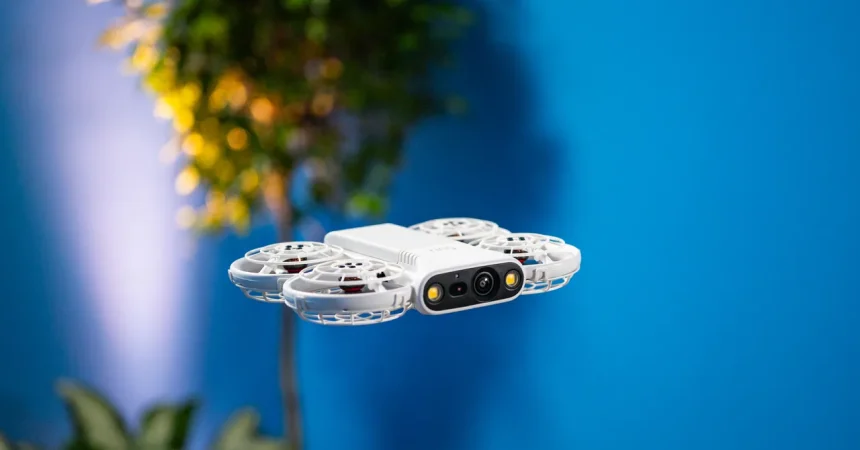
For years, the idea of a security camera that could move around your home on its own felt like something out of a science-fiction movie—a tiny, watchful eye that could glide down hallways, peek around corners, and check on strange noises wherever they happened to be. Now, that idea is becoming a reality. Ring, the Amazon-owned smart-home company best known for its doorbells, has finally unveiled the Ring Drone Cam: an indoor flying camera that can patrol your home, respond to security alerts, and give you a live view of whatever is happening, wherever you need to look. It’s not a gimmick, according to Ring’s founder and CEO, Jamie Siminoff. It’s a dream he has been chasing for nearly a decade. Siminoff says the concept first came to him in 2016, even before Amazon acquired Ring. He imagined a “flying sentry” that could go beyond the limits of a fixed camera, offering a level of awareness that static devices simply can’t provide. The company actually announced an earlier version of this concept in 2020, called the Ring Always Home Cam, and it came close to launching it last year. But the closer the team got to shipping it, the more complicated the project became.
The challenge wasn’t the flying itself, nor was it the camera. The problem was that building something that would fly around an unpredictable indoor environment—with furniture, pets, people, stairs, doors, and all the chaos of everyday life—requires an extraordinary amount of intelligence. A stationary camera can be designed to handle a specific field of view. A flying camera has to make split-second decisions, constantly interpreting its surroundings, avoiding obstacles, and figuring out where it is and where it needs to go. The Ring team kept running into “edge cases,” those odd, unexpected situations that occur in real homes and are nearly impossible to anticipate in a lab. Every new edge case demanded more sensors. Every sensor required more computing power. Every bit of extra computing power meant more energy, and more energy meant a heavier battery. And a heavier battery made the drone harder to fly, less agile, and more dangerous. It was a vicious cycle. The drone was becoming too heavy, too power-hungry, and too complicated to be practical. Siminoff and his team had to rethink their entire approach. The solution, as it turned out, was not to make the drone smarter, but to let the drone lean on something much larger than itself: the cloud.
By moving the drone’s “brain” off the vehicle and into Ring’s servers, the team was able to make the Drone Cam remarkably lightweight and nimble. The drone sends its video feed directly to the cloud, where a custom AI system called the AI Pilot processes the imagery and decides where to fly next. This is a significant departure from how most drones work. Traditional drones rely on onboard computers to process navigation data, but the Ring Drone Cam offloads most of that thinking to remote servers. Only a minimal amount of intelligence remains on the device itself, just enough to handle one crucial emergency: if the drone loses its internet connection, it can safely land on its own. That means the drone isn’t completely helpless when the Wi-Fi drops, but all of its sophisticated navigation, mapping, and decision-making abilities sit in the cloud. This cloud-dependent architecture is a bold choice, and it raises obvious questions about latency and network reliability. But Ring appears confident that the approach is the right one. By doing the heavy lifting in the cloud, the drone can be smaller, quieter, and more efficient, which makes it less intrusive in daily life. It also means the drone can be continually improved over time, since Ring can update the AI Pilot without requiring users to buy new hardware. The intelligence is effectively living in a data center, learning from every flight, and getting smarter all the time.
Of course, when you’re talking about a flying object with spinning propellers moving through your living room, safety is the first concern. Ring has designed the Drone Cam with multiple layers of protection. It is equipped with obstacle-avoidance technology that keeps it away from people, pets, furniture, and walls. It can see and avoid objects in its path, which sounds straightforward but is actually one of the hardest challenges in robotics. Siminoff also addresses the inevitable question of what happens if you accidentally stick your finger into the propellers. He says you’ll feel it, but “you’ll be fine.” That’s reassuring, though he acknowledges that there are limits to what the drone can survive. Your cat, for instance, might decide to treat the drone like a toy and swat it out of the air. In that case, the drone could suffer real damage. Ring is being careful about how it handles those situations. A company spokesperson told WIRED that if the drone is damaged, customers shouldn’t “fly it” and should contact support for help. Ring hasn’t said anything about whether the drone can be repaired, but the company does seem to be building in some preventive measures. Before every takeoff, the Drone Cam runs a motor health check. If it detects any problem, it simply refuses to fly. This is a thoughtful touch. It acknowledges that drones are mechanical devices that can fail, and it tries to catch issues before they become dangerous. For people who are nervous about a flying camera in their home, these safety features are probably the most important part of the entire product.
But the Drone Cam isn’t just a clever gadget that flies around on command. It’s designed to be an autonomous guardian. Users won’t have a joystick to control it manually, and that’s intentional. Instead, the drone is meant to work with the rest of your Ring ecosystem. You can set up custom flight routes and patrol schedules, telling the drone where to go and when to check things out. It can also respond automatically to alerts from your existing security sensors, such as motion detectors, door sensors, or window sensors. If a sensor goes off, the drone can fly to that location and start recording, giving you a real-time view of what triggered the event. This turns a collection of dumb sensors into a proactive security system. Instead of getting an alert on your phone and wondering what’s happening, you can watch the drone fly to the source of the disturbance and see for yourself. The drone needs a Wi-Fi network to operate, which means it will never leave your home. It uses the Alexa Home Map, a digital floor plan you may have already created using Echo devices, to help it navigate. This is a clever integration, because it means the drone doesn’t need to build its own map from scratch. It can use the knowledge the house has already accumulated. Siminoff sees this as the natural evolution of home security. “There are times when you do just want to be able to see everywhere around the home, but you don’t necessarily want a [fixed] camera,” he says. That’s why, he adds, the company created Ring Robotics. It’s a signal that Ring intends to be a robotics company, not just a camera and doorbell company.
No product is perfect, and the Ring Drone Cam has some clear limitations. For one thing, it can only fly for five to eight minutes on a single charge. That’s not a long time. It’s enough for a quick patrol, a short response to an alert, or a fast check on a room, but it won’t be hovering around your home all day. When the battery runs low, it will need to return to its charging base, which is where it lives and powers up between flights. The charging base itself is a visual clue that this is more of a companion device than a constant presence. The drone is meant to be used at specific moments, not as a never-ending airborne surveillance system. Also worth noting: the final production model will be black, not the white version seen in early photos. This is a small detail, but it suggests Ring is still fine-tuning the product before it reaches customers. There’s no word yet on exact pricing or availability, and it’s clear that the company is being cautious about promising a launch date, given the history of delays. The earlier Always Home Cam was supposed to launch last year but never made it to market. Siminoff and his team clearly want to get this right, even if it takes longer than expected. That’s probably a good thing. A flying camera is not the kind of product you want to rush. It has to be safe, reliable, and genuinely useful.
In the end, the Ring Drone Cam represents a new chapter in home security. It’s not just a camera that sits on a shelf or watches from a corner. It’s a moving, thinking, autonomous sensor that can go where the action is. Siminoff has been thinking about this since 2016, and watching his team work through the challenges of battery life, weight, sensors, computing power, and safety has clearly been a long and humbling process. The decision to move the drone’s intelligence to the cloud was a breakthrough, but it also points to a future where our homes are monitored not only by static devices but by small robots that can navigate, understand, and respond to the spaces we live in. There will be concerns, of course, about privacy, trust, and the idea of a flying camera inside your personal space. Ring will have to address those concerns carefully, especially given the company’s history with law enforcement partnerships and privacy controversies. But the Drone Cam is undeniably a bold step forward. It’s a product that feels both futuristic and practical, ambitious and grounded. It’s not a replacement for every camera or sensor in your home, but it is a reminder that the smart home is still evolving. The next time you hear a strange noise in the middle of the night, you might not have to get up to investigate. A small drone might just fly over to check for you, sending you a live view from its quiet, watchful eyes. And that, for better or worse, is the world Ring is building.