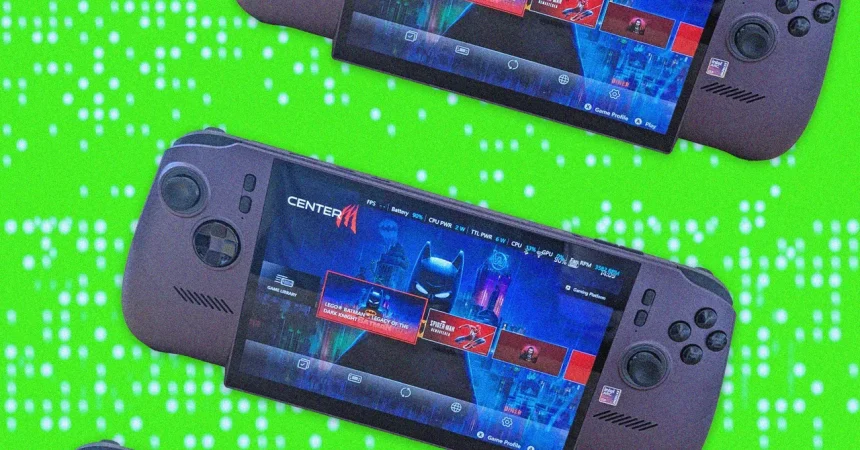
The latest handheld gaming PC to hit the market—the “Void Purple” Claw—is a masterclass in hardware connectivity and future-proofing. It manages to pack an impressive array of ports into a portable frame, including two Thunderbolt 4 USB-C slots, a microSD card reader, and a dedicated 3.5-mm audio jack. Beyond the immediate hardware, it’s built for longevity; the device supports the latest Wi-Fi 7 standards and features an accessible design that allows for SSD upgrades should you need more storage down the road. It feels like a device built for the long haul rather than a fleeting trend, successfully bridging the gap between a high-end mobile console and a traditional gaming rig.
The build quality is equally striking, featuring an etched micro-texture that gives the shell a premium, grippy feel that avoids the “cheap plastic” trap of many other handhelds. While the Xbox-style button layout is familiar and ergonomic, those with smaller hands might find the four system buttons flanking the screen a bit of a stretch. However, the analog sticks and triggers are the real highlight, utilizing Hall effect sensors that provide precise, reliable input while resisting the dreaded “stick drift” that plagues so many modern controllers. Even the D-pad feels substantial and chunky, though its glossy finish is admittedly prone to gathering micro-scratches over time.
Software-wise, the Claw offers a smart experience that hides the occasionally clunky nature of Windows 11 under a streamlined, Xbox-inspired interface. This “Xbox Mode” acts as a central hub, pulling in games from every storefront into one cohesive library. While the device strangely lacks a dedicated home button, the inclusion of two mappable rear grip buttons solves this issue immediately; one can be assigned as the system key, while the other can act as a shortcut for Steam’s Big Picture Mode. It is a thoughtful design choice that acknowledges how PC gamers actually want to navigate their libraries, making the transition from a desktop environment to a handheld console feel natural and intuitive.
One of the most surprising aspects of the Claw is its ergonomics. At 785 grams, it is undeniably heavier than both the Steam Deck and the ROG Ally X, yet it never feels like a burden. The weight is distributed so masterfully that you can play for hours without experiencing the wrist or hand fatigue often associated with heavier hardware. This comfort is paired with excellent advanced haptics that turn the “feel” of the game into a tangible experience, subtly mimicking explosions and environmental impacts. It is a handheld that feels refined, engineered specifically to be held and used for extended gaming sessions.
The display is a solid performer, even if it doesn’t quite hit the breathtaking heights of an OLED panel. The 500-nit IPS screen is sharp, bright, and vibrant, and the 120-Hz refresh rate with variable refresh rate (VRR) support keeps gameplay fluid and tear-free. The 16:10 aspect ratio provides a little extra vertical estate, which is a welcome luxury. Furthermore, the design team included a clever, subtle feature: the screen extends slightly below the main shell, allowing the device to stand vertically on its own. This makes it incredibly easy to dock the console to a TV without needing a bulky caddy, turning the Claw into a legitimate, space-saving living room console.
Ultimately, the true engine under the hood is the Intel Arc G3 Extreme chipset, which changes the game entirely. Built on the new Panther Lake architecture, it represents a massive generational leap over previous Lunar Lake chips, putting it in a league of its own compared to competing handhelds. When you combine this raw horsepower with Intel’s XeSS upscaling technology—which uses AI to boost frame rates and image quality—the resulting performance is nothing short of phenomenal. Whether you are aiming for high-fidelity graphics or smooth, competitive frame rates, the Claw demonstrates that the future of PC gaming isn’t just in your office; it’s comfortably resting in your hands.