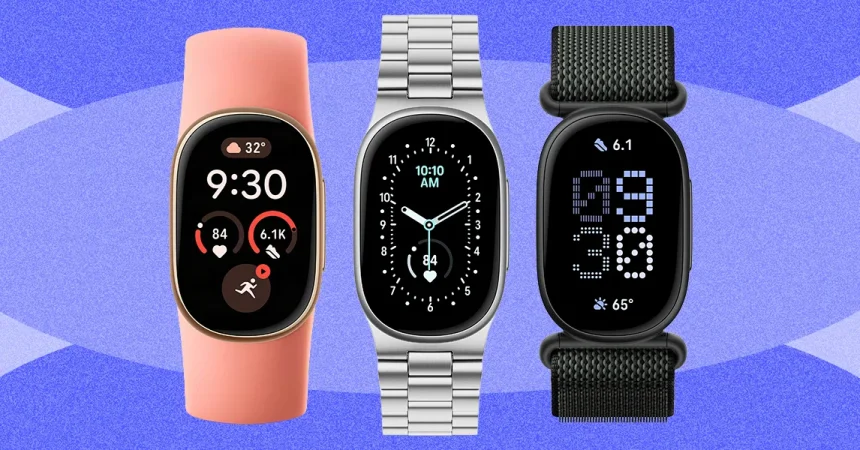
Honestly, a smartwatch is only as good as how it feels on your wrist. The Fitbit Edge seems to understand this, because no matter how many sensors it packs inside, the everyday experience begins and ends with the band. The Edge comes with Google’s Active Band, which is a perfectly fine strap for workouts but not the one I really want to wear all day long. I also tried the HNBR Active Sport, and while it feels durable and sporty, it didn’t do much for me aesthetically. Fortunately, Google offers plenty of alternatives: the breathable Performance Loop, the silicone Magnet band, the Metal Links band, and a few others. I found myself alternating between the Metal Links and the Performance Loop. The Metal Links looks sharp and polished, and it’s the option I pick when I’m going out to dinner or want to feel a little more put together. The Performance Loop is my go-to for everyday wear. Its micro-adjustable fit is great because you can dial in exactly how tight you want it, which is useful for workouts. But it’s also easy to over-tighten by mistake. I caught myself pulling it too tight several times, and on a few occasions, while I was adjusting it, the band popped loose from one side. It wasn’t enough to make me panic about losing the tracker, but the lack of security definitely nagged at me. I had to double-check the connection more often than I’d like, and eventually I realized the locking button was stuck. I had to fiddle with the mechanism before it clicked back into place, like a tiny piece of plastic had shifted out of alignment. It was one of those small maintenance issues that makes you respect the design a little less, even if the overall comfort is still there. The ability to swap bands easily is a nice feature though, and having so many options means you can make the Edge feel like yours. Whether you want something sleek for a night out or something light for a morning run, there’s a band for that.
The 1.34-inch display is the Edge’s big advantage over the screenless Air. I felt that difference most during workouts. When I was running outside, I could glance at my wrist and see my metrics without slowing down, and I could control my music without pulling out my phone. That might sound like a small thing, but when you’re mid-stride and trying to keep your rhythm, it makes a huge difference. I used the on-wrist controls to skip tracks and adjust volume, and it quickly became one of those features I didn’t want to live without. The display is also roughly twice as bright as the Charge’s, so it stays readable even in direct sunlight. I’ve lost count of how many screens I’ve had to shade with my other hand in the past, so this was genuinely nice. Google Maps integration is another winner. I’m someone who likes to explore new neighborhoods on foot or by bike, and being able to follow turn-by-turn directions from my wrist meant I could leave my phone in my pocket and still find my way. That said, I’m not completely in love with the software. Having used Wear OS, I prefer its more colorful and polished interface. Fitbit’s watch faces feel a little more basic and elementary by comparison, as if they were built for function first and style last. I missed being able to express my personality with a more lively face. But Fitbit’s software has a major counterpunch: up to seven days of battery life. The Pixel Watch can’t come close to that, and neither can most full smartwatches. The Edge also works with both iOS and Android, which makes it a much easier recommendation for people who don’t all use the same phone. Add in that cross-platform compatibility, and you’ve got a device that fits into your life rather than forcing you to switch ecosystems.
One of the most surprising things about the Edge is that it’s Google’s first repairable fitness tracker. The modular construction includes a replaceable battery, which is a big deal in a world where most gadgets are sealed shut and effectively disposable. It matches the Pixel Watch in that respect, and it’s probably no coincidence that the timing lines up with new battery regulations in the European Union. Those rules, which take effect on February 18, 2027, will require smartphones, smartwatches, and similar devices to have removable and replaceable batteries. It’s refreshing to see a company get ahead of a regulation like this instead of fighting it, because repairability is good for consumers and good for the planet. Repairability is one of those things you don’t think about until you break your gadget and find out it costs nearly as much to fix as to replace. A device you can keep for an extra year or two is a device that doesn’t end up in a landfill. I’d still like to see more repair options and easier access to parts, but this is an encouraging first step. Between the long battery life, cross-platform compatibility, and repairable design, the Edge feels like a practical choice. But the real reason most people will buy it is the health tracking, and that’s where the Edge takes its biggest leap forward.
Compared to the Charge 6, the Edge is a serious upgrade when it comes to health and fitness capabilities. Google has added more detailed workout metrics and a few hardware upgrades that make the Edge feel like a much more capable fitness companion. Some of the new features are aimed at long-term health tracking, and they’re the kind of thing you don’t appreciate until you need them. Like the Pixel Watch 5 and the Air, the Edge offers monthly blood pressure and insulin resistance trends. That might sound technical, but if you’re trying to keep your metabolic health in check, having those trends on your wrist is genuinely useful. The SpO2 readings have also been improved: instead of just giving you a one-time blood oxygen measurement, the Edge now shows nightly averages, ranges, and changes over time. That gives you a much better sense of what’s normal for you. There’s also 24/7 heart rate tracking, which has been a Fitbit staple for years, but now it’s paired with cardio load metrics. Cardio load helps you understand whether your training is actually making you stronger or just wearing you down. The updated ECG app is another standout, and it now includes atrial fibrillation detection. If you’ve ever felt your heart skip a beat or flutter for no obvious reason, having an ECG tool right on your wrist is equal parts fascinating and reassuring. I especially appreciated this because it gave me a way to keep an eye on things without making a doctor’s appointment every time I felt a little off. And for people who need to watch their blood sugar, the Edge goes even further. Alongside nutrition logging, you can pair it with a continuous glucose monitor, or CGM, and see glucose insights directly on the tracker. That level of health information is impressive for something that fits on your wrist and lasts a week on a single charge.
All that said, the Edge is not perfect, and there are a few things that keep it from feeling like a truly refined product. The workout experience is improved, but little quirks still show up. I loved the bright display during outdoor runs, but I occasionally found the touchscreen less responsive when my hands were sweaty, which is exactly when you need it to work. I found myself wiping my shirt before swiping, and that got a little annoying. The band issue I mentioned earlier also made me hesitate to trust the Performance Loop during long workouts, even though it was otherwise the most comfortable option. On the software side, Fitbit’s interface is clean and straightforward, but it lacks the visual energy of Wear OS. The watch faces are simple, and some feel a little childish compared to the customizable, expressive options you get elsewhere. But there’s a reason Fitbit keeps things simple: it’s efficient, battery-friendly, and focused on health data rather than flashy animations. For me, that trade-off is worth it, especially with a seven-day battery life. The Edge also works with both iOS and Android, which is a huge advantage in households where not everyone uses the same phone. And if you’re someone who likes to keep a device for years rather than upgrading every cycle, the repairable battery is a strong selling point. The workout metrics are detailed, but there’s a learning curve to understanding what they all mean. Still, once you get used to the system, it becomes a helpful part of your daily routine. It feels like Google is finally listening to people who want their gadgets to last longer and work better, not just look more impressive in a spec sheet.
At the end of the day, the Fitbit Edge feels like two steps forward and one step back. The health and fitness upgrades are substantial, and the display is a clear step up from the screenless Air. The seven-day battery life, cross-platform compatibility, and repairable design make it a smart, practical choice for anyone who doesn’t want to be tethered to a charger every night. But the band fastening issue, the occasional software bug, and the underwhelming watch faces remind you that there’s still room to grow. After several weeks with the Edge, I’ve come to appreciate it as a companion rather than just another gadget. I no longer panic when I forget my charger, because one full charge can get me through a work trip. If you care less about smartwatch bells and whistles and more about tracking your health in a thoughtful, comprehensive way, the Edge is easy to recommend. It gives you the data you need without demanding constant charging, and it works with whatever phone you already own. When you want to dress it up, switch to the Metal Links band. For daily comfort, choose the Performance Loop—just be mindful not to pull it too tight. You might even get a few extra years out of the Edge thanks to the replaceable battery, which is more than you can say for most fitness trackers. The Edge isn’t perfect, but it’s a meaningful step in the right direction. It proves that a fitness tracker can be both smart and sustainable, and it gives you a reason to feel good about the device on your wrist—not just for what it tracks, but for what it represents: a future where our gadgets are made to last and to serve us better.