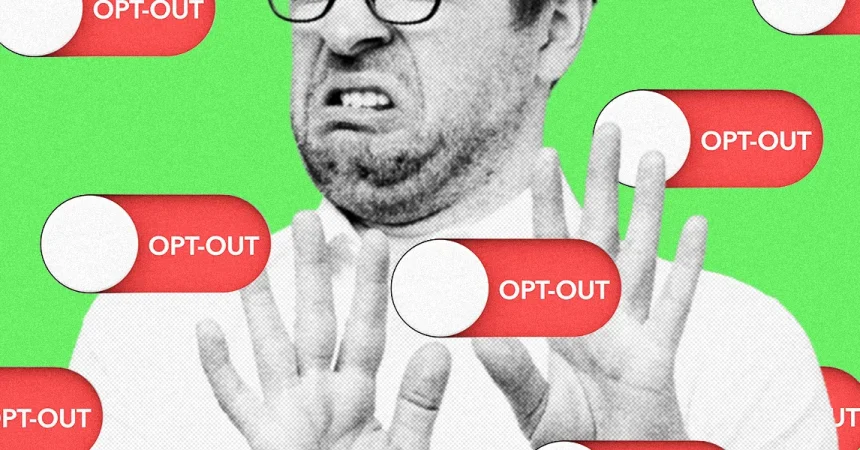
The modern digital landscape has become an endless obstacle course of “opt-out” settings, particularly concerning the aggressive integration of generative AI. Every major software update now seems to arrive with a new suite of experimental features already toggled to “on,” effectively turning millions of users into unwitting test subjects for algorithmic data processing. This approach is not merely a design choice; it is a fundamental shift in the power dynamic between companies and their customers. By burying these invasive settings deep within sub-menus or assuming consent through silence, tech giants are prioritizing the rapid advancement of their machine learning models over the basic digital autonomy of the people who actually use their platforms.
The frustration surrounding this practice is rooted in a simple expectation of agency. When a company pushes a feature that harvests data to train a large language model or embeds AI directly into a private workflow, the default should never be automatic enrollment. For years, we have grown accustomed to the “opt-in” model as the standard for meaningful consent—the idea that you must explicitly invite a tool into your private sphere before it starts analyzing your habits. When developers switch that standard to “opt-out,” they are essentially gambling that most users will either be too overwhelmed by complex interfaces to notice or too inconvenienced to hunt for the off switch. It is a cynical maneuver that treats user data as a free resource to be mined rather than a private asset to be protected.
We must recognize that “opt-out” toggles are often designed as dark patterns. They are frequently obscured by dense, legalistic jargon in service agreements, or hidden behind layers of settings that require a significant investment of time to navigate. For the average person trying to accomplish a task—whether it is drafting an email, editing a photo, or managing a spreadsheet—the expectation that they should spend their morning auditing privacy settings is entirely unreasonable. By making consent the exception rather than the rule, companies are essentially weaponizing convenience. They know that if a switch is already flipped, most people will leave it that way, which allows organizations to claim widespread “adoption” of their AI tools while ignoring the fact that the participation was passive at best and coerced at worst.
Establishing “opt-in” as the universal default for all generative AI features that interact with sensitive or personal data is a necessary step toward re-establishing trust. This shift would force companies to prove the value proposition of their AI before claiming access to user information. If a feature is truly beneficial, users will enthusiastically choose to turn it on once its utility is explained, rather than being forced to endure a “surprise” integration. Setting “opt-in” as the standard would also hold companies accountable for the quality of their AI projects. Instead of relying on a massive, captive dataset automatically fed by millions of users, corporations would have to design features so compelling that people feel compelled to invite those features into their digital lives.
Furthermore, the ethical implications of the status quo cannot be overstated. Generative AI models thrive on the breadth and depth of the information they ingest, and when that information is scraped from private interactions without explicit permission, it creates a massive gray area regarding intellectual property and personal privacy. We are currently living through a period where the barrier between our private thoughts—drafted in private files and documents—and public-facing AI training sets is dangerously thin. By demanding that AI features be opt-in, we are effectively setting a boundary that states our creative and administrative output is our own until we decide, with full awareness and consent, to share it with a neural network. It is a necessary safeguard for the preservation of creative integrity and personal privacy in an era of hyper-automation.
Ultimately, the fight to change the default from “opt-out” to “opt-in” is a fight for the basic integrity of our digital futures. We have reached a point where the sheer reach of artificial intelligence necessitates a new social contract between tech developers and the people they serve. We no longer want to be passive participants in the expansion of an industry that treats our workflows as training weight; we want to hold the steering wheel. If generative AI is to become a truly useful and ethical partner in our work, it must rely on explicit, informed, and enthusiastic consent. It is time to treat the user’s right to ignore or reject an AI feature with the same level of respect as the feature itself. The age of silent, automatic data extraction must end, and the era of proactive, conscious participation must take its place.