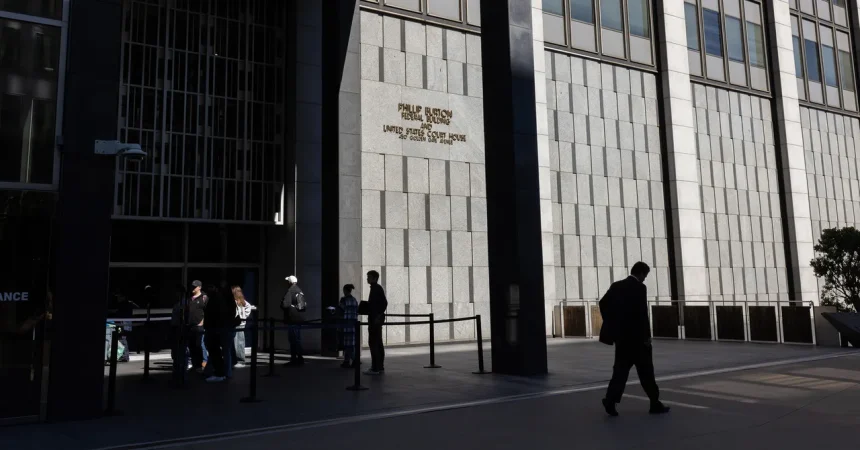
The San Francisco courtroom was packed on Monday, a rare and telling sign of how much attention one man’s case has drawn. In the middle of it all sat Abdulrahman Alfozan, a former OpenAI engineer, dressed in an orange prison uniform with a surgical mask pulled down around his neck. He appeared calm but somber as federal magistrate judge Alex Tse prepared to decide whether he would spend the coming months in custody or be allowed to await trial at home. Alfozan is accused of bugging a conference room at OpenAI, a charge that sounds almost quaint in an era of sophisticated cyberattacks, but the circumstances around it have turned an ordinary corporate espionage case into an international incident. The courtroom was filled to capacity with journalists, students on a field trip, and roughly twenty supporters who had come to show their belief in Alfozan. Their presence did not seem to sway the judge. Tse ruled that Alfozan must remain in custody, explaining that the risk of him fleeing the country was simply too high. The decision was a major blow to Alfozan’s legal team, which had argued that there was no reason to keep him locked up. But for the judge, the bigger question was not whether Alfozan had committed the crime, but whether he could be trusted to show up for trial if released. And on that question, the court’s answer was a firm no.
The heart of the government’s argument was that Alfozan is a flight risk because he has strong ties to Saudi Arabia, his native country, and because the Saudi government itself appears willing to help him. Prosecutors alleged that Saudi officials have offered to support Alfozan with no strings attached, and they pointed to a particularly striking detail: the Saudi consulate reportedly offered to work with a bail bonds firm to help fund his release. To the judge, that offer was not a comforting sign of community support but a dangerous blank check. “It seems like a blank check. ‘We’re going to pay whatever the court wants to get him out,’” Tse said. He also questioned whether Alfozan might be considered an “asset” for the kingdom, a term that carries heavy geopolitical weight. If the Saudi government was so eager to secure Alfozan’s freedom, the judge reasoned, it might also be eager to help him disappear. Tse made clear that he would have been more reassured by family members willing to put up their own property or savings as collateral. Alfozan’s attorney, William Pernik, dismissed the flight risk concerns as baseless, insisting that his client had no intention of running. But the judge was not convinced. “There is a real threat here that once he leaves the case is over,” Tse said. It was a stark and simple summary of the court’s fear, and it hung over the courtroom as Alfozan’s supporters looked on helplessly.
The case is unusual not because an employee allegedly tried to steal confidential company information, a problem that is common in Silicon Valley, but because of the amateur spycraft and geopolitical tensions involved. Authorities have not offered a clear motive for why Alfozan would allegedly bug a conference room at OpenAI. But they have noted that he has worked for a Saudi venture capital firm, offered consulting services to Saudi companies, and is supposedly friendly with people high up in the Saudi government. Prosecutors also alleged that Alfozan was in frequent communication via WhatsApp with a member of the Saudi royal family throughout 2025 and 2026. Those connections are not crimes in themselves, but they help explain why the government sees him as a potential flight risk. Alfozan is a U.S. permanent resident who had been on the path to obtaining citizenship, and his lawyers have tried to paint him as someone with deep roots in America. But his ongoing ties to Saudi Arabia, especially at such a high level, have made it hard for the court to trust that he would remain in the country if given the chance to leave. For Alfozan, this means the very connections that might have made him an attractive hire in the world of international business and technology have now become the evidence used to keep him behind bars.
The alleged crime itself has also drawn attention for its strangely low-tech nature. According to the government, Alfozan is accused of planting a listening device in an open conference room at OpenAI, a place where anyone could supposedly work. There was no elaborate hacking scheme, no stolen laptops, no encrypted messages discovered in the dead of night. Instead, the case has been described as a clumsy attempt at espionage, the kind that seems more suited to a spy novel than a cutting-edge artificial intelligence company. Pernik, Alfozan’s attorney, seized on this point during the hearing. “It’s not as if he sneaked in under the covers of darkness,” he said. “This was an open room where anybody could work in.” The defense argues that the government has not provided any evidence that Alfozan was spying for Saudi Arabia or engaging in some covert operation. There is no proof, they say, that he intended to pass secrets to foreign agents or that he even understood the device would be considered espionage. But the judge was less interested in the specifics of the alleged bugging than in the bigger picture of Alfozan’s loyalties. Even if the act itself was amateurish, the stakes were enormous. OpenAI is one of the most important companies in the world, at the center of the artificial intelligence boom, and any attempt to eavesdrop on its internal discussions would naturally raise alarm bells far beyond Silicon Valley.
After the hour-long hearing, Pernik spoke to reporters outside the courtroom and expressed his disappointment with the custody ruling. He said he would continue to fight the decision, but for now Alfozan remains in jail, awaiting a trial that could take months to begin. The legal battle ahead will likely focus on two separate questions: whether Alfozan committed the crime he is accused of, and whether the government’s portrayal of him as a foreign asset is fair or simply an overreaction based on his Saudi nationality. The first question is a matter of evidence, but the second is more subtle and more troubling. In a country that has often struggled with how to treat immigrants and foreign-born residents during times of geopolitical tension, Alfozan’s case raises uncomfortable questions about whether ties to one’s home country can ever truly be left behind. His lawyers argue that he is being punished for his associations rather than his actions, and that the Saudi government’s offer to help with bail, however unusual, should not be treated as proof of guilt. But the court sees it differently. From the judge’s perspective, a man with powerful friends in a foreign government, no apparent reason to stay, and an allegedly serious criminal charge hanging over him is exactly the kind of person who might decide to disappear.
The case is ultimately a collision between the open culture of Silicon Valley and the closed world of international intelligence. For years, companies like OpenAI have thrived on the free exchange of ideas, hiring talent from all over the world and encouraging collaboration across borders. But that openness also creates vulnerabilities, and when an employee is accused of using it to spy, the fallout can be severe. Alfozan’s case has become a cautionary tale, not just for would-be corporate spies, but for the many foreign-born engineers and researchers who work in America’s technology industry. It shows how quickly a promising career can be derailed by allegations, and how difficult it can be to prove that you belong in a country when powerful forces abroad seem to be pulling you away. For Alfozan, the immediate future is clear: he will remain in custody, trading his former life as a tech professional for a jail cell, while his lawyers try to convince a skeptical judge that he is not a flight risk. But the larger questions raised by his case will not be resolved so easily. What does it mean to be loyal to a country? Can a person have roots in two places without being torn apart? And how should the justice system balance the need for security against the presumption of innocence? As Alfozan awaits trial, those questions will continue to echo through the courtroom, far beyond the strange story of a listening device in a conference room.