Here is a humanized and expanded interpretation of the provided content, structured into six detailed paragraphs that build upon the original ideas, elevate the narrative, and dive into the emotional and horological nuances of this compelling 38mm Speedmaster.
Paragraph One: The First Glance and the Siren Call of the Black Dial
When a watch is designed with the kind of precision that whispers rather than shouts, it immediately demands a closer look. This new 38-millimeter Speedmaster embodies exactly that quiet confidence. My eyes are first drawn to the uncluttered expanse of the dial, a pure, matte black with a subtle varnish that catches the light in a way that makes the surface look almost liquid yet completely flat—it is supremely legible, a tool watch aesthetic that refuses to be dressed up beyond its means. The reduction in size from the standard professional model instantly shifts the character of the piece; it feels more intimate, less like a piece of cockpit machinery strapped to the wrist and more like a sophisticated everyday companion. The black aluminum bezel, a material that has thankfully been refined over the years, now possesses a depth and consistency that the older, faded steel inserts could never achieve. It is smooth to the touch, matte in finish, and it frames the crystal beautifully. As I trace my gaze around the case, memories of a specific watch from the late 1980s surface—the classic Speedmaster Reduced. It is a name that evokes a specific era of luxury sports watches, and this new release is clearly a spiritual heir, borrowing its proportions, its sleek profile, and its undeniable charm. The immediate reaction is not one of mere approval, but of deeply felt nostalgia, a recognition of a silhouette that many of us have admired on the wrists of friends, mentors, and in the pages of vintage catalogues, and that has always represented the perfect intersection of form and function.
Paragraph Two: The Friend, The Covet, and the Goldilocks Size
For years, a close friend of mine has owned an original Speedmaster Reduced, and I have coveted that piece with a persistence that borders on obsession. Every time we meet for coffee or dinner, he wears it, and every time he moves his hand, my gaze follows that domed hesalite crystal and the way the light plays across those subdials. It always looks perfect on his wrist—not too large, not too small, but just the right weight and presence to feel substantial yet refined. The genius of that 1988 model was its case diameter of 38.5-millimeters. That half-millimeter difference from this new 38-millimeter iteration might seem negligible on paper, but in the metal, it is the difference between a watch that feels like a tailored suit and one that feels like a borrowed jacket. The 38.5mm case had a specific presence; it wore larger than its dimensions suggested thanks to the integrated bracelet design, but it never dominated the wrist. It was the perfect bridge between the petite watches of the 1930s and the oversized tool watches of the 2000s. This new 38mm version clearly aims to capture that spirit, but it also has its own distinct character. It is a delicate balancing act—honoring the past while carving out its own identity. When I see my friend’s watch, I see a piece of history, a testament to a time when watchmakers understood that precision didn’t require bulk. I yearn for that specific proportion, and this new offering feels like a chance to finally possess that elusive “Goldilocks” size, even if it’s a slightly tighter fit.
Paragraph Three: The Devil is in the Details – Crown and Bezel
However, for all the nostalgic pull, a connoisseur knows that the true fidelity of a modern reinterpretation lies in its subtle, seemingly insignificant details. When I hold this new 38mm up next to the mental image of my friend’s vintage Reduced, the differences begin to materialize. The most obvious departure is in the positioning of the crown. On the original Reduced, the crown sits lower on the case, visibly offset from the chronograph pushers. This asymmetry is a hallmark of that specific design, a deliberate choice to accommodate the movement’s architecture, giving the case side a distinct, almost stepped character. This new model, however, places the crown in line with the pushers, a more symmetrical and modern approach that aligns it with the traditional Moonwatch. Additionally, the bezel tells a fascinating story. On the original Reduced, the famous “Dot Over Ninety” (or DON) detail on the tachymeter bezel is absent—the “90” is placed on the same level as the “70”. This new 38mm follows suit, omitting the DON marker. To the untrained eye, these are negligible quirks, but to a collector, they are the fingerprints of history. The placement of the crown dictates how the watch sits on the hand and how it interacts with the wearer’s wrist; the bezel font and alignment speak to the manufacturing processes of a bygone era. Acknowledging these differences is not a criticism; rather, it is an open admission that this watch is not a museum replica, but a modern descendant, free to evolve while carrying the family DNA. The human connection here is the joy of learning these details—the excitement of spotting the tiny disparities that make a watch a source of endless conversation and quiet, knowing smiles among fellow enthusiasts.
Paragraph Four: The Biggest Giveaway – The Subdial Geometry
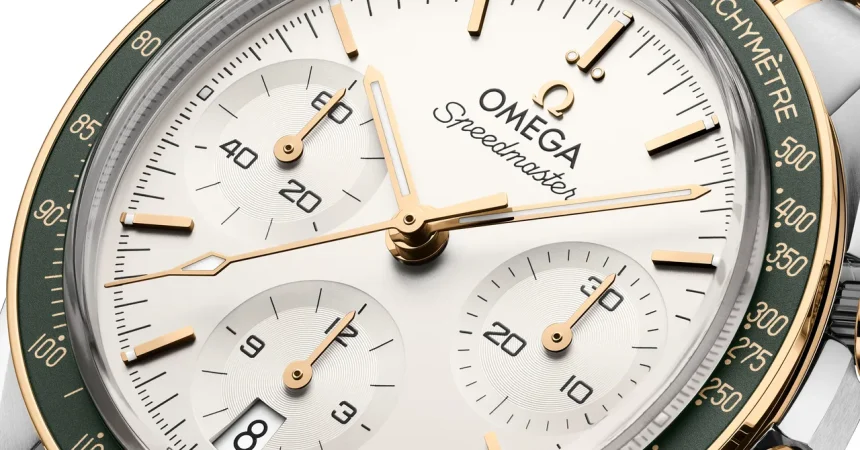
If the crown and bezel are the subtle clues, the subdial layout is the undeniable exclamation point. The most obvious way to distinguish this new 38-millimeter piece from the original Reduced is to look at the arrangement of the tiny chronograph counters. On the 1988 Reduced, the layout was specific: running seconds occupied the 3 o’clock position, a 12-hour totalizer sat at 6 o’clock, and a 30-minute totalizer was placed at 9 o’clock. This 3-6-9 configuration was a signature of that movement, a logical and balanced arrangement. This new 38mm version completely flips that script. It reverses the layout, placing the 30-minute totalizer at 3 o’clock, the running seconds at 9 o’clock, and leaving the 6 o’clock position for the 12-hour counter. This is not a minor tweak; it’s a complete re-architecture of the dial’s visual weight. The reversed layout is, in fact, exactly the configuration found on the larger, professional Moonwatch—the 42mm icon that went to space. This means the designers have deliberately chosen to align the aesthetics of this smaller model with the Moonwatch family rather than the Reduced family. When I look at this dial, my brain initially registers the familiar Speedmaster silhouette, but upon closer inspection, the twist of the subdials creates a refreshing puzzle. It bridges two generations, taking the compact wearability of the Reduced and marrying it to the iconic dial architecture of the Moonwatch. It’s a clever move that allows the wearer to enjoy a smaller case while still carrying the exact visual pedigree of the Apollo-era chronograph.
Paragraph Five: Redefining the Concept – A “Mini Moonwatch”
Given these modifications, it is entirely right to shift our perspective. Rather than viewing this piece as a direct reissue of the Reduced, we should embrace it for what it truly is: a brilliantly executed “Mini Moonwatch.” This is the most logical and compelling way to understand the design decisions. The core DNA is unmistakably that of the Omega Speedmaster Professional—the lyre lugs, the central chronograph seconds hand, the iconic black bezel, and now the reversed 3-6-9 subdial layout perfectly replicate the look of the 42mm legend in a more accessible, contemporary size. The “Mini Moonwatch” moniker is not a diminishment but an invitation. It captures the spirit of exploration and the rugged, go-anywhere mentality of the original NASA-tested chronograph, but scales it down to fit the wrists of those who find the 42mm case too imposing. It is for the watch collector who appreciates the history but prioritizes everyday comfort. When I strap this watch on, I am not pretending to be a pilot or an astronaut; I am celebrating the design legacy in a way that fits my life. The matte black dial and the slim profile make it a versatile piece, capable of wearing with a suit to a board meeting or with a t-shirt on a weekend adventure. It conjures up the memory of the ’80s Reduced, but it boldly steps forward as a statement that a smaller watch does not mean a lesser watch—it simply means a more considered, personal choice.
Paragraph Six: The Final Reward – Value and Skinny Wrists
And then there is the matter of price. Omega has positioned this 38mm Speedmaster as the most accessible entry point into the “Moonwatch” family. It is significantly more affordable than its 42mm siblings, offering the undeniable prestige, the superb finishing, and the heritage of the Swiss marque without requiring a second mortgage. This strategic pricing is a welcome relief in a market where prices often feel detached from reality. But the real payoff is the physical reward for those of us with slimmer wrists. For years, the watch industry’s trend toward massive case sizes marginalized a significant portion of the buying public. Those of us with 6-inch wrists were forced to either wear oversized dinner plates that drooped over our delicate bones or step down to 34mm dress watches that felt too delicate for daily sports use. This 38mm watch is the triumphant answer to that dilemma. It is a rare, almost unicorn-like scenario where the industry has given us exactly what we want: a legitimate, beautifully crafted tool watch that fits perfectly without compromise. Wearing this watch is a quiet victory. It is a reward for years of watching sizes balloon and waiting for common sense to prevail. It is a statement that style is not about the sheer volume of metal on the wrist, but about the harmony of proportions, the clarity of the dial, and the weight of history carried comfortably against the skin. It is, to put it simply, a triumph for those of us who have always known that sometimes, less truly is more.