Paragraph 1: The Unexpected Ringtone Shatters the Corporate Ritual
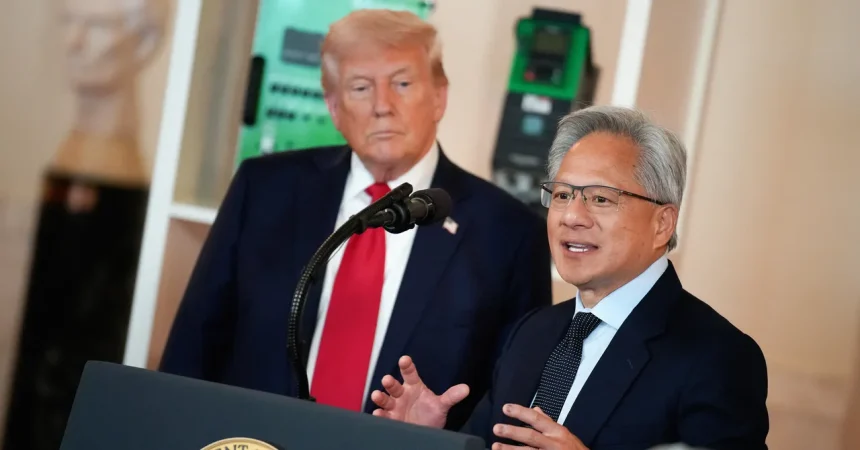
The Santa Clara headquarters of Nvidia usually hums with a quiet, focused energy during CEO Jensen Huang’s all-hands meetings. It is a meticulously choreographed ritual where the leather-jacketed leader takes the stage, walking back and forth with the easy confidence of a professor delivering a masterclass, fielding questions from a live audience of eager employees while thousands of remote workers tune in from around the globe, their screens lighting up the digital ether. It is a bastion of predictability, a carefully calculated display of corporate strength and technological bravado in a city that worships at the altar of the silicon wafer. But on Thursday morning, that carefully constructed rhythm was shattered by the most unexpected of intrusions—a call from the highest office in the land. Mid-presentation, Huang’s mobile phone buzzed. Without a word of explanation, he stepped aside, leaving the stage momentarily vacant, a vacuum of awkward silence that stretched far longer than the few seconds it actually took. As he answered, the unmistakable, gravelly cadence of Donald Trump’s voice erupted through Huang’s onstage microphone—a surreal audio leak that bypassed the bounds of secure conference lines and landed directly in the ears of thousands of stunned employees. Staffers could hear the president clearly, though the specific words were muffled, drowned out by the sheer absurdity of the moment. They looked at each other, some stifling laughter, others exchanging wide-eyed glances of disbelief category shattering the carefully maintained illusion of corporate control. It was a raw, unscripted moment of political gravity piercing the pristine bubble of Silicon Valley success—a brief but potent reminder that in the age of AI, the world’s most valuable chipmaker is no longer just a tech company but a national asset, subject to the whims and social schedules of the leader of the free world.
Paragraph 2: The Aftermath and the Astronomical Numbers
The phone call lasted less than a minute, ending almost as abruptly as it began, but its ripple effects spanned far beyond the stage in Santa Clara. As Huang returned to his podium, a wave of hushed whispers and raised eyebrows swept through the roomig audience; remote viewers, who had watched the silent, awkward pause, were left to speculate wildly on internal chat channels. A spokesperson for Nvidia declined to comment, a standard corporate deflection that nevertheless did little to quell the storm of gossip. But the universe of the call was made abundantly clear just hours later when President Trump took to social media to shower praise on Nvidia’s “incredible” quarterly sales and a jaw-dropping financial forecast. Nvidia had just reported second-quarter revenue of $96 billion, a staggering 106 percent increase year-over-year—a figure that dwarfs the GDP of many small nations and solidifies the company’s place as the undisputed king of the artificial intelligence gold rush. The casual yet politically potent gesture—a president dialing a CEO in the middle of a corporate town hall—was a naked display of the symbiosis between the White House and Silicon Valley’s most valuable engine. For Huang, who routinely “jet-sets” to Washington to grease the wheels of policy, this was not a novel experience. But for the thousands of employees watching the livestream, it was a jarring, unforgettable reminder that their boss operates in a rarified atmosphere where heads of state are just a phone call away, and that the company’s fate is now inextricably woven into the fabric of national politics.
Paragraph 2: A Stolen Glance into the CEO’s Heated Politics
The scene was surreal, almost cinematic. Staffers could hear the muffled but unmistakable timbre of Trump’s voice spilling from Huang’s device, the words obscured but the tone undeniable. Huang, ever the composed showman, stepped to the side, listened intently for less than sixty seconds, and then seamlessly resumed his presentation, as if a presidential call were just another routine email. But the disruption had already worked its magic—the glass-walled bubble of corporate normalcy had been shattered rankled by the unmistakable weight of geopolitical influence. Within hours, Trump took to social media to praise Nvidia’s “incredible” quarterly sales and its rosy, year-ahead forecast. The numbers tell the story of why the President felt compelled to dial in: Nvidia had just reported a staggering second-quarter revenue of $96 billion, a 106 percent surge compared to the same period last year. These numbers aren’t just impressive; they are otherworldly, representing a hyper-growth trajectory that dwarfs almost any other publicly traded company in history. For Trump, whose political brand is built on narratives of American dominance and economic strength, a company like Nvidia is the ultimate trophy. Boosting this semiconductor titan aligns perfectly with his “America First” agenda, framing national pride in terms of market capitalization and AI infrastructure. This call, however brief, served as a direct line of communication that bypassed formal briefings and press releases. It signaled a personal relationship that transcends mere political courtesy. It hinted at the back-channel deals, the whispered promises of favorable export controls, and the tacit understanding that Nvidia’s chips are the strategic equivalent of oil reserves in the 21st-century power struggle. For Huang, who has mastered the art of diplomatic ambiguity—visiting the White House while simultaneously courting international regulators—this call reinforces his status as a kingmaker, a man who can chat with a president over lunch and still drive a hard bargain in closed-door meetings on defense contracts and AI safety.
Paragraph 3: The Strategic Pivot – PACs and Political Currency
Yet, the warm, congratulatory tone of the Thursday call belies a much colder, more complex strategic dance unfolding behind the scenes. In a move that speaks volumes about the shifting landscape of AI politics, Nvidia announced the creation of a new employee-funded political action committee (PAC) on the very same day as the presidential interruption. This is a calculated, deliberate step. For years, Nvidia has often adopted a quiet, behind-the-scenes lobbying approach, relying on the technical acumen of its executives to sway policymakers. But the announcement of a PAC signals a more aggressive, arms-length engagement with the messy reality of federal elections. The company can no longer afford to be a passive observer in Washington; the debate over AI policy is no longer a niche topic for tech insiders, it is a bipartisan battleground concerning existential issues like national security, labor displacement, and the very nature of free speech online. By creating a PAC, Nvidia is building a war chest to support federal candidates who align with its vision of rapid AI deployment, minimal regulatory friction, and expansive data-use rights. Humanly speaking, this is the corporate equivalent of a high-school student suddenly deciding to run for class president—a recognition that you can no longer rely on your grades alone to get you into the good college. Nvidia must now curry favor, build networks, and ensure that its voice is not drowned out by the cacophony of competing interests, from Big Tech rivals to national security hawks.
Paragraph 4: The Tightrope Walk Between Cooperation and Conflict
The irony of Trump’s jovial call is that Nvidia’s relationship with the administration has been far from harmonious. Behind the handshakes and the social media congratulations lies a series of knife-edge disagreements that could define the future of global technology. One of the most contentious flashpoints is the regulation of open-source AI models. The Trump administration, leaning heavily toward a national security lens, has pushed for stricter controls on the release of powerful open-source models, fearing that unfettered access could allow adversaries to weaponize AI. Nvidia, whose GPUs are the foundational hardware for virtually every AI model, has publicly pushed back, arguing for a more innovation-friendly framework that doesn’t stifle the open-source community that fuels its ecosystem. Similarly, the sale of advanced chips to China remains a thorn in the side of the relationship. Nvidia has repeatedly engineered chips to comply with US export controls while still capturing the lucrative Chinese market—a high-wire act of regulatory loopholes and political pandering. Trump’s direct call, therefore, was not just a pat on the back; it was likely a moment of quiet negotiation, a proverbial arm around the shoulder to ensure that Nvidia remains aligned with the administration’s hawkish stance on China, even as Huang privately pragmatizes about the billions of dollars at stake. It is a delicate balance of mutual dependency—Trump needs Nvidia for national security dominance, and Huang needs Trump to keep the export spigot open to the global market.
Paragraph 4: The Corporate Pivot to Political Engagement
Adding an intriguing layer to this political entanglement is the announcement of a new, employee-funded political action committee (PAC) by Nvidia on the very same day. This was not a coincidence. The timing reveals a company acutely aware that its future is no longer determined solely by engineering wins or quarterly earnings, but by the capricious winds of federal legislation, export controls, and diplomatic squabbles. While Nvidia has historically relied on the persuasive power of its technology and the charm of its CEO in closed-door meetings, the creation of a PAC signals a strategic shift toward direct financial influence in the political arena. It is a sobering acknowledgment that as AI moves from research labs to national security ministries, the company must buy a seat at the table where laws are written)Skip. The PAC will fund federal candidates—presumably those who understand the necessity of relaxed export controls, or who propose tax incentives for domestic chip manufacturing. This is classic corporate survival in a polarized climate. But the announcement on the same day as Trump’s call creates a potent subtext: it suggests that Nvidia is hedging its bets, preparing to engage in a political landscape that is far more volatile than the steady stream of data-center orders it processes. The relationship between Nvidia and the Trump administration is not one of simple friendship; it’s a transactional, high-stakes marriage of convenience. Trump needs Nvidia to maintain its global preeminence and strengthen the American economy before the next election. Huang needs Trump to ease regulatory restrictions, provide favorable defense contracts, and perhaps most importantly, avoid the kind of punitive antitrust scrutiny or export bans that could cripple his supply chain. The press call is a public embrace, but the PAC is the silent insurance policy, a way to hedge bets across the political spectrum in the event the political winds shift, while ensuring the company has a seat at the table when critical legislation regarding AI chips, open-source models, and national security is drafted.
Paragraph 5: The Hugging Face Bombshell and the Irony of Openness
While the world focused on the presidential phone call, a far more consequential corporate storyline was quietly circulating in the tech press: The Information reported that Nvidia is in advanced talks to acquire Hugging Face, the beloved open-source platform that has become the de facto repository for AI models and datasets. The potential price tag, a staggering exceeds $13 billion, would make it one of the largest acquisitions in AI infrastructure history deserts the typical M&A landscape. Humanizing this move requires understanding the philosophical paradox at its core. Hugging Face is the cathedral of the open-source movement—a platform where independent researchers, academics, and scrappy startups freely share their transformer models and tools, democratizing access to the most cutting-edge AI technology. Nvidia, by contrast, is the crown jewel of proprietary hardware, winning its fortune by selling high-performance chips that power the very models hosted on Hugging Face. An acquisition would officially put the planet’s leading chip maker in charge of the world’s largest open-source AI repository乐. This is a marriage of convenience, not ideology. For Nvidia, owning Hugging Face would be an unbeatable moat, locking in a massive ecosystem of developers who rely on the platform to test and deploy their models using Nvidia’s CUDA architectureive unit. It would also give Huang unprecedented visibility into the bleeding edge of AI research, allowing him to fine-tune his hardware roadmap based on the wildest experiments of the open-source community. Yet, it also risks alienating that very community, which has built its reputation on independence and resistance to corporate control. The philosophical irony is profound: a company that thrives on proprietary, closed architectures is about to own the hearth of openness. Such a deal, valued at over $13 billion, would almost certainly trigger lengthy antitrust reviews, forcing Nvidia to navigate a complex legal and political minefield just as it deepens its relationship with the presidential administration.
Paragraph 6: A Snapshot of a New Gilded Age
Ultimately, the brief, fuzzy voice of the President echoing through a corporate auditorium is much more than a quirky anecdote; it is a vivid snapshot of the new Gilded Age, where the lines between corporate power and executive authority are not just blurred, but practically erased. The incident reveals a fundamental truth about the AI era: that the most important conversations about the future of technology are no longer happening in boardrooms or sandboxed coding forums, but in phone calls between the head of state and the richest industrialist of the day. For the employees watching from their desks, the call was a powerful morale booster—a validation that their work sits at the very heart of the American economy and geopolitical strategy. Yet, it also carried a subtle undercurrent of unease, a reminder that their company’s trajectory is now subject to the volatile whims of political climate change just as much as market forces. The juxtaposition of the massive PAC formation, the pursuit of a controversial open-source acquisition, and the President’s personal phone call paints a picture of a corporation operating at the peak of its power, yet facing unprecedented scrutiny and fragility. One wrong move on China policy, one misstep in the AI safety debates, and the mighty juggernaut could face regulatory retribution or public backlash. But for now, the story is one of triumph—a CEO taking a personal call from the leader of the free world to accept congratulations on a quarterly report that would make any industry titan weep with envy. As Huang put the phone down and smoothly continued his presentation, the message was clear: the boundary between Silicon Valley innovation and Washington power has dissolved entirely. What remains is a symbiotic, often contentious, dance of mutual dependence, played out in real-time in front of a virtual audience of thousands—a fitting prologue to the coming age of artificial intelligence, where the most powerful players hold both the microchips and the ear of the President.