Paragraph 1: The Vision Versus the Vehicle
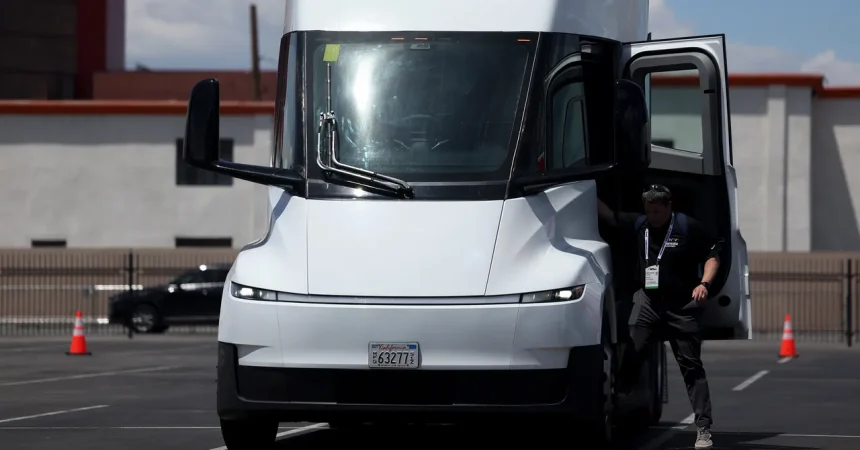
At first glance, there was something almost comical about the scene unfolding on a Thursday evening in Sparks, Nevada. Here was Tesla, a company whose CEO, Elon Musk, had spent the better part of two years insisting that the world should stop thinking of his automaker as an automaker at all. Musk had been telling investors, with the kind of messianic certainty that has defined his career, that Tesla was now a robotics and artificial-intelligence company, a bet so enormous that it could one day justify a $20 trillion valuation—roughly four times the current market value of Nvidia, the semiconductor giant that has become the poster child for the artificial-intelligence boom. It’s a grand, shimmering vision, the kind that makes for glowing conference keynotes and breathless podcast appearances. But on this particular evening, the grand vision was set aside. There was no humanoid robot on stage, no talk of a self-driving robo-taxi network that could lull passengers to sleep as it weaves through city streets. Instead, the Tesla team was in Nevada to talk about a truck. Not a futuristic, cybertruck-inspired wedge that doubles as a living room, but a big, hulking, Class 8 heavy-duty hauler—the workhorse of America’s highways, the kind of machine that ships the goods that fill the shelves of superstores and the warehouses of suburban America. And that, right there, is the beautiful irony at the heart of Tesla’s Semi launch event. While Musk dreams of a $20 trillion future built on software, robotics, and artificial intelligence, his company is still, at its core, a car company. And not just any car company—one that had just taken a nearly decade-old concept and finally figured out how to build it at scale, in a factory that stretches across the high desert of northern Nevada, under the watchful eyes of the cost-conscious, bottom-line-obsessed people who manage sprawling trucking fleets. The event was invite-only, livestreamed to the faithful, but its audience was unmistakably niche: the men and women who decide whether a truck is worth the dent it puts in their profit margins. They didn’t come for the robots. They came for a vehicle that could one day save them money on diesel, labor, and maintenance.
Paragraph 2: A Long-Awaited Debut, Minus the Ringmaster
The Tesla Semi’s journey to the production line has been long and often frustrating, a saga that began in late 2017 when a sleek, futuristic-looking prototype rolled onto a Tesla stage, much to the delight of a crowd that had grown accustomed to Musk’s theatrical presentations. Back then, the Semi looked like a prop from a science-fiction film, all rounded edges and pillarless cab, capable of hitting 60 miles per hour in five seconds—empty or hauling 80,000 pounds. The promises were grand: a range of 500 miles on a single charge, a price tag that made economic sense for a fleet operator, and a driver experience that would feel less like piloting a lumbering behemoth and more like driving a sports car. The concept was meant to disrupt an industry that had seen precious little innovation since the advent of the diesel engine. But nearly a decade later, the Semi’s journey from prototype to production has been defined by delays, redesigns, and more than a few broken promises. On this evening, however, Tesla was finally ready to celebrate. The factory in Sparks was filled with a pulsing techno beat, the kind that sounds like the future thumping through a club speaker. One by one, a handful of fleet executives—all men, all wearing the slightly uncomfortable smiles of people who are not used to being asked to walk across a stage—trooped up, one after another, to be personally thanked for their orders. They weren’t there for the pyrotechnics or the celebrity cameos. They were there because they had placed a very real, very expensive bet on a vehicle that many in the trucking industry had long dismissed as a pipe dream. And where was Musk, the man who had made the Semi a fixture of his public promises for so many years? He wasn’t there. In perhaps the most notable absence of the night, Musk skipped his second consecutive vehicle debut, choosing instead to attend a White House State Dinner honoring Chinese President Xi Jinping—a fitting symbol of the strange, Escher-esque political and personal universe that Musk has occupied in recent years. His speech was pre-taped, a disembodied voice over a crackling loudspeaker, but even in that glitchy, filmic format, he managed to stoke the crowd. “It’s going to be, really, a driver’s truck,” Musk said, his voice echoing through the factory. “It’s like a sports car in truck form.” It was a classic Musk line, designed to make an impossibly mundane object—a semi-truck—seem thrilling, visceral, almost desirable. The crowd didn’t seem to mind the absence. They were here for the Semi, not the man. But the moment spoke volumes about the tension between the future Musk wants to sell from the world’s biggest stages and the more prosaic, incremental work of building a truck that can haul pallets down a highway.
Paragraph 3: The Specs That Matter
When it comes to heavy-duty electric vehicles, the range is everything. A truck that runs out of battery on a remote stretch of highway isn’t just an inconvenience—it’s a disaster. Until recently, the EV truck market has been a patchwork of short-range options that could never quite escape the city limits, leaving long-haul fleets with no choice but to stick with diesel. The Semi, Tesla’s engineers were at pains to point out, is different. Lars Moravy, Tesla’s vice president of vehicle engineering, took the stage—or rather, appeared in a video—to confirm that the long-range version of the Semi will travel an estimated 500 miles on a single charge. To put that number in perspective, it’s roughly the average number of miles a long-haul trucker drives in a single shift, the daily grind that carries goods from the warehouses of Southern California to the distribution centers of the Pacific Northwest. The standard-range version, for those whose routes are a little more forgiving, will get an estimated 325 miles per charge. That’s still significantly more than the 155 to 430 miles offered by competing electric trucks from established players like Kenworth, Volvo, and the startup Rivian, which has made its own incursion into the commercial EV space. On paper, the Semi looks like it belongs in a different class. But as any fleet manager will tell you, numbers on a spec sheet are only the beginning. The real question is how those numbers translate into uptime, reliability, and, above all, cost. And there, the Semi still has a lot to prove. The truck is heavy, because its battery pack weighs as much as a fully grown adult male giraffe, and that extra weight eats into the payload capacity that truckers rely on to make a living. It needs to be charged, which is a problem considering the current state of the charging infrastructure. And it needs to be reliable, day after day, through rain, snow, heat, and the brutal, grinding stop-and-go of congested highways. The Semi is aiming for a future that hasn’t yet arrived, and it’s going to be a bumpy ride before that future becomes a reality.
Paragraph 4: The Steep Uphill Battle
The Tesla Semi is entering a market that has been slower to embrace electrification than almost any other. In China, electric vehicles account for nearly 30 percent of heavy-duty truck sales, a figure that would be the envy of any other nation on Earth. But in the United States, heavy-duty electric trucks remain a rounding error, a tiny fraction of the roughly 2 million semi-trucks that ply the country’s highways each year. The reasons for this are numerous and deeply entrenched. For one thing, the upfront cost is brutal. An electric semi can cost two to three times as much as its diesel-burning counterpart, and while the fuel and maintenance savings over the vehicle’s lifetime can potentially close the gap, that kind of payback period is a hard sell for a small fleet operator who has to watch every dollar. There’s also the infrastructure problem, which makes the chicken-and-egg dilemma of electric vehicles look like a weekend picnic in comparison. Charging a single truck is one thing, but charging a fleet of them? That requires a countrywide network of specialized megawatt chargers, massive, industrial-strength units that can fill a truck’s enormous battery pack in a matter of hours, not days. Tesla’s website currently lists just two such public chargers in operation in the entire Los Angeles area—a drop in the ocean for a state that relies on the movement of goods through its ports and freeways. Dan Priestley, Tesla’s Semi program leader, told the assembled crowd that the company plans to have 30 of these chargers up and running by the end of the year, but even that ambitious target is a far cry from what would be needed to support the kind of mass adoption that Tesla envisions. And then there’s the political environment. The Trump administration and the Republican Party—the same movement that Musk spent millions to help return to power—cut billions of dollars in federal support for electric vehicles last year, stripping away the tax credits and subsidies that had helped offset the higher upfront cost of EVs. The administration has also moved to weaken fuel-economy standards for truck engines, a move that would have required manufacturers to hit increasingly aggressive climate targets. This is happening even as heavy trucks account for roughly 7 percent of all greenhouse gas emissions in the United States.
Paragraph 5: An Unexpected Tailwind
And yet, for all the challenges, there’s an argument that this is actually the perfect time to be in the electric truck business. US diesel prices hit record highs this month, soaring in the wake of the ongoing Iran War, which has disrupted oil production and shipping in the Middle East, sending a shockwave through global fuel markets. Prices are now nearly double what they were this time last year, and for an industry that runs on diesel, those spikes are more than just a headache—they can be existential. “The truck is going to make a ton of sense economically because the cost of electricity is much less than the cost of diesel, especially in these crazy times,” Musk said in his pre-taped address, nodding pointedly to the conflict that his administration has become entangled in. The economic tailwind is already beginning to translate into hard sales. This week, an alliance of shippers, including household names like Microsoft and PepsiCo, placed a record-setting order for 2,500 Tesla Semis, to be delivered starting this year and rolling out over the next 18 months. The order would nearly double the number of heavy-duty electric trucks on American roads today, if all 2,500 vehicles manage to reach customers. The group selected Tesla’s trucks after a careful evaluation process that weighed price, performance, production capability, and service support, according to Meena Bibra, a spokesperson for the nonprofit Smart Freight Centre, which helped coordinate the deal. But the order is not a guarantee of loyalty. The group’s members belong to a broader ecosystem of shippers and carriers, and if they’re already invested in another truckmaker’s vehicles—or if other electric trucks like the Kenworth, the Ride, or the Volvo better meet their needs—they’re free to purchase those instead. By pooling their demand, the group said, they hope to bring down prices across the industry. It’s a clever strategy, one that uses competition to nudge all the players in the market toward greater efficiency.
Paragraph 6: The Promise, Delayed
The Semi, for all its promise, still has to answer for the ghosts of promises past. Tesla’s “Full Self-Driving” feature, the company’s highly controversial driver-assistance system that Musk has promised for years would enable cars to drive themselves with just a human keeping an eye on things, will not be available on the Semi—at least, not yet. Musk made clear that the feature would arrive “in the very near future,” a phrase that has become something of a running joke among Tesla watchers, who have spent the better part of a decade hearing variations of the same assurance. The Semi was supposed to get Enhanced Autopilot, the simpler predecessor to FSD, back in 2017, when the truck was first unveiled. As with so many Tesla promises, that feature has yet to materialize in its full glory. The delay is understandable. A self-driving semi is not just a car with a few extra zeros on the sticker price; it’s a vehicle that can weigh as much as 40 tons when fully loaded, a veritable land missile that can’t stop on a dime, and any error in its autonomous driving software could have catastrophic consequences. But it’s also true that the Semi’s eventual success might depend less on its ability to drive itself than on its ability to do the humdrum job of a traditional truck: get the goods from point A to point B, on time, without drama, and above all, profitably. The men and women who manage America’s fleets aren’t looking for a sports car in truck form. They’re looking for a machine that starts when they turn the key, doesn’t break down on the side of the road, and makes economic sense at the end of the day. The Tesla Semi, with its 500 miles of range, its record-breaking orders, and the political and economic winds now blowing in its favor, might just be the truck that finally makes that possible. But it’s going to take time, and a hefty dose of trust, to prove that the era of the electric semi has truly arrived. And when that day comes, perhaps the world will finally understand why Musk, the visionary who dreams of $20 trillion and beyond, is still willing to spend his Thursdays in Nevada, surrounded by the unglamorous iron and steel of an American truck factory.