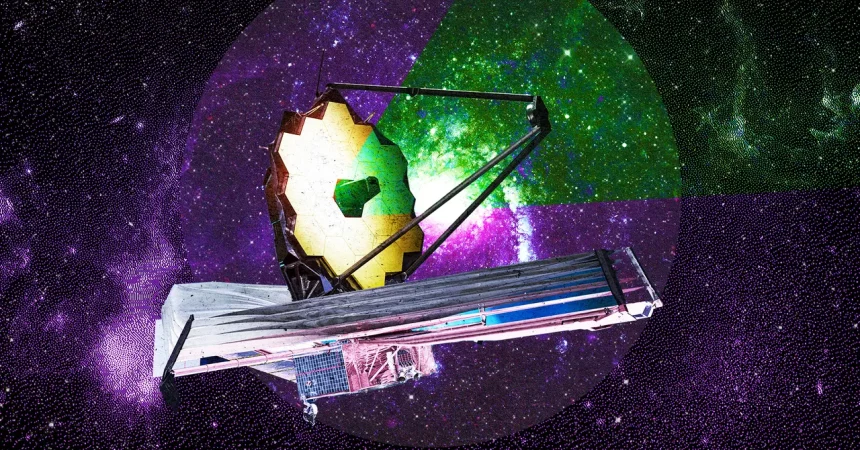
The James Webb Space Telescope has captured the public imagination with stunning images of the distant universe—glittering galaxies, swirling nebulae, and faint light from the edge of time. But as astrophysicist Rachel Mandelbaum of Carnegie Mellon University points out, Webb is optimized for looking at very far away, incredibly faint objects, and it can only do so by staring at a tiny patch of sky. Think of Webb as a cosmic zoom lens, capable of seeing details across billions of light-years, but only through a narrow keyhole. The Nancy Grace Roman Space Telescope, on the other hand, is about to give us a completely different gift: a wide-angle lens. Roman is designed to look at enormous swaths of the sky at once, scanning hundreds of millions of stars and galaxies in a single campaign. Where Webb sees a single tree in exquisite detail, Roman will see the entire forest—and in doing so, it will answer questions that require a crowd, not just a close-up. This difference in vision is not just a technical detail; it is the key to Roman’s ability to survey the cosmos in ways that no previous mission has ever managed, and to open up new windows into planets, stars, dark matter, and the evolution of the universe itself.
One of the most exciting ways Roman will use its wide view is by finding planets beyond our solar system. Most exoplanet-hunting telescopes, including the celebrated Kepler mission and the current TESS mission, rely on the transit method: they watch for the tiny dip in starlight that occurs when a planet passes directly in front of its host star. It is a brilliant technique, but it has a bias. It tends to find big planets with short orbits—giant worlds that circle their stars quickly and closely, repeatedly blocking their star’s light. That tells us a lot about one kind of planet, but not the whole story. Roman will use a different, more subtle trick called gravitational microlensing. This effect is rooted in Einstein’s general relativity: when two stars happen to line up one behind the other as seen from Earth, the gravity of the foreground star bends and magnifies the light of the background star. It acts like a natural magnifying glass in space. If that foreground star happens to have a planet, its own gravity adds another tiny, telltale twist to the magnified light. Matthew Penny, an exoplanet researcher at Louisiana State University, explains that this method is uniquely powerful because it can detect planets that are much farther away from their stars than other methods can. You don’t have to wait for a planet to complete an entire orbit before you see its signal—you just need a lucky alignment, a passing glance, and Roman’s incredibly sensitive eye to catch it.
Roman’s sensitivity to these microlensing events is almost mind-bending. It should be able to detect planets with less mass than Mercury—worlds that are barely more than rocks in the dark. Even more thrilling, it may spot free-floating “rogue” planets: orphaned worlds that have been flung out of their parent systems by gravitational slingshots, or perhaps never attached to a star at all, wandering alone in the cold void between the stars. Until now, such planets have been nearly impossible to study because they emit no light of their own and orbit nothing bright enough to reveal their presence. But microlensing can catch them, too, because even a solitary planet still bends the light of a background star when it drifts across our line of sight. For planetary scientists, this is like finding a hidden population of animals that live in the shadows. By cataloging these strange, lonely worlds, and by probing the cold outer reaches of planetary systems where gas giants form and migrate, Roman will give us the first truly complete census of what kinds of planets actually populate our galaxy. Penny emphasizes that without a full survey of the entire range of possible planets, we can’t really know how common Earth-like planets are, or how typical our own solar system is. The missing pieces are not just in close orbits, but in the vast, mostly unexplored territories beyond them—and that is exactly where Roman will be looking.
This census has profound implications for one of the oldest questions we have: are we alone? Our solar system, with its rocky inner worlds, an ice giant, a gas giant family, and a habitable Earth sitting at just the right distance for liquid water, might seem like the perfect recipe for life. But Penny points out that our solar system is potentially quite unique—although we don’t really know yet, because we haven’t seen enough of what lies out there. There are a lot of potentially lucky coincidences in our cosmic neighborhood that make life possible. Jupiter, for instance, may have played a crucial role in shaping the inner solar system, and the way that giant planets form far from their star can actually influence whether smaller, rocky planets can form and survive closer in, in the habitable zone where water can exist as a liquid. If we only ever study systems with giant planets on tight orbits, we are essentially looking at only a tiny, skewed sample. Roman’s wide-field microlensing survey will fill in those blank spots, revealing how planetary systems are arranged on a grand scale—from the inner, scorching regions to the frozen outskirts, and everything in between. By comparing these distant planetary families to our own, scientists will finally have a basis for understanding whether our particular arrangement of worlds is a rare fluke or one of many ways a star system can unfold. That, in turn, can tell us whether planets like Earth are common enough to make life a frequent visitor to the galaxy or so unusual that we might truly be alone.
But Roman’s gaze will reach far beyond the realm of planets and into the deepest mysteries of the universe’s structure. In addition to scanning hundreds of millions of stars, it will observe more than a billion galaxies, with a special focus on a population of galaxies from roughly two to six billion years after the Big Bang. This was a critical period in cosmic history, a time when the universe had expanded enough that large structures were beginning to mature, and when dark energy was already starting to leave an unmistakable mark on the expansion of space. Mandelbaum, who studies cosmic structure, explains that one of the central goals is to understand the history and growth of cosmic structure itself. In the very early universe, matter was almost uniformly distributed, with only the tiniest irregularities—small patches that were just a fraction denser, or sparser, than their surroundings. But those negligible variations were everything. Over time, the slightly denser regions attracted more and more matter through gravity, growing into vast clumps of an invisible substance we call dark matter, which forms giant halos. These halos are the scaffolding of the cosmos. Gas falls into their centers, ignites into stars, and swirls together to form galaxies—so if we want to understand how galaxies like the Milky Way came to be, we have to trace the growth of these dark matter halos. Roman’s wide, deep surveys are designed to do exactly that, by imaging thousands of square degrees of sky and measuring the subtle distortions in the shapes of distant galaxies—a signal known as weak gravitational lensing. That distortion is caused by all the intervening matter, including dark matter, bending light from more distant galaxies, and it gives astronomers a way to map where the unseen mass actually lives.
In the end, Roman is not just another telescope; it is a cosmic survey instrument for the twenty-first century, one that will complement Webb’s deep zoom with a broad, panoramic sweep. It will help us discover thousands of new planets, some of them bizarre and extreme, others perhaps startlingly familiar. It will search out dark matter by mapping its gravitational fingerprints across billions of light-years. It will peer back in time to a period when galaxies were growing and changing in ways we are still struggling to understand. And it will do all of this by capturing enormous numbers of objects at once, allowing astronomers to think in terms of statistics rather than individual curiosities. This is what makes Roman so exciting: it can ask questions like “How common are Earths?” and “How did the universe grow such enormous structures?” rather than just “What is this particular object like?” The answers may rewrite our textbooks, but also the way we see ourselves. The very fact that we are sentient beings on a rocky planet, wondering about our place in the cosmos, is made possible by the same cosmic forces that Roman will study—the formation of galaxies, the assembly of planetary systems, and the strange, invisible dark matter that holds everything together. Roman’s wide-eyed gaze across the sky is, in a very real sense, a reflection of our own wide-eyed search for meaning in the vast, silent universe, a search that began with our ancestors staring up at the stars and continues now with machines that can see the deep past and measure the invisible.