It’s that familiar, slightly chaotic stretch of the calendar again. The leaves are starting to turn, the air is getting crisp, and the tech world is in full launch mode, pushing out new products left and right. I found myself writing something similar just yesterday, when Boox announced its latest e-reader devices, and now Dyson has jumped into the fray with not one, not two, but three brand-new robot vacuums. Dyson, of course, is a name that’s become practically synonymous with high-end vacuum cleaners, those sleek cordless sticks, and futuristic-looking fans and hairdryers that somehow make ordinary household chores feel a little more exciting. So when Dyson makes a move, people pay attention. And the company has been unusually busy this season. Earlier in September, Dyson teased a whole slate of innovations, ranging from updated vacuums to an electric toothbrush with a built-in camera, which is exactly the kind of unexpected, slightly surprising idea that Dyson loves to drop into the conversation. But now the vacuum news has become real. Three robot vacuums in the new Dyson Nurovi line are starting to arrive, and they’re not just a fresh coat of paint on old machines. This is a redesigned lineup with new technology, new pricing tiers, and a clear sense of purpose. The lineup includes the Dyson R1 Nurovi Dry at $550, the Dyson R2 Nurovi Wash + Dry at $700, and the Dyson R3 Nurovi Spot+Scrub UV at $1,200. Those prices put Dyson in some interesting territory: the entry model is competing with plenty of capable, value-minded robot vacuums, while the top-end model is going head-to-head with serious premium flagships. If you’ve been waiting for Dyson to really double down on robot vacuums, this feels like the moment. It’s exciting, a little overwhelming, and honestly, exactly what you’d expect from a brand that seems to enjoy making the everyday feel futuristic. I’m genuinely curious to see how these perform in real homes, but first, let’s dig into what makes this launch different from the Dyson robot vacuums we’ve seen before.
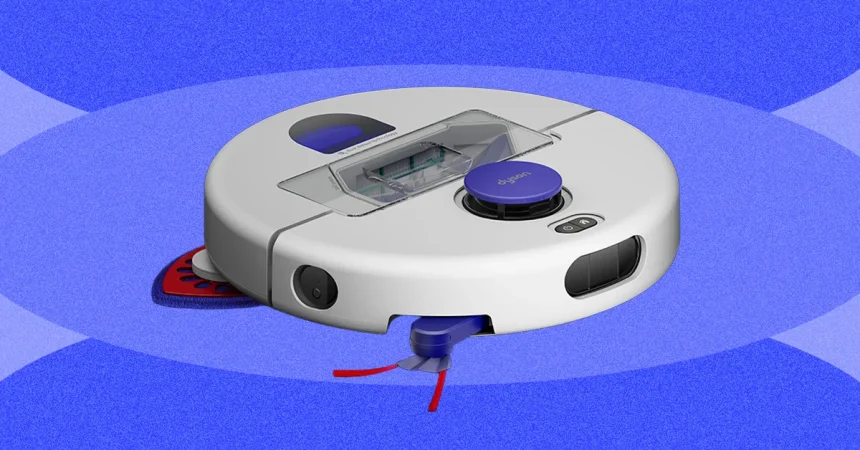
Across all three models, the Nurovi line shares a new visual identity that immediately sets it apart from the older Dyson Spot+Scrub Ai. The color scheme is a soft, light gray, which gives both the vacuum and its charging base station a clean, almost minimalist feel. It’s subtle, but it matters. You can tell at a glance that this is a new generation, not just another iteration with a slightly bigger dustbin. That said, the base stations still feature the canister-style compartments that make Dyson’s robot vacuums look so unmistakably Dyson, like a miniature version of their cordless vacuums sitting quietly in the corner of your living room. Under the hood, though, the changes are more significant. The most important one is navigation. Dyson’s previous robot vacuum relied heavily on an HD camera to map your home and figure out where it was going. That worked, but camera-based navigation can sometimes struggle in dimly lit rooms or tricky spots. The new Nurovi models switch to lidar laser-precision navigation, which is a big deal. Lidar is the same kind of technology used in many of the best robot vacuums on the market, and it’s known for being fast, accurate, and reliable even in the dark. So right out of the gate, Dyson is addressing one of the biggest criticisms of its earlier robot efforts. The new vacuums also come with what Dyson calls a Twin-Capture System, an engineering feature designed to grab dust and debris from both hard floors and carpets more effectively. The idea is that one side of the system handles the kinds of particles you find on hard floors, while another handles the deeper dirt embedded in carpet fibers. There’s also an important distinction in what each model can do. The R1 is a vacuum-only robot, while the R2 and R3 are vacuum-mop hybrids, meaning they can wash your floors as well as vacuum them. That middle model, the R2, is a bit of a wild card because it’s only going to be available at Costco, which is an interesting move from Dyson. The R1 and R3, meanwhile, will be sold on Dyson’s own website and presumably at other retailers down the line. This is the kind of launch that makes you want to stop and ask: which one actually fits my life? I’m planning to test all three soon, but already there are a few features that have caught my eye and made me think about how they might perform in real-world homes.
Let’s start with the entry point: the Dyson R1 Nurovi Dry, which will set you back $550. If you have a home with mostly carpet, soft flooring, and no real need for mopping, this might be the one that speaks to you. It’s a vacuum-only robot, but it shares the same lidar navigation and Twin-Capture technology as its more expensive siblings, so you’re not paying for features you’ll never use. And that’s actually a refreshing thing. A lot of robot vacuums these days try to be everything at once, with mopping attachments and bonus modes that you might touch twice before forgetting about them. The R1 keeps things focused. It’s about getting the basic job done well: moving through your home efficiently, avoiding obstacles, and picking up dirt, dust, and pet hair from the surfaces you actually have. Dyson says it promises a much better experience than the Dyson Vis Nav, the company’s earlier robot vacuum that left some people wanting more. That’s a bold claim, but also a necessary one. The Vis Nav had some clever engineering, but it sometimes felt like a first attempt, and the robot vacuum market is crowded with competitors that have had years to refine their algorithms and cleaning patterns. At $550, the R1 is not necessarily cheap. You can find other robot vacuums at that price that vacuum and mop, which makes you wonder if Dyson is asking you to pay a premium for the brand and the design. But if you already own a mop or you simply don’t need a wet-cleaning feature, the R1 might make a lot of sense. There’s also something nice about a simpler machine, one that doesn’t overcomplicate your cleaning routine with mopping tanks you have to fill and empty, or modes you have to fiddle with before every run. Sometimes you just want a robot that efficiently sucks up the crumbs and cat hair, and then gets out of your way. The R1 seems to understand that, and I’m looking forward to seeing whether it lives up to the promise of being a true leap forward from Dyson’s earlier robotics efforts.
Then there’s the Dyson R2 Nurovi Wash + Dry, priced at $700 and positioned interestingly as the middle child of the lineup. It’s also a vacuum-mop hybrid, which means it can handle both dry debris and sticky messes or hard floor grime, and it does so with the same lidar navigation and Twin-Capture technology as the R1. The big twist here is availability: the R2 will only be sold at Costco, at least for the time being. That’s a strategic choice that makes you wonder about Dyson’s relationship with the warehouse retailer and how the brand is thinking about reach. Costco shoppers tend to be practical, value-conscious people who want quality but don’t necessarily want to chase down the latest tech trend. By placing the R2 there, Dyson is clearly trying to meet a different kind of buyer, someone who might not otherwise wander into the Dyson website and drop $700 on a robot vacuum without seeing it in person. The $700 price point is, in many ways, the sweet spot for this entire category. It’s expensive enough to feel like a serious investment, but not so expensive that you start questioning whether you should just hire a cleaning service instead. With the R2, you get the convenience of a hybrid machine without paying the premium price of the top-tier R3. You also get the flexibility to handle kitchens, bathrooms, and entryways where spills and wet messes are just a normal part of life. For my money, the R2 might be the most interesting model in the whole launch, because it sits right in the middle of the lineup and targets people who want a little bit of everything. I love that Dyson is using Costco as a testing ground for this model, because it suggests a willingness to experiment with retail channels, even as its other models take the traditional online route. And while I haven’t tested it yet, I’m already picturing what it would be like to let it loose in my own home: vacuuming up the dust, then switching over to mop the kitchen floor after dinner, all without having to haul out a separate mop and bucket. If it works as advertised, the R2 could be the one that wins over the “maybe I don’t need a robot vacuum” crowd.
At the top of the Nurovi range sits the Dyson R3 Nurovi Spot+Scrub UV, and this is where Dyson really lets its imagination run wild. At $1,200, the R3 is unquestionably a premium product, the kind of robot vacuum you buy if you want the very best, or if you’ve simply fallen in love with the idea of a machine that can find stains you didn’t even know you had. The headline feature here is the UV light, which Dyson uses in a clever way. Instead of just navigating around your home and blindly cleaning every spot equally, the R3 shines a UV light on your floors to help identify stains that might be invisible to the naked eye. If that sounds a little sci-fi, that’s because it kind of is. It’s the sort of feature that makes you feel like you’re living in the future, and it’s genuinely unique in the robot vacuum world. Once it finds those problem areas, the R3 can focus its attention on them, using a spot scrub mode to really dig into stubborn messes. This is where the “Spot+Scrub” part of the name comes from, and it’s aimed squarely at people who have kids, pets, or just a habit of walking through the kitchen with muddy shoes. The R3 also includes all the shared features from the rest of the line: lidar navigation, Twin-Capture, and the light gray design that ties the family together. It’s a vacuum-mop hybrid, just like the R2, but it adds that extra layer of intelligence and cleaning power to justify the higher price. Of course, $1,200 is a lot of money, and you have to ask yourself whether a robot vacuum can ever truly replace a deep manual clean. The honest answer is that no robot is perfect, but the R3 is clearly trying to be as close as possible. It also raises the bar for competitors, because everyone else in the premium category is going to have to respond to a robot that can find a dried juice stain on your kitchen floor and then decide to spend extra time scrubbing it away. I’m especially curious to see how the UV stain detection works in practice, because it’s one of those features that sounds amazing in a press release but could end up being either a genuine game-changer or a party trick you rarely rely on. I suspect the truth will land somewhere in between, but it’s exactly the kind of bold, slightly quirky innovation that makes Dyson interesting.
Taken together, the new Nurovi line represents something bigger than just three robot vacuums. It’s Dyson saying, loudly and clearly, that the robot vacuum category is worth taking seriously, and that the company is willing to invest in the kind of engineering advancements that made its stick vacuums so popular in the first place. From the switch to lidar navigation to the new Twin-Capture system and the UV stain-finding technology, every model in this lineup has at least one feature that feels like a step forward, not just a refresh. The fact that Dyson is also experimenting with retail exclusivity by putting the R2 at Costco shows that the company is thinking about how people actually shop, not just about how to make a better gadget. There’s a real understanding that robot vacuums are no longer a novelty for early adopters; they’re becoming an essential household tool for busy families, pet owners, and anyone who would rather spend their weekend relaxing than pushing a vacuum. That’s why I’m so eager to get these machines into my own space and test them out. Specs and press materials only tell you so much. The real question is how they handle real life: the loose cords, the odd corners, the stubborn pet hair, the kitchen floor that somehow gets sticky every single day. Dyson has promised a better experience than its earlier robot vacuum, and the redesigned hardware and navigation choices certainly suggest that. But the proof will be in the cleaning. For now, if you’re in the market for a new robot vacuum, it’s worth paying attention to this launch, even if you’re not ready to spend $1,200 on the top model. The R1 offers a focused, simpler option for carpet-heavy homes, the R2 gives you the hybrid experience at a value-minded price (provided you have a Costco membership), and the R3 is for anyone who wants the absolute latest in cleaning technology. Whatever your budget or your floor situation, Dyson has clearly listened, pivoted, and delivered something that feels new, thoughtful, and genuinely useful. Whether it works as well in the real world as it does on paper is something I’ll be finding out soon, and I have a feeling the results are going to be interesting.